Photography is a powerful tool for exploring the world around us. By capturing architectural structures, animals, landscapes, or people, we can appreciate beauty and aesthetic sense in a moment frozen in time.
Even in the midst of monotony, an image of a corner of Mexico can be entertaining and allow us to learn something new that we could discuss in meetings.
The image of the day, provided by the National Institute of Anthropology and History (INAH), invites us to reflect on human creativity and the beauty found in our country. Without further ado, here is the image of the day.
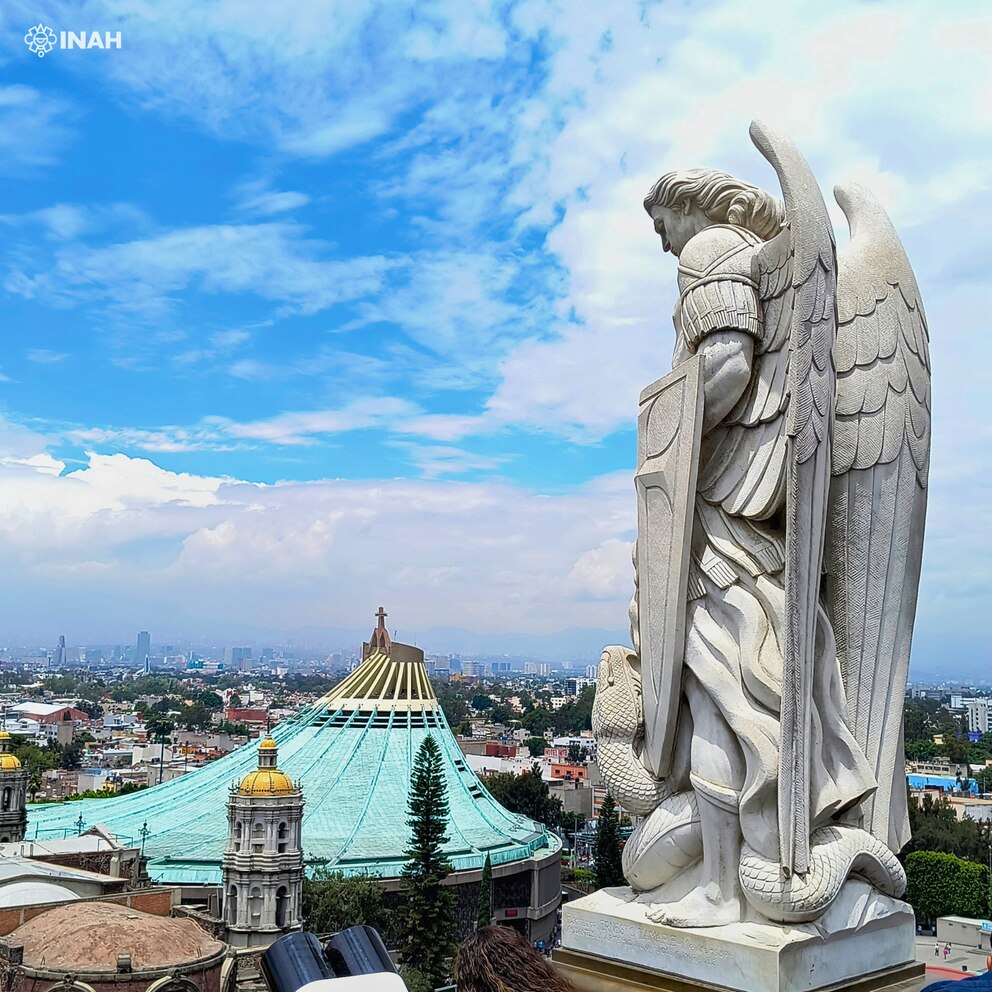
The Basilica of Guadalupe, located at the foot of Tepeyac Hill, is one of the most visited religious sites in the world and a central reference in the religious and cultural history of Mexico. Its origins date back to the 16th century, in the context of evangelization and the formation of a New Spain identity. Since then, it has been a meeting point between indigenous and Catholic traditions.
Over the centuries, the urban and architectural layout of La Villa de Guadalupe has constantly transformed. After the Marian apparition in 1531, a first chapel was built for the veneration of the image of the Virgin of Guadalupe, but the building soon proved insufficient for the growing influx of devotees.
The current basilica, inaugurated in 1976, coexists with other historic buildings of the Guadalupe complex, such as the old basilica built in the 18th century, and the chapels of Cerrito and Pocito, all declared Historic Monuments by the INAH (National Institute of Archaeology and History). Together, they form a site of deep social roots, where expressions of popular devotion, sacred architecture, and collective memory and identity have converged for almost 500 years.
The country is full of diverse landscapes and cultures that enrich it. From pre-Hispanic peoples to the present day, it has a diverse heritage throughout its territory, which is the fourteenth largest in the world. Although Spanish is the primary language in Mexico, there are 67 indigenous languages spoken daily.
Deserts, beaches, and jungles are some of Mexico’s diverse ecosystems, which, along with its cities, allow each photograph of the day to be different from the last, while still providing educational value.
According to the federal government, there are 189 archaeological sites. Among the most distinctive are Teotihuacán, Tajín, Palenque, Tulum, and Chichen Itzá, the latter considered one of the New Seven Wonders of the World in 2007 and a World Heritage Site, declared by the United Nations Educational, Scientific, and Cultural Organization (UNESCO) in 1988.
Among other sites inscribed as World Heritage Sites, there are six natural sites, as well as the ancient Mayan city of Calakmul, located in the state of Campeche. Across the 31 states, there are 120,000 historical monuments, 1,321 museums, 1,976 cultural centers, and 111 magical towns.
The images selected by the INAH include everything from pre-Hispanic artifacts, landscapes, murals, ruins, nature, and even corners of the different cities that span from north to south.
Source: infobae