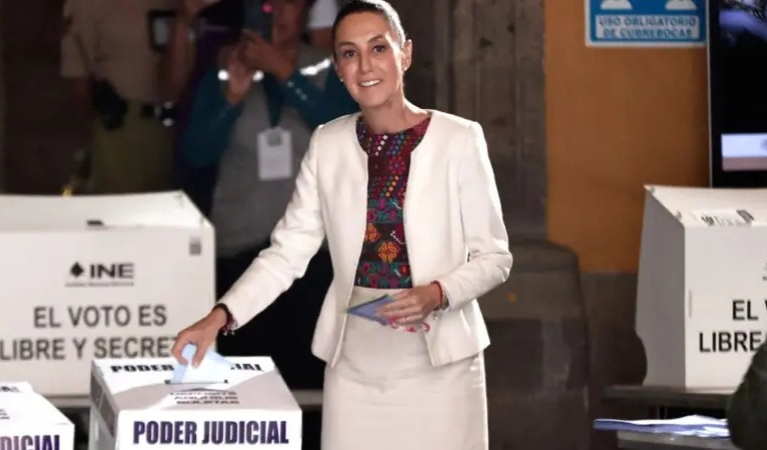

This Sunday, the Mexican people were called to the polls to elect 2,681 national and local judges and magistrates in an unprecedented exercise, not only in the country but also in the world.
Although similar systems exist in Bolivia, Japan, and the United States, the judicial reform promoted by the ruling Morena party is an invention that no one else can claim.
And for such a significant development, the 13% turnout of the population called to vote is, at the very least, a wake-up call for Claudia Sheinbaum’s government, which boasts an approval rating of over 80%, according to various polls.
“Everything can be improved; yesterday was the first election; conclusions will be drawn to improve in 2027. It was a great exercise, and many people participated,” the president said on Monday.
What for Sheinbaum is a popular election system that deepens democracy in a country with a 90% impunity rate for homicides, for others, both in the opposition and in specialized sectors, is a blow to the rule of law.
Except for the estimated turnout, the results of Sunday’s elections are yet to be known: first, the names of those elected to the Supreme Court will be announced, then those of the new judicial oversight bodies, and then those of the judges in each state.
However, before Sunday, it was already possible to predict that the ruling party would win, not only because half of the candidates were considered Morena supporters, but also because the opposition—fragmented and lacking in discourse—called for abstention.
According to polls, nearly 70% of Mexicans were in favor of reforming the justice system, and 60% said the election would be legitimate if more than half of the registered voters participated.
How, then, can we explain why so few people responded to the call to vote?
Sheinbaum’s explanation
For the president, that 13% is, in fact, a sign of “success.” And for the Secretary of the Interior, Rosa Icela Rodríguez, the turnout “met expectations.”
The officials drew a comparison with the referendum promoted by Andrés Manuel López Obrador (AMLO) in 2021 on the impeachment of former presidents, in which 6% participated.
“If the same number of people vote as in the first referendum, then it’s a very good result,” Sheinbaum said before Sunday.
That election, however, was not binding, nor did it generate the political uproar that this one did, nor did it structurally change a pillar of the state.
There was also a referendum in 2022 on AMLO’s term, in which 18% participated.
Sheinbaum has also compared this election to the local judges’ election in the United States, where 20% typically participate.
In her view, for an election like this, it’s expected that minority segments of the electorate will participate.
And no poll questions the president’s connection to the people, who hold her—as well as her predecessor—responsible for reducing poverty, achieving tangible results, and standing firm and calm in the face of the threat posed by Donald Trump.
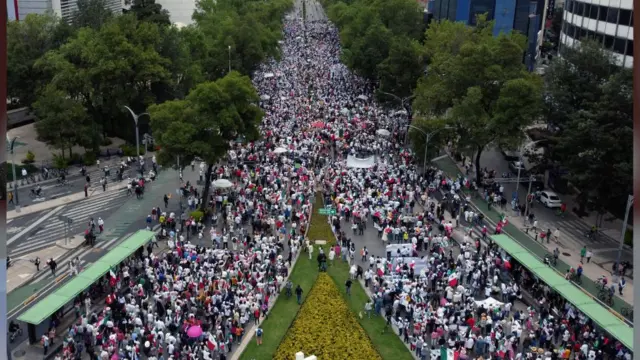
A Necessary Reform
But precisely because of the difficulty of activating majorities in the election of judges, among other reasons, many consider this system to be flawed by definition.
Part of the reason for the system’s existence is that the reforms promoted by AMLO between 2018 and 2024 were blocked by the judiciary, which became the main actor of his opposition. The reform became a political struggle.
In addition, corruption, nepotism, and the influence of drug trafficking mark the Mexican justice system. At least 90,000 people deprived of their liberty have not been sentenced. The system is slow and operates unequally for each citizen.
But the political urgency of the reform took precedence over its judicial relevance.
“The low turnout doesn’t seem to me to be a reflection of people’s enthusiasm for the reform, but rather of the problems with its implementation,” Vanessa Romero Rocha, a lawyer and political analyst, tells BBC Mundo.
The expert, who served on an evaluation committee for federal judge candidates, adds: “It was a midterm election—which typically has lower turnout—nonpartisan—which eliminates that typical identity-based drive—and also very complex: difficult to understand who the candidates were and what the positions were doing.”
“All of this, coupled with the hasty and abrupt nature of the process, largely explains the lack of interest.”
Implementation Problems
Candidates for the judicial elections could not receive public or private resources for campaigning. Nor could they campaign in the media.
The presence of organized crime, as is common in Mexico, conditioned the process in some regions.
Mexicans abroad could not vote; nor could prisoners awaiting a court ruling, who were probably the most directly affected by the election.
Added to this was the fact that voting was particularly difficult: each citizen received between 6 and 10 complex ballots, and according to specialized studies, the average voter would spend between 10 and 15 minutes exercising their right.
One of the substantial changes brought about by the reform is that it relaxed the educational and experience requirements for aspiring judges. Many candidates, then, appeared in the campaign as inexperienced. Others were found to have ties to drug trafficking.
A return to the past or a step toward a promising future?
Sheinbaum swept the 2024 presidential elections: she won with 60% of the vote, 30% more than her opposition opponent.
Furthermore, the ruling party achieved absolute majorities in Congress, and it was precisely this that allowed them to approve the constitutional reform of the Justice System, which now materializes with the election of judges and will have another contest in 2027, when the remaining judicial officials are renewed.
In Sheinbaum’s year, Morena became an all-powerful party that also controls the legislative and judicial branches of the state, as well as the vast majority of governorships, mayoralties, and local assemblies.
Today, Sheinbaum is one of the most popular heads of state in the world.
Many believe that, due to this growing accumulation of power, Mexican democracy received a devastating blow this Sunday; one similar to those dealt during the 20th century by the Institutional Revolutionary Party (PRI), Mexico’s ruling party for 71 years.
Others, like Sheinbaum, believe exactly the opposite: that these elections move Mexico away from the clientelist and corrupt authoritarianism of yesteryear.
What for some is a setback, for others is an evolution. And it is in this historical tension that Mexicans will live from Sunday onward.

Source: bbc