
During 2024, 7,975 births to girls and adolescents between the ages of 10 and 14 were documented in Mexico, according to figures from the Ministry of Health. This figure means that, on average, 22 minors gave birth every day.
An independent analysis conducted by researcher Montserrat Mora using official databases shows that Chiapas, the State of Mexico, Veracruz, Puebla, and Jalisco accounted for four out of ten births registered in this age group. Together, they totaled 3,208 cases.
Looking at the age distribution, three births were to girls as young as 10, while 32 were to girls aged 11, 195 to girls aged 12, 1,422 to girls aged 13, and 6,323 to girls aged 14. The states with the fewest births were Colima (33) and Baja California Sur (50).
When analyzing the proportional birth rate per 10,000 girls, Chiapas ranks first with 28.3 cases. It is followed by Guerrero (24), Campeche (20.6), Chihuahua (20), and Oaxaca (19.3), all above the national average of 14.6.
The phenomenon also reveals severe disparities in the ages of those listed as fathers. In a review disseminated by the researcher on social media, 30 births were identified to girls between 10 and 12 years old, whose partners ranged in age from 13 to 65. In only seven cases were the men minors. The rest were adults or older adults.
One of the most extreme cases occurred in El Oro, State of Mexico, where a 12-year-old girl gave birth to a child with a 65-year-old man. Another documented case in Texcoco involved a 10-year-old girl and a 32-year-old adult.
Child Sexual Violence
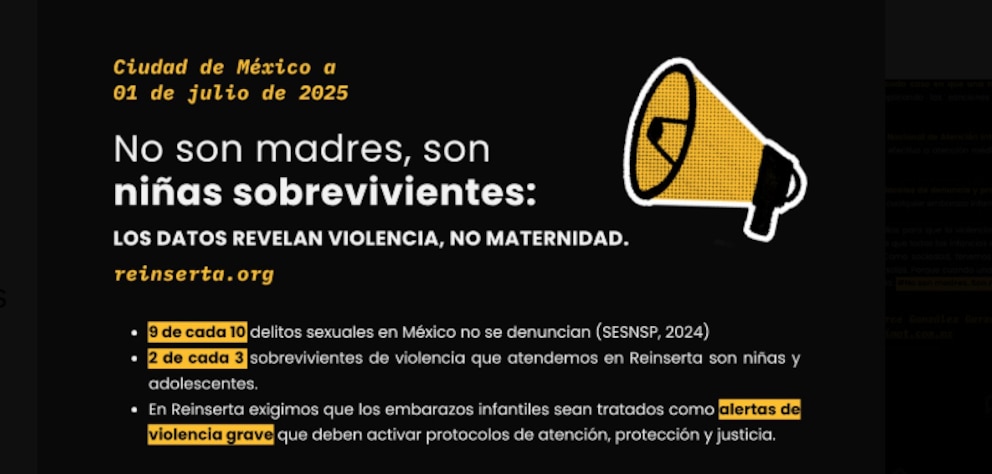
Civil rights organizations have indicated that these cases should be treated as a result of child sexual violence. Reinserta, an association specializing in justice for minors, called for every pregnancy in a minor with an adult as the alleged father to be criminally investigated and punished according to the law.
In addition, it proposed the creation of a National Comprehensive Care Route for girls who are victims of sexual violence. This proposal includes specialized medical, psychological, and legal care, as well as the obligation to activate protocols in schools, hospitals, and civil registry offices for any detected child pregnancy.
The data and reactions gathered regarding these births reveal the inadequacy of institutional mechanisms to prevent sexual abuse against girls, as well as the lack of a timely and effective response from the Mexican State to protect their basic rights.
Source: infobae