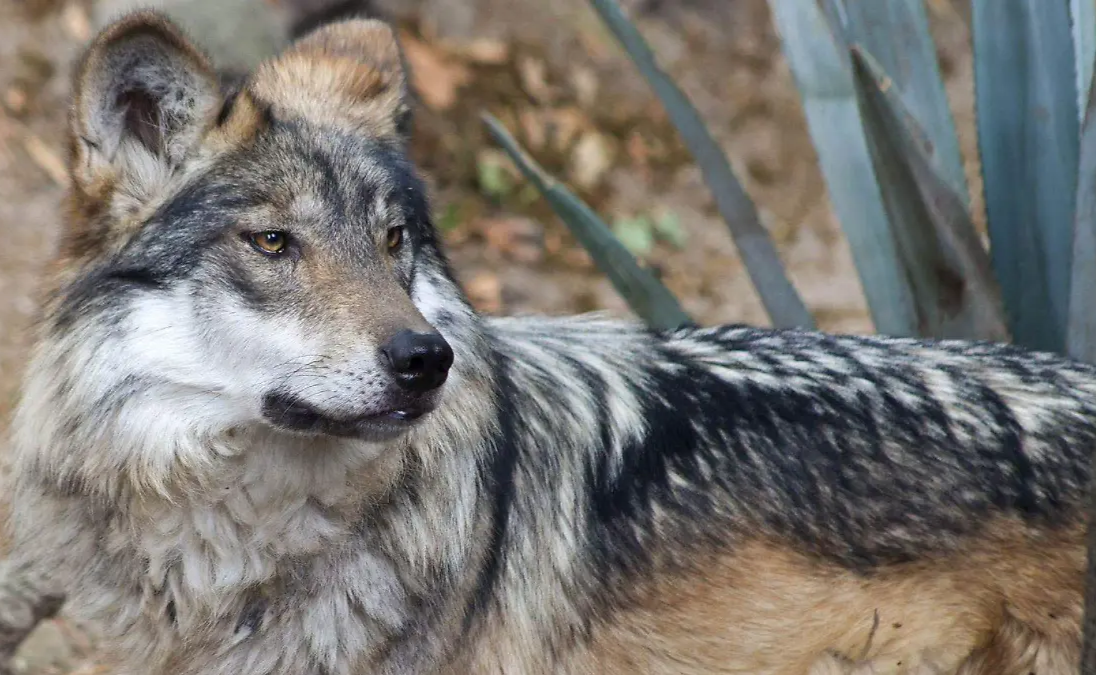

Five Mexican wolves will be released in the Sierra de Durango next year, 2026. Rabbits and rats will also be included as food for this species. The scientific study will be conducted in the municipality of Tepehuanes and supervised by the Ministry of Environment and Natural Resources (Semarnat).
The head of the Ministry of Natural Resources and Environment of the State of Durango (SRNyMA), Claudia Hernández Espino, noted that the pilot project is a binational agreement between Mexico and the United States for the conservation of the Mexican wolf, which currently has only 113 specimens in the country.
The five Mexican wolves will arrive in the state in the early months of 2026 to be released in the northwestern region of the state, in the municipality of Tepehuanes. The corresponding studies have been conducted for two years to evaluate whether the state’s ecosystem is beneficial for this species.
“They have been discussing the population to be released. Obviously, it will be done gradually, with an initial pack, so to speak, of five members, five wolf specimens,” stated Hernández Espino.
The head of the (SRNyMA) even emphasized that a plan is being considered to introduce the wolf’s basic diet, such as the Irish rabbit and a particular species of rat, in order to encourage the wolf to feed on them and not on other species endemic to the Durango mountain range.
The Bajío del Tarahumar area in Tepehuanes will be home to these five wolves, which will have a GPS chip to track their location and study their behavior, in order to make important scientific advances for their conservation in open natural areas.
The Mexican wolf is the smallest wolf subspecies in North America, about the size of a German Shepherd. According to NOM-059-SEMARNAT-2010, an official Mexican standard that identifies endangered wildlife species in Mexico, this type of wolf is likely extinct in the wild, leading to introduction programs.
The western slopes of the Sierra Madre Oriental, in northern Coahuila, identified as the Sierra del Carmen; the Sierra Madre Occidental of Chihuahua in the Sierra del Nido; the Sierra de las Tunas; and the mountain ranges of Nuevo León, San Luis Potosí, Zacatecas, and finally Durango are the areas listed as suitable for the release of the Mexican wolf.

Source: oem