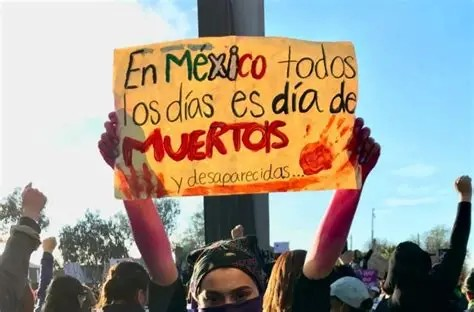

Combating insecurity in Mexico has become one of the greatest challenges facing the state in recent decades. Despite multiple plans, reforms, and deployments of security forces, governments have failed to sustainably reverse the violence plaguing society. Strategies such as the militarization of public security or the implementation of social programs have not been sufficient to curb the spread of organized crime or reduce the widespread perception of insecurity among the population.
In this context, Andrés Manuel López Obrador’s six-year term ended with around 200,000 homicides, an alarming figure that illustrates the depth of the problem. Therefore, President Claudia Sheinbaum’s announcement of a reduction of more than 25% in the intentional homicide rate takes on significance: the reported figures speak of 22 fewer murders per day on average. Although this figure could be interpreted as significant progress, the complexity of the phenomenon forces us to question whether this is a structural change or a circumstantial result.
On the one hand, the government maintains that this reduction is the result of its security model, based on addressing the social causes of violence, strengthening the National Guard, coordination with state governments, and implementing intelligence work. These measures, according to Sheinbaum, have begun to bear fruit in just ten months of her administration.
However, doubts immediately arise. One of the main objections lies in the reliability of the figures: while in the case of poverty, an autonomous agency like INEGI reports the information, in matters of security, the statistics come from state reports, often questioned due to a lack of transparency and the reclassification of intentional homicides as negligent homicides or other crimes against life. In this sense, the debate focuses not only on the actual decrease in violence, but also on the credibility of the data.
While recognizing that the change in strategy is perceptible, all public policies require time to consolidate. The National Guard, for example, still faces the challenge of transcending its role as a community police force to become a corporation with effective investigative capabilities. The same is true of the national intelligence system: how long will it take to develop an apparatus capable of effectively confronting organized crime?
The picture becomes more complicated when considering external factors. Relations with the United States are a prime example: while Mexico extradites drug lords and allows US drone overflights over its territory, it rejects formal collaboration with the DEA. This ambivalence raises doubts about the coherence of its security policy. In terms of security, the government must recognize its limitations; at this time, it lacks the technological or human capabilities to confront organized crime groups alone.
Furthermore, crises persist in various regions of the country that call official results into question. In Jalisco, the missing persons crisis reflects a situation that is out of control. In Mexico City and the State of Mexico, extortion has become an everyday crime that seriously affects the lives of the population. Thus, although the homicide rate may be declining, the perception of insecurity remains high, and the territorial control of organized crime remains a difficult-to-eradicate “cancer.”
The current government’s security strategy appears to be headed in the right direction, but it is still far from achieving definitive results. To consolidate progress, Mexico needs not only to clarify how the figures are measured, but also to build a comprehensive and credible strategy that recognizes state limitations, strengthens cooperation with other actors, and, above all, promotes a judiciary capable of reducing impunity. If this aspect is not addressed, any reduction in homicides risks being insufficient given the complexity of the phenomenon of violence in the country.

Source: oem