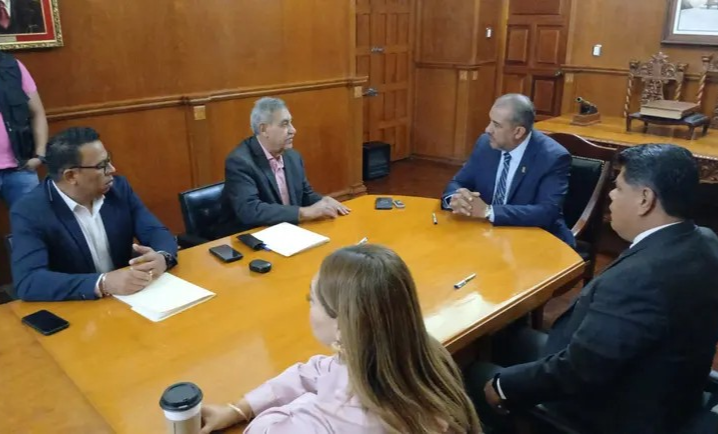

The Juárez University of the State of Durango (UJED) and the State Council of Science and Technology (COCyTED) signed an agreement with the National Autonomous University of Mexico (UNAM) to implement the creation of the National Earth Observation Laboratory (LANOT) in the state.
This project will provide useful information to organizations, institutions, and agencies dedicated to preventing the effects of natural phenomena as they pass through the country.
José Betancourt Hernández, General Director of COCyTED, stated that this collaboration between educational institutions benefits Durango society and the scientific community.
Natural phenomena such as hurricanes, earthquakes, forest fires, cold fronts, severe storms, and volcanic ash emissions will be addressed. This laboratory will also allow for the analysis and evaluation of drought conditions affecting different regions of the country, analyze vegetation changes, and promote crop evaluation for the purpose of predicting agricultural production.
The director emphasized that the LANOT’s main objectives are to receive, store, process, and interactively distribute remote sensing data and images, as well as conduct various studies on vegetation cover, evaluate its changes, conduct ongoing monitoring of the oceans and atmosphere, and establish their interrelationships and impacts on society.
It will also allow the scientific community to access information that would otherwise be very difficult to obtain. It will directly and indirectly support research areas such as short-term weather forecasting models, climate change, marine/satellite oceanography, vegetation cover assessment, land surface temperature, forest fires and volcanic ash emissions, and high-resolution aircraft photography, among others.
The Laboratory will operate under the joint efforts of UNAM, the Navy, the National Center for Disaster Prevention (CENAPRED), the National Meteorological Service of the National Water Commission, and other university institutions in Mexico and abroad.
It will facilitate the development of public utility projects that will significantly reduce the timescale and accuracy of information, such as geographic risk atlases, urban and population planning, land registry, and urban, industrial, and rural development planning.
Source: elsiglodetorreon