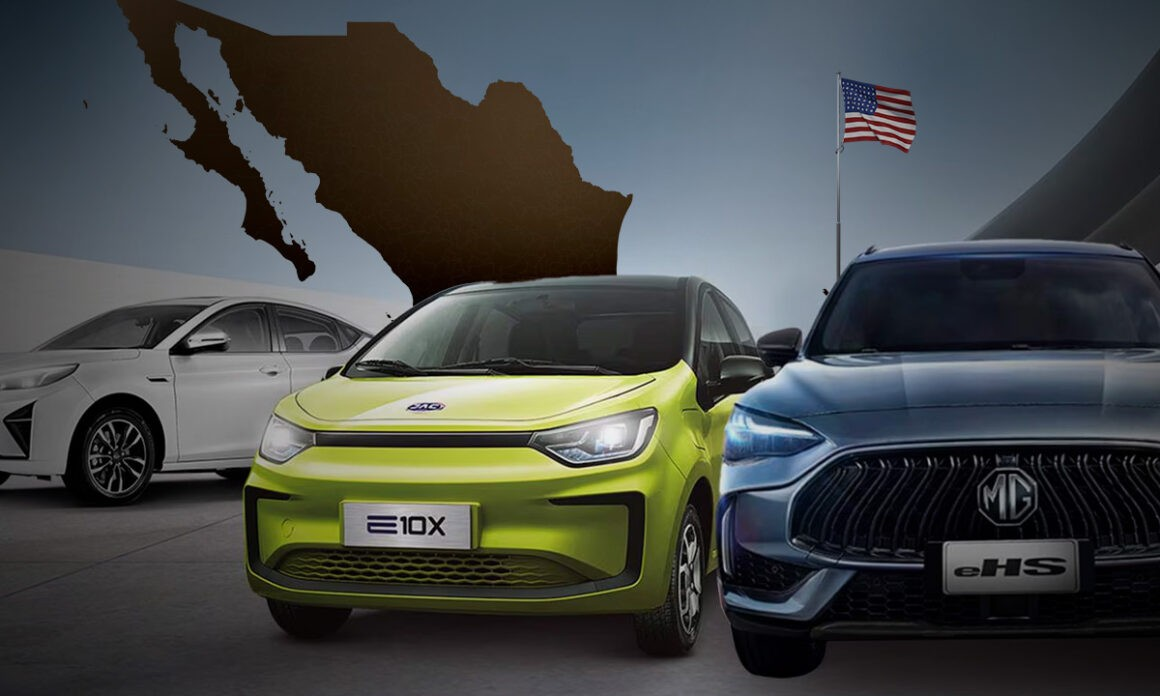

Mexico has just struck a major blow on the trade table, as the 2026 Economic Package includes a tariff of up to 50% on light vehicles imported from countries with which it does not have a free trade agreement. This measure directly impacts China—the main source of these imports—but also affects other Asian economies without a current agreement with Mexico.
The Ministry of Economy, headed by Marcelo Ebrard, explained that the objective is to protect the domestic industry and stem the flood of Chinese electric and combustion vehicles that were gaining ground due to price. According to Reuters, the measure covers not only cars but also auto parts, with tariffs ranging from 10% to 50%. And according to official figures, the affected universe encompasses approximately 1,400 tariff items, equivalent to $52 billion in imports (approximately 8.6% of Mexico’s total external purchases).
“Mexico is seeking to protect its market from unfair competition, but also to send a political signal to the United States,” wrote the Financial Times, highlighting how the decision comes amid direct pressure from the Trump administration for USMCA partners to toughen their stance toward China.
What did Donald Trump say?
Although he never issued a direct call for Mexico to raise tariffs to 50%, Donald Trump and his team have been insistent in their rhetoric against Chinese cars. In several speeches and announcements throughout 2025, the US president warned of “a tsunami of low-cost electric vehicles from Asia” and called on his partners to align measures to protect North American supply chains.
Bloomberg detailed that negotiations between Mexican and US officials included this topic since the beginning of the year. Reuters also noted that, following Trump’s threats to impose reciprocal tariffs of up to 30% on Mexico in July 2025, the pressure to act became inevitable.
When does it take effect?
The announcement is contained in the 2026 Economic Package, and as Ebrard explained, the tariffs would be applied 30 days after its publication in the Official Gazette of the Federation (DOF). So far, the decree still has to go through the legislative process, which means that the exact date of entry into force will depend on its approval and official publication.
Beyond cars: Industries under scrutiny
The “tariff increase” is not limited to the automotive industry. The IMCO technical document on the fiscal package reveals that sectors such as steel, textiles, furniture, plastics, electronics, toys, paper, cosmetics, and household appliances will also face tariffs ranging from 10% to 50%.
In other words: it is not a punishment exclusive to China, nor only to cars, although the most media- and strategic impact falls there.
Immediate and Medium-Term Repercussions
The measure is seen as a temporary shield for automotive plants established in Mexico and their suppliers. According to the newspaper El Economista, “It seeks to level the playing field against brands that have been entering with much cheaper products thanks to state subsidies and dumping practices.”
However, the same newspaper warned that the impact on consumers will be immediate: Chinese-made models currently offered at aggressive prices could increase by up to 50%, which will reduce affordable options in a market where half of sales are financed.
For the Mexican automotive industry, the risk is twofold. On the one hand, it opens up an opportunity to attract more foreign investment: Chinese brands could decide to set up assembly plants in Mexico to avoid the tariff. But at the same time, established manufacturers could face higher auto parts costs if part of their inputs come from countries subject to the new taxes.
Bloomberg analyzed that some Japanese and European manufacturers operating in Mexico would be the biggest beneficiaries, as they would gain competitiveness against Chinese and Korean rivals that depend on imports.
Reactions and political interpretation
The Mexican announcement was interpreted in Washington as a sign of alignment with Trump’s strategy. “Mexico is toughening its stance toward Beijing at a key moment,” noted the Financial Times.
But there are also risks of retaliation: China could respond with mirror measures or restrictions on exports to Mexico, which would affect sectors other than the automotive industry. Furthermore, analysts warn that these types of policies could strain relations with the World Trade Organization (WTO), as Mexico is pushing its tariffs to the limits of what is allowed.
A historic move
With this decision, Mexico breaks with its tradition of being one of the most open economies in the world. The 50% tariff on Asian cars is, in fact, the highest level imposed in decades and marks a protectionist shift that could reshape the way consumers, manufacturers, and trading partners interact in the Mexican market.
Reuters summed it up this way: “Mexico seeks to balance free trade with the defense of its industry, at a time when geopolitics weighs as much as the economy.”
How the imposition of this tariff was developed step by step
January – February 2025
Donald Trump returns to the White House and places China at the center of his trade agenda.
In speeches and conferences, he warns about “the tsunami of Chinese electric cars” and promises to protect the US industry with reciprocal tariffs.
Reuters and Bloomberg report that US officials are beginning to pressure Mexico and Canada to coordinate measures against Asian cars and auto parts.
March – June 2025
In bilateral meetings, Trump’s economic team insists that Mexico must close the door to subsidized Chinese imports.
It has been leaked that the topic is being discussed in high-level talks within the framework of the USMCA.
The Financial Times documents these pressures and warns that the region could experience a “preemptive tariff war” against China.
July 2025
Trump announces a package of 30% tariffs on certain products from Mexico and Canada if they do not “align measures with China.”
Reuters reports that this announcement accelerates discussions within the Mexican government.
August 2025
Reports in the Mexican press (El Financiero, El Universal) indicate that the Treasury and Economy Ministry are considering including an extraordinary tariff on Chinese cars in the 2026 Economic Package.
The Mexican Ministry of Industry and Trade (IMCO) publishes a preliminary risk analysis, warning that more than 1,400 tariff items could be affected.
September 5, 2025
The Mexican government formally presents the 2026 Economic Package to Congress.
The document includes a proposal to raise tariffs of up to 50% on light vehicles and up to 50% on auto parts and other sectors such as steel, textiles, electronics, plastics, and furniture.
Reuters confirms the news: “Mexico will raise tariffs on Chinese cars to 50%.”
September 6–7, 2025
Secretary of Economy Marcelo Ebrard clarifies in interviews that the measure will take effect 30 days after its publication in the Official Gazette of Mexico (DOF).
He emphasizes that this does not only apply to Chinese cars, but to any country without a trade agreement with Mexico, although in practice the greatest impact is on China.
September 2025 (present)
Congress begins discussion of the Economic Package.
Analysts warn that the measure could:
Raise consumer prices.
Protect assembly plants located in Mexico.
Incentivize Chinese brands to open plants in Mexico.
Trigger possible retaliation from China.
Next steps to watch
Publication in the Official Gazette of Mexico (DOF): expected in the coming weeks.
Entry into force: 30 days after official publication.
Possible challenges: The measure could be challenged at the WTO or in multilateral trade forums.
China’s reactions: No retaliation has yet been announced, but it is a latent risk.
Source: msn