
The Digital Transformation and Telecommunications Agency (ATDT) presented the new National Open Data Platform (PNDA), a project that seeks to solve a long-standing problem: fragmentation, broken links, and incompatible formats that have made public data a difficult terrain to explore.
The initiative is conceived as an ecosystem that not only consolidates databases but also ensures quality, backup, and immediate visualization.
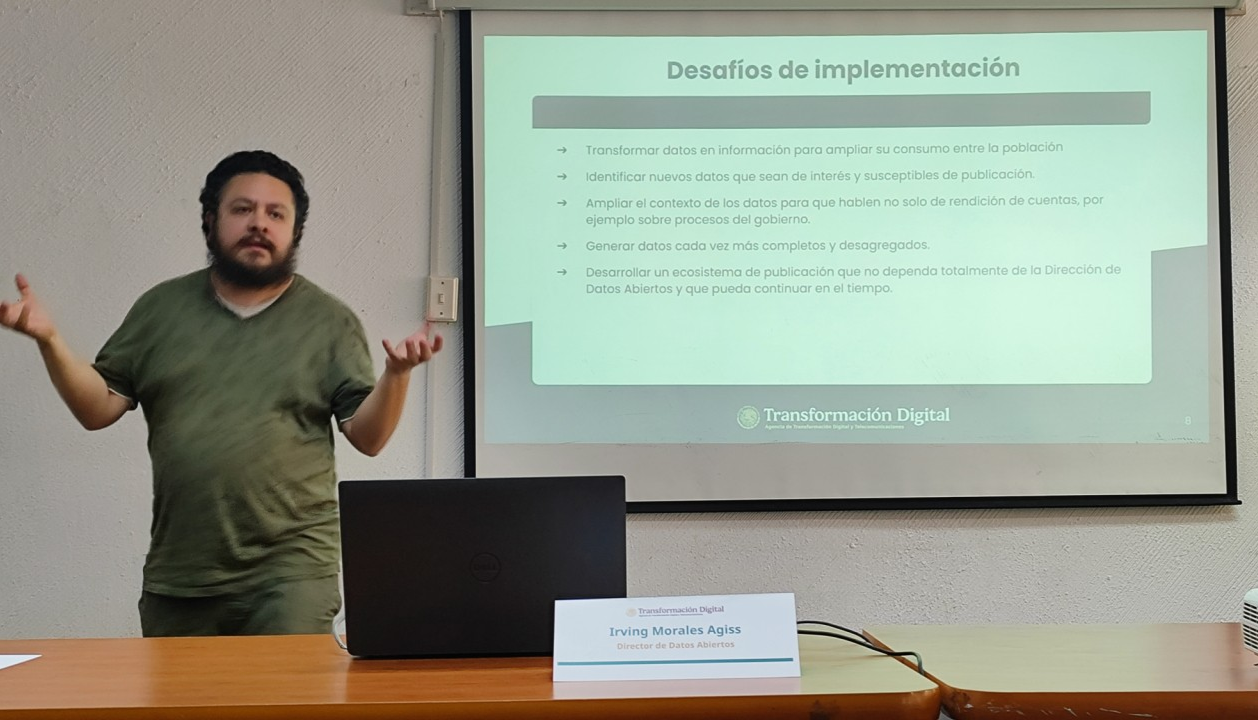
“The goal is to transform data into information that citizens can consult and use without the need for advanced technical knowledge. The platform generates graphs, tables, and all of this is designed within a much broader ecosystem than a simple repository,” said Irving Morales Agiss, Director of Open Data at the Digital Transformation and Telecommunications Agency.
The starting point was a diagnosis. The previous platform accumulated more than 50,000 data resources, of which nearly 20,000 were broken links. Many were PDF documents with embedded tables or Excel files with multiple sheets, impossible to process.
For this reason, the new platform established strict criteria: only CSV files are accepted for tabular data and Shapefiles for spatial data. Everything else (Excel, PDFs, Word) is rejected or must be previously transformed.
“The system does not accept unstructured formats. If an institution wants to upload an Excel file with multiple tabs or a PDF with notes within the cells, the validator rejects it. What we need is machine-processable data that is truly interoperable,” Morales said at a conference.
How to use the platform?
For the average citizen, the National Open Data Platform begins with a simple search. The portal includes a central search engine where keywords such as crime incidence, drinking water, or women can be entered.
The engine returns results in two categories:
Datasets (thematic collections).
Resources (specific tables).
Upon selecting a resource, the system immediately displays interactive charts and pivot tables, which respond to filters by state, date range, or specific variables.
“It doesn’t make sense to force citizens to download a huge database just to get a graph. From the platform, they can filter and view immediate visualizations. And if they want to go deeper, they can download what they need,” said the Open Data Director.
How to download information
Downloads are designed on two levels:
The full resource, in CSV, Excel, or JSON formats.
The filtered subset, that is, only the resulting portion after applying search criteria.
Each resource includes a download button and a dictionary of variables to interpret the data. This way, a journalist covering security in Guanajuato can obtain only the records for that state instead of processing millions of national rows.
APIs and Subscriptions
PNDA is also designed for developers and academics. The portal allows access via APIs, making it easy to integrate information directly into applications or analysis systems without manual downloads.
In addition, the agency announced a future subscription system, with which users can receive notifications when the datasets they closely monitor are updated.
“We’re working so that any user can subscribe to a resource and be notified when it changes. The idea is that they don’t have to check in every week to see if it’s been updated,” he said.
Old Data
One of the main problems with the previous platform was that links would expire when institutions modified their pages. The PNDA seeks to solve this with a central repository that backs up each resource on the Digital Transformation Agency’s servers.
This way, even if a secretariat moves or deletes its original file, the resource in the PNDA will remain available.
“On the previous platform, we had thousands of resources that no longer existed. Now the logic is different. Even if an institution changes its website, the data remains backed up in our infrastructure,” said Morales Agiss.
The team is also working on migrating historical data, with the goal of recovering information since 2015. However, they recognize that not everything can be recovered. Old unstructured PDF or Excel files don’t meet the new quality criteria.
Who publishes and how often?
In this first phase, the PNDA already gathers information from approximately 89 institutions. The goal is to reach approximately 300 units of the Federal Public Administration by mid-2026.
Each agency must designate an open data department with sufficient hierarchy to request information from other internal departments. The change seeks to prevent publication from depending on isolated decisions.
The update frequency varies depending on the data source: there are monthly, semiannual, and annual sets. The platform sends reminders to the responsible institutions and applies automatic validations before releasing a resource.
Pending Challenges
Although the PNDA represents a technological leap, it does not completely eliminate the challenges. The quality of the information will continue to depend on each institution, and delays in updating may persist.
Therefore, specialists recommend always reviewing three elements: the last update date, the methodological definition of the variables, and, in critical cases, direct confirmation with the agency that generated the database.
“What we publish is not just data, it’s information. And that implies a double responsibility: of the institutions that generate the database and of the users who interpret it,” said Morales Agiss.
The new National Open Data Platform is the Mexican government’s most ambitious effort to organize the supply of open data. The challenge will be to maintain quality and ensure constant updating. If successful, the platform could become a permanent infrastructure that brings public information to citizens in a reliable and accessible way.
Source: eleconomista