
Over the course of three years, a family from the United States—the Jensens—illegally smuggled 2,881 shipments of crude oil from Mexico, disguising it as other substances to avoid the corresponding taxes at border customs. To sustain their illegal enterprise, which earned them a profit of $300 million, the Jensens received assistance from the Jalisco New Generation Cartel (CJNG), to whom they paid a fee. In Mexico, what the Jensens committed is known as “tax huachicol.” The peculiarity of this case is that it does not involve the type of trafficking that has recently grabbed headlines in the Latin American country, where the government has dismantled a vast network of huachicoleros operating out of the Navy at ports and border customs offices. Fuel trafficking typically follows a north-south route, from refineries in the United States—especially in Texas—to Mexico. Unexpectedly, the Jensens reversed the equation and earned a fortune in just a few years. Their luck ran out in April, when US authorities dismantled the family smuggling ring.
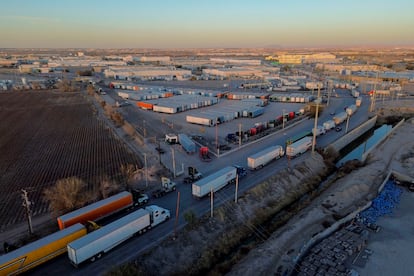
The clan, originally from Utah, consists of James Lael Jensen, the 68-year-old patriarch, considered an oil magnate in the United States; his wife, Kelly Anne; and their two sons, Maxwell Sterling, alias Max, and Zachary Golden. All are accused by the US Attorney’s Office of conspiracy to launder money and smuggling goods through false declarations. Court documents in the case indicate that the operation involved smuggling crude oil through customs, declaring it as lubricants and distillates, in violation of US Tariff Law. The oil was then transported to containers owned by the family company, Arroyo Terminals LLC, located in Rio Hondo, Texas. While the documents do not explain the locations through which the hydrocarbons were smuggled, the file lists several oil tankers and tank cars insured by the company, making it likely that the trafficking took place by sea and land through the customs offices and ports of Tamaulipas, which borders Texas.
The value of the oil trafficked by the Jensens between May 2022 and April of this year—when the FBI dismantled the illegal business—is estimated at $300 million. The crude was allegedly stolen by the CJNG from Pemex, the Mexican state-owned oil company, by exploiting pipelines or oil terminals. By the time the U.S. Attorney’s Office filed the indictment against the Jensens, the CJNG had already been designated a transnational terrorist organization by President Donald Trump, adding further aggravation to the family’s situation. In May, the DEA published a report drawing attention to the millions in losses suffered by Pemex due to fuel theft by organized crime. That same month, the Treasury Department sanctioned three drug traffickers and two CJNG companies linked specifically to fuel theft.
Court documents claim that James and Kelly Anne Jensen have “strong ties” in Mexico. “James Jensen has business relationships with individuals he knows work with criminal organizations in Mexico. Any company that supplies oil outside of Mexican government regulations can only obtain crude oil through cartels,” the Prosecutor’s Office indictment states. The file adds that the Jensens’ suppliers are located in Mexico, and that at least $47 million was transferred from their business accounts in the US to Mexican companies. The Prosecutor’s Office considers the Jensen clan to be “sponsors” of the CJNG (National Criminal Investigation Unit), so another aspect of the accusation against them is terrorist financing. “Combating drug cartels requires not only focusing on the traffickers and hitmen directly employed by them, but also on their accomplices and sponsors,” the agency stated.
The US justice system is seeking to confiscate the Jensens’ properties in the amount they earned through huachicol (a type of fuel theft). The description of the targets reveals a portion of their empire. Initially, the Trump administration is demanding all funds deposited in the bank accounts of Arroyo Terminals and another company, Big Hog Energy LLC; four oil transport ships; three trucks registered to another firm, Jentran LLC; a sports car, a luxury pickup truck, and a van. It is also claiming the property and oil storage facilities at Arroyo Terminals’ headquarters, as well as a mansion in Utah valued at $9.1 million. The Jensens also have properties in the tax haven of the Bahamas, but they are outside US jurisdiction.
James Jensen and his wife were arrested in April at their Utah mansion, while their sons Max and Zachary, who formally worked for Arroyo Terminals, were arrested in Texas. If convicted, they could face a 20-year prison sentence and a combined $2 million in fines. The Jensens’ case is now the most emblematic example of how the same criminal phenomenon has its co-responsible counterpart in both neighbors, Mexico and the United States. However, in the case of fuel theft, the Latin American country is the most affected, both by the millions of barrels of fuel that US companies smuggle across the border without paying taxes, and by the oil stolen from Pemex that is sent north. To the shared problem of migration, drugs, and weapons, now comes the problem of fuel theft.
Source: elpais