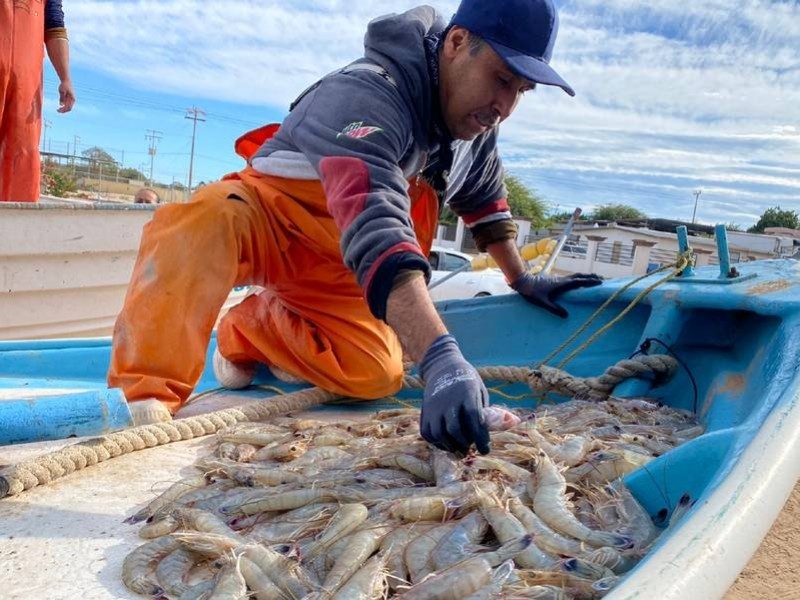
On September 19, 2025, the estuary shrimp harvest began in Nayarit following the federal agreement that staggered the end of the ban in the Mexican Pacific (lagoons, marshes, and bays starting September 19; high seas on September 29; and the Upper Gulf of California on October 14). The measure was made official in the Official Gazette of the Federation and disseminated by CONAPESCA.
The president of the Nayarit Coastal Federation, Juan de Dios Fernández, questioned the decision, arguing that there were no prior field verifications by the Mexican Institute for Sustainable Fisheries and Aquaculture Research (IMIPAS) and the National Ban Committee. He stated that the sector had to comply with the date despite the disagreement and attributed the lack of sampling to budget cuts, which he said prevented the deployment of technicians to carry out this work.
“We had to abide by the schedule even though we disagree. The decision was made without going to the field; this way, we can’t guarantee that the dates are appropriate,” said Fernández.
Why does it matter for Nayarit?
The capture and fishing in the estuaries of the National Marshes and other lagoon systems support thousands of families on the Nayarit coast, as shrimp is one of the key species in the local fishery.
Reasons for the fishing sector’s dissatisfaction
If the schedule is defined without recent sampling (sizes, abundance, recruitment), uncertainty about the sustainability and economic performance of this activity increases.
Closed seasons aim to protect reproduction and growth so that the shrimp will be larger and more commercially valuable when the season opens. Opening the season too early can increase catches of small organisms and put pressure on the resource, while opening it too late can shift profits to the offshore fleet when the resource migrates to the open sea.
Nayarit fishermen asked the Federal Government for technical opinions and decisions based on fieldwork, with pre- and in-season sampling in the state’s systems, as well as differentiated calendars for each water body to adjust the opening to the actual dynamics of each estuary and replenish resources to guarantee sampling, participation in committees, and institutional presence in the territory. Fernández emphasized that the intention is not to confront, but rather to align the calendar with the biology of the resource and the economic viability of the communities.
Source: meganoticias