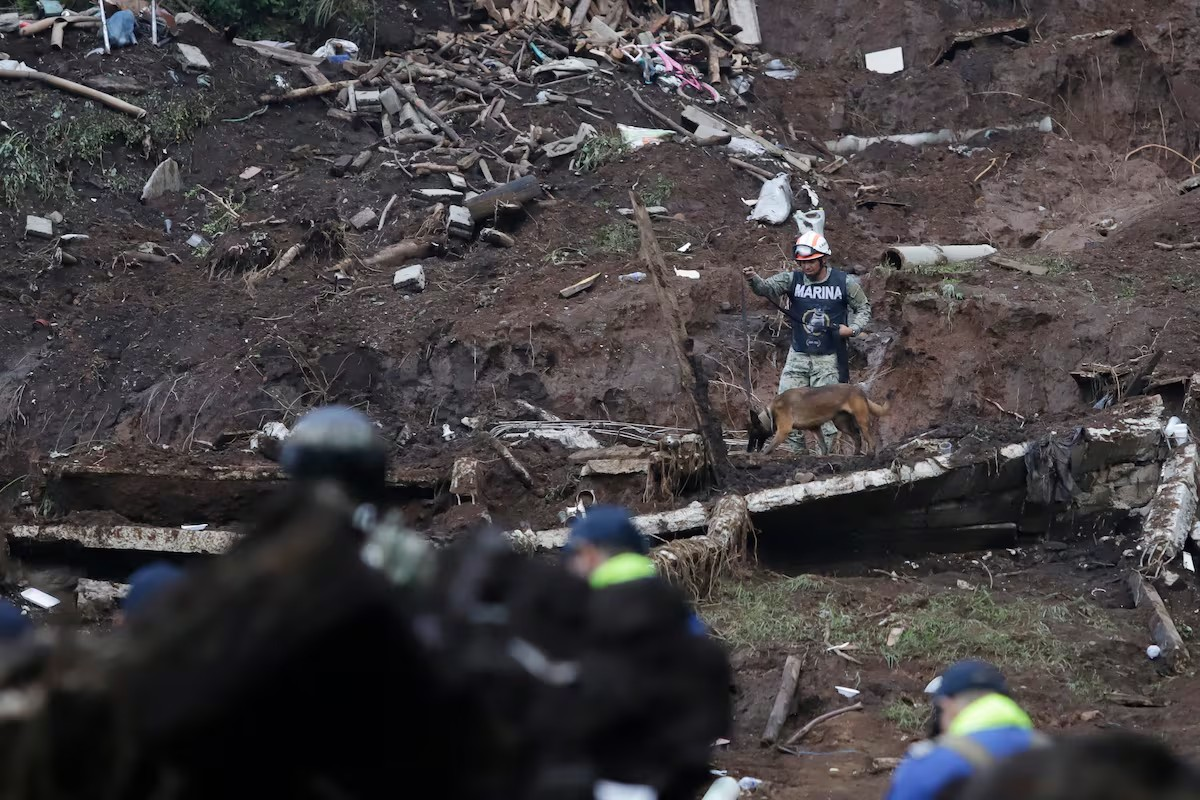

At least 64 people have died as a result of the deluge that hit the states of Veracruz, Puebla, Hidalgo, San Luis Potosí, and Querétaro in central Mexico last week. This figure, with another 65 missing, could rise. This natural disaster, in which an estimated 100,000 homes have been damaged, has once again brought to the fore the discussion about the elimination of the Natural Disaster Fund (Fonden), a trust fund for these types of emergencies, and its replacement with an annual budget allocation. As on other occasions, the federal government promises that there will be sufficient funds, while opponents criticize the improvisation and lack of clarity in the allocation of resources.
“The recent floods that have affected thousands of families are tragedies that ignore color or ideology. We at the PAN are doing everything in our power to help those affected. Once again, we raise our voices for the return of the Fonden (National Fund for the Development of the Nation), with sufficient resources and real attention for each person affected,” Jorge Romero, leader of the opposition National Action Party, wrote on social media. Ricardo Monreal, the deputy leader of the ruling Morena party, described such messages as “politically motivated.” “They shouldn’t use this tragedy for partisan purposes, the very despicable use of this tragedy for electoral gain,” he charged.
As in the case of Hurricane Otis in Acapulco, the Mexican government confirmed its approach to responding to these types of emergencies. On the one hand, brigades of National Servants conduct a census of disaster victims, giving them cash and a range of goods such as appliances and mattresses. On the other hand, funds are transferred to municipalities for infrastructure projects. According to what was stated at the Presidential press conference on Monday, there are 19 billion pesos allocated for natural disaster relief, of which nearly 3 billion have already been used.
“If the Fonden and its rules were in effect, 28 billion pesos would have been allocated this year, 9 billion more than what was allocated,” explains Jorge Eduardo Cano, coordinator of the Public Spending Program at the think tank México Evalúa. Previously, according to law, disaster funds had to be capitalized year after year at a minimum of 0.4% of the budget’s programmable expenditure.
Cano says that eliminating the Fonden was a mistake, “a setback of more than 30 years in financing and prevention of natural disasters.” The Fonden was a sort of checking account where money was deposited each year and saved so that, in the event of a major natural disaster, the entire amount could be used. When it was dissolved, it held approximately 35 billion pesos.
It was the government of Andrés Manuel López Obrador, Claudia Sheinbaum’s mentor and predecessor, that effectively ended this trust fund, arguing that it was a hotbed of corruption. The truth is that several audits found irregularities in the execution of projects, but primarily in the use of resources by the states, rather than in the management of the trust fund itself.
The new model, called the Program for Emergency Response to Natural Hazards, had its first major test in Acapulco and the management of the city’s reconstruction after Hurricane Otis. A European Union satellite monitoring system estimated that 560,000 of the city’s 780,000 inhabitants were affected in some way, with nearly 7,400 hectares of buildings and structures damaged or directly destroyed.
The government allocated 61.3 billion pesos to the Reconstruction and Support Plan for the Affected Population in Acapulco and Coyuca de Benítez; the majority, 22 billion pesos, went to direct support, followed by exemptions from payments and taxes with 19.4 billion pesos, and, in third place, infrastructure reconstruction with 12.5 billion pesos. “The use of resources is focusing much more on direct transfers of social support, household goods, food supplies… which may be useful, but are not exactly reconstruction, and have a political and electoral component,” Cano explains.
The Acapulco case was an example of the problems with this new model. There were complaints from thousands of affected people who couldn’t be counted and didn’t receive money or their household goods; there were documented cases of a single household where several people were counted and received various financial aid packages and appliance packages. In Facebook groups, people could buy these refrigerators, stoves, fans, and mattresses delivered by the government. They were identified as “Otis Price Sales.”

Source: elpais