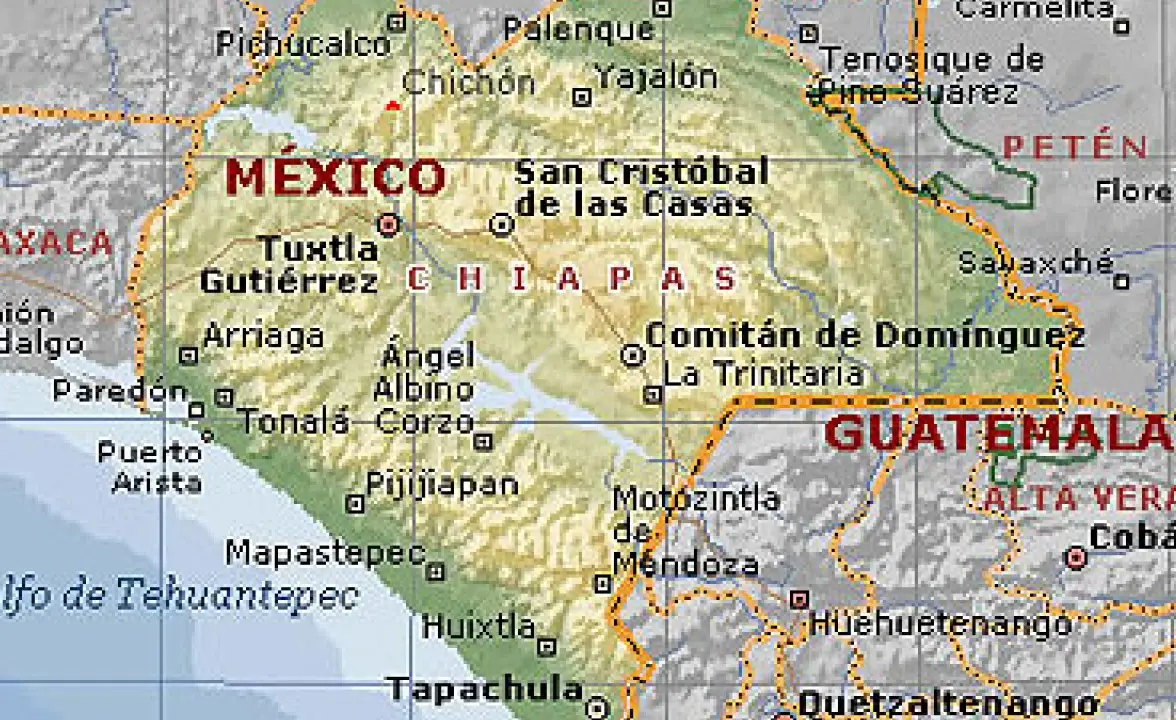

Chiapas is the state that will receive the largest amount of physical investment from the 2026 federal budget, accounting for 11% of the 321.978 billion pesos in physical investment transferred to states and municipalities, according to the 2026 Federal Expenditure Budget Project (PPEF).
The resources for physical investment transferred are federal funds that the government transfers to states and municipalities for the execution of public works and infrastructure projects.
They are comprised of Branch 33, which includes funds such as the FAIS (Social Infrastructure Contribution Fund), the FORTAMUN (Contribution Fund for the Strengthening of Municipalities and Territorial Demarcations of the Federal District), and the FAFEF (Municipal Social Infrastructure Contribution Fund). They also include Decentralization Agreements (Branch 16), such as those signed with the National Water Commission.
The total Transferred Physical Investment budget projects a 17.0% increase for 2026, rising from 275,097.1 million pesos approved in 2025 to 321,978.0 million pesos in the 2026 project.
Behind Chiapas are the State of Mexico with 9.5% of the total, Veracruz with 7.0%, Oaxaca, Guerrero, Puebla, Mexico City, and Michoacán. Together, these eight states account for 52% of the Physical Investment resources, according to an analysis by the Center for Public Finance Studies (CEFP).
These resources should be allocated to the creation, expansion, maintenance, or improvement of capital assets that will provide services for a long period of time. “Infrastructure not only drives economic growth but can indirectly strengthen human capital by facilitating access to basic services such as education and healthcare, among others,” according to México Evalúa.
A portion of the total budget, 37,501.9 million pesos, equivalent to 11.6%, is classified as Non-Geographically Distributable (NGD) and corresponds to the Fund for Hydrocarbon Producing Entities (Branch 23) and Forestry Development programs (Branch 16). Therefore, their final allocation to specific entities will be determined during fiscal year 2026. According to CEFP data, these resources exceed the individual budget allocated to any state, except Chiapas and the State of Mexico.
Compared to 2025, Mexico City registered the largest percentage growth in its allocation, with 44.5%, going from 10,012.1 million pesos to 14,462.6 million; Aguascalientes came in second with a 39.0% increase in its budget, rising from 1,951.8 million pesos to 2,713.4 million pesos, and Baja California with a 28.1% increase, which translates to an additional 1,188.5 million pesos, from 4,234.4 million to 5,422.9 million pesos.
At the other extreme, Baja California Sur is the only state experiencing a reduction in its physical investment budget, with a 32.4% decrease, falling from 1,869.3 million pesos to 1,263.0 million pesos.
Federalized Spending
It is worth mentioning that by 2026, federalized spending will represent 27.8% of total spending, the lowest proportion since 1998. This implies less public policy capacity in the areas of sewage, streets, lighting, and waste management, which are obligations of states and municipalities, reported México Evalúa.
The distribution of federalized spending among states responds to economic factors and institutional designs.
“The states of southeastern Mexico have a higher amount of spending because there are specific funds for those states that are oil producers,” said Jorge Eduardo Cano Anaya, coordinator of the public spending program at México Evalúa.
“Mexico City has a greater amount of federalized spending due to its level of economic activity,” since the distribution formulas “include a component of local revenue collection.” It is intended to redistribute resources, but it is closely linked to the level of economic development or economic activity,” he added.
Like Baja California Sur, Colima will have only 0.4% of Transferred Physical Investment, followed by Aguascalientes and Campeche with 0.8% each, and Tlaxcala with 1.1%, which demonstrates the concentration of resources in a small group of states compared to the marginal allocation received by most states.

Source: eleconomista