
In the context of the changes that global trade has undergone in 2025, the Mexican Institute for Competitiveness (IMCO) analyzes the impact of these measures on Mexican exports and compares its performance with that of other trading partners, including the European Union, the United Kingdom, and Japan.
Mexico has managed to maintain greater relative access to the U.S. market compared to the rest of the world, despite the 50% tariffs on steel, aluminum, and copper products, and the 25% tariff on automobiles and products that do not comply with the USMCA rules of origin. However, uncertainty surrounding potential new tariffs, such as those announced on pharmaceuticals and heavy trucks, creates a complex outlook for investment.
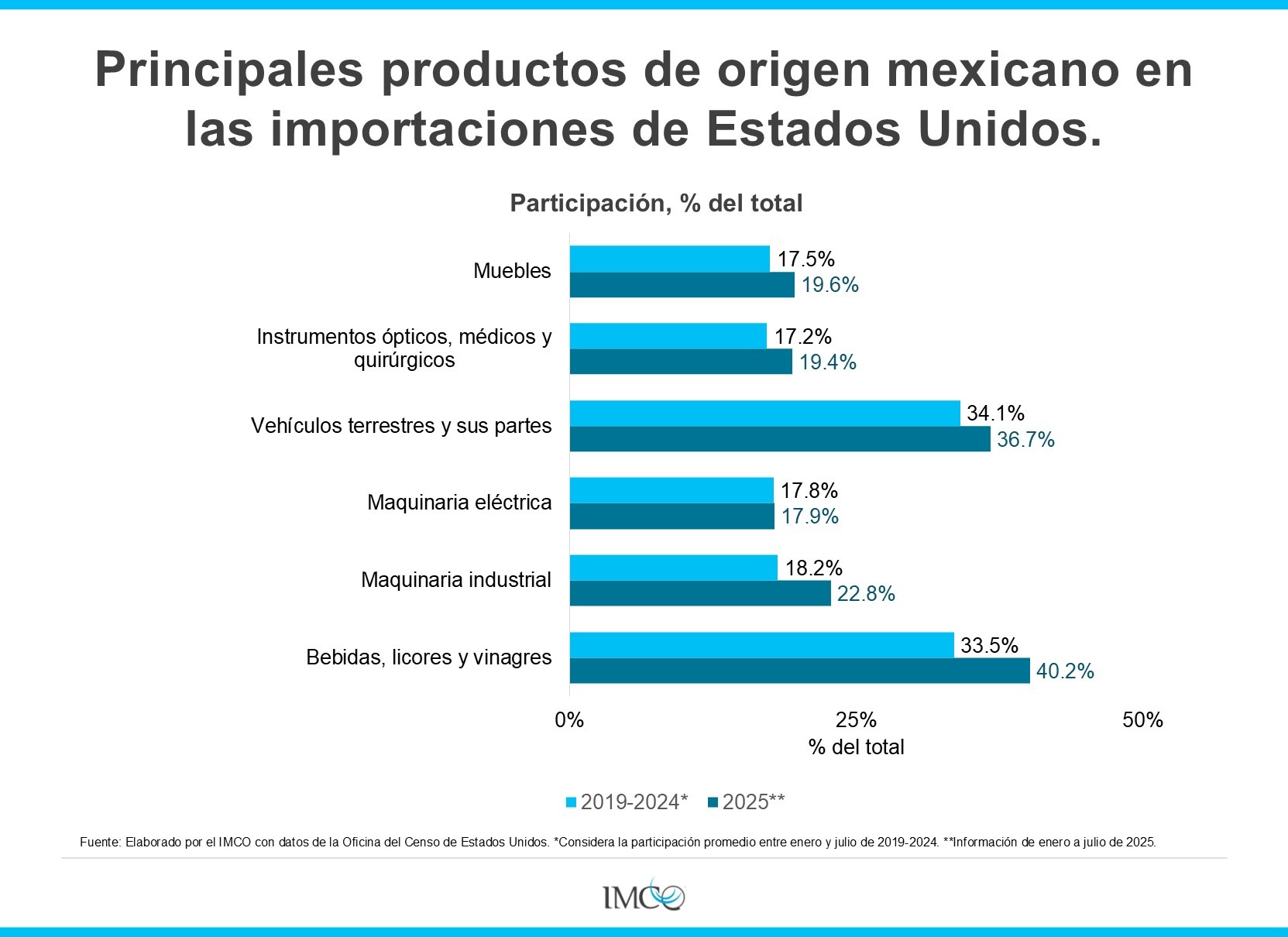
In July 2025, U.S. imports from Mexico reached $32.2 billion, an 8% increase compared to the same period in 2024. In contrast, during the same period, imports from other partners such as China, the European Union, and Canada decreased by 5.2%, 2.2%, and 1.5%, respectively. Mexican exports are concentrated in sectors such as land vehicles and auto parts, industrial machinery, optical and medical instruments, furniture, and beverages, spirits, and vinegar, showing significant increases in their market share compared to the 2019-2024 average.
Mexico combines preferential access under the USMCA, geographic proximity, and productive complementarity. These conditions position the country as an indispensable supplier to the United States. However, without a long-term environment of predictability and certainty, the country will remain exposed to the trade fluctuations of Washington. Given this scenario, IMCO proposes:
Taking advantage of the public hearing at the U.S. International Trade Commission as part of the consultations for the review of the USMCA. It is necessary to mobilize Mexico’s allies in the United States, including Mexican companies with significant operations there, U.S. companies with significant operations in Mexico, key legislators, business chambers, research centers, and state governments.
Investing in the development of logistics infrastructure through long-term plans to modernize ports, highways, and customs facilities. It is necessary to promote long-term plans to develop logistics infrastructure that facilitates Mexico’s foreign trade and considers the country’s needs with a multi-year vision. In this regard, it is important to prioritize actions included in the Mexico Plan, such as the modernization of 11 ports and 3,000 kilometers of railway lines, especially regarding freight transport.
Guaranteeing the supply of natural gas in all regions of the country to increase investment opportunities in states that currently lack this resource. It is necessary to continue expanding the gas pipeline network to bring natural gas to states that currently lack or have limited access to this fuel, such as Nayarit, Guerrero, Chiapas, Oaxaca, and Quintana Roo.
Simplifying customs procedures is also crucial. The United States Trade Representative identified deficiencies in customs as one of the trade barriers the U.S. faces with Mexico. It is necessary to streamline procedures and develop a system with predictable rules to improve customs operations, promote e-commerce, and encourage the participation of SMEs. Furthermore, the restriction limiting customs brokers to operating in a maximum of four customs offices should be eliminated.
Source: imco.org