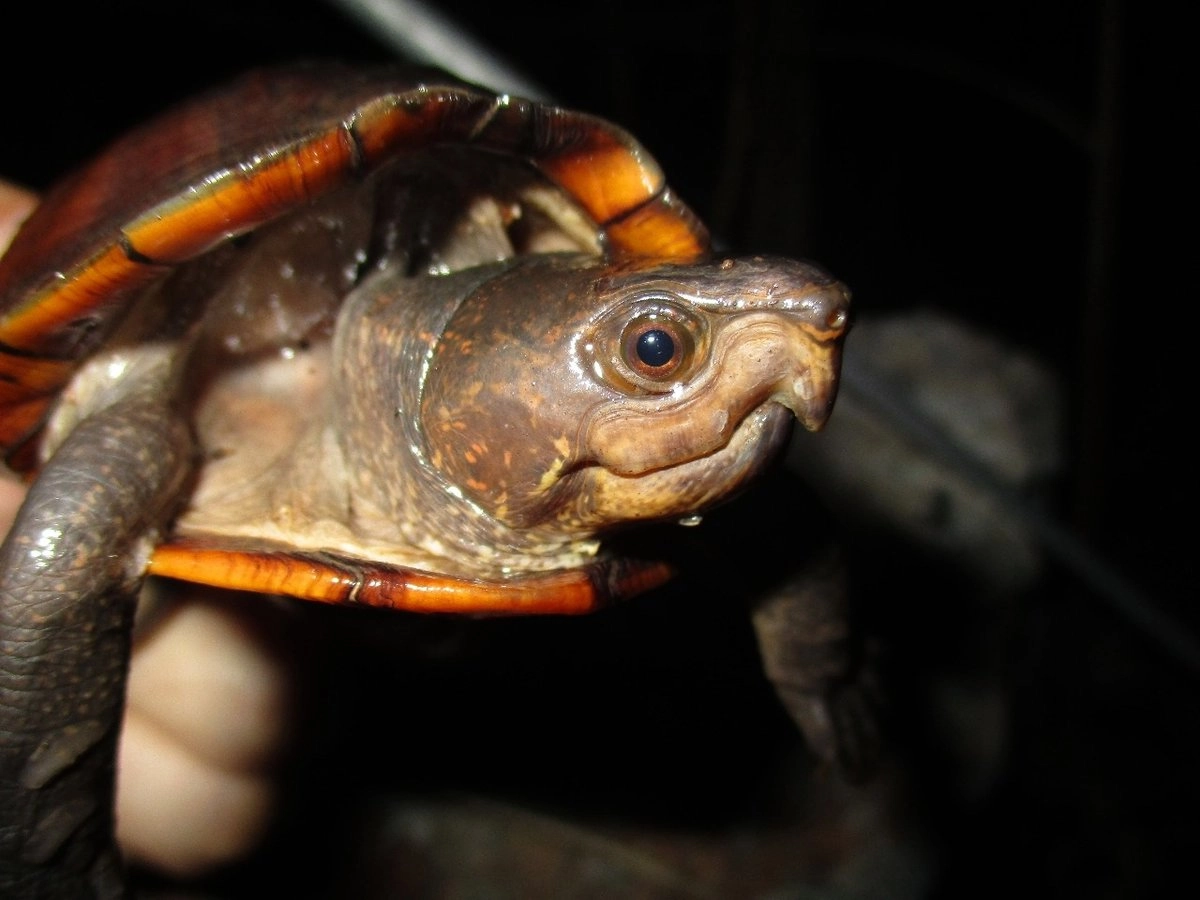
The Yucatán Swamp Turtle, known in the Mayan language as Xtuk’is, which is found primarily in this southeastern Mexican state, has been reclassified as “Near Threatened,” and its extinction risk would rise to “Near Threatened.” If it were to disappear here, it would vanish from the entire planet, reported Luis Fernando Díaz Gamboa, director of the Network for the Conservation of Amphibians and Reptiles of Yucatán (RCARY).
In an interview, the academic stated that the Yucatán Swamp Turtle (Kinosternon creaseri) is on the Red List of Threatened Species, along with four other species that survive in the state and other regions of the southern Yucatán Peninsula. This freshwater swamp turtle is concentrated in a small region of jaltunes (water accumulations in limestone rocks), located in southern Yucatán, between the Mayan municipalities of Oxkutzcab and Tekax.
He added that, in addition to sea turtles, there are 12 species of land and sea turtles in Yucatán, half of them at risk. For example, the White Turtle (Dermatemys mawii), also called Suc aak in Mayan, is “Critically Endangered,” and four other species were already listed as “Near Threatened,” the same category the Yucatán swamp turtle has now reached.
Likewise, the Musk Turtle (Claudius angustatus), or Pool kep in Mayan; the Mountain Turtle (Rhinoclemmys areolata), or Chac pol in Mayan; and the Three-backed Turtle (Staurotypus triporcatus), or Jolom kok in Mayan; The Tabasco River Turtle (Kinosternon acutum) and the Yucatan Marsh Turtle are now listed as “Near Threatened.”
According to the activist, the Red List of Threatened Species is the most respected global tool for assessing the extinction risks of animals and plants and is compiled by a worldwide network of scientists and conservationists affiliated with the International Union for Conservation of Nature (IUCN).
He stated that, according to the IUCN Red List criteria A2c+4c, the Yucatan Marsh Turtle is experiencing a significant decline in its population, its habitat is severely fragmented, and it is suffering from a continuous loss of habitat.
The Yucatan Marsh Turtle was listed as “Least Concern” before being reclassified as “Near Threatened.” He emphasized that if this trend continues, the next level it will reach is “Critically Endangered.”
The IUCN changed the risk status of this small turtle after a biological assessment presented to the global organization by specialists from RCARY, led by Díaz Gamboa himself, at the headquarters of the Ministry of Environment and Natural Resources (Semarnat).
The experts conducted fieldwork for several weeks to compile the scientific information required by the IUCN to update the assessment of this species, sometimes called the mud turtle.
The Yucatán mud turtle lives in pools and puddles, which are accumulations of rainwater in natural cavities in the limestone, functioning as small, temporary lagoons. This little animal’s only defense is a very characteristic odor that it secretes to protect itself from other animals. “The Yucatán mud turtle has a musk gland on the back of its body that it uses as a defense against predators,” the expert noted.
The director of the Network for the Conservation of Amphibians and Reptiles believes that saving the turtles requires the necessary conservation of their natural habitat. The opposite puts them at greater risk. In fact, “climate change and the increase in drought seasons on the Yucatán Peninsula are also risk factors for the species,” he concluded.
Source: jornada