People from the United States, aboard a boat, placed six signs on Bagdad Beach in Tamaulipas, marking the area as a restricted and prohibited zone, sparking controversy over who was responsible and border boundaries.
In response, Mayor Claudia Sheinbaum stated that a U.S. government agency indicated that a company had indeed been hired to put up the signs, without providing further details.
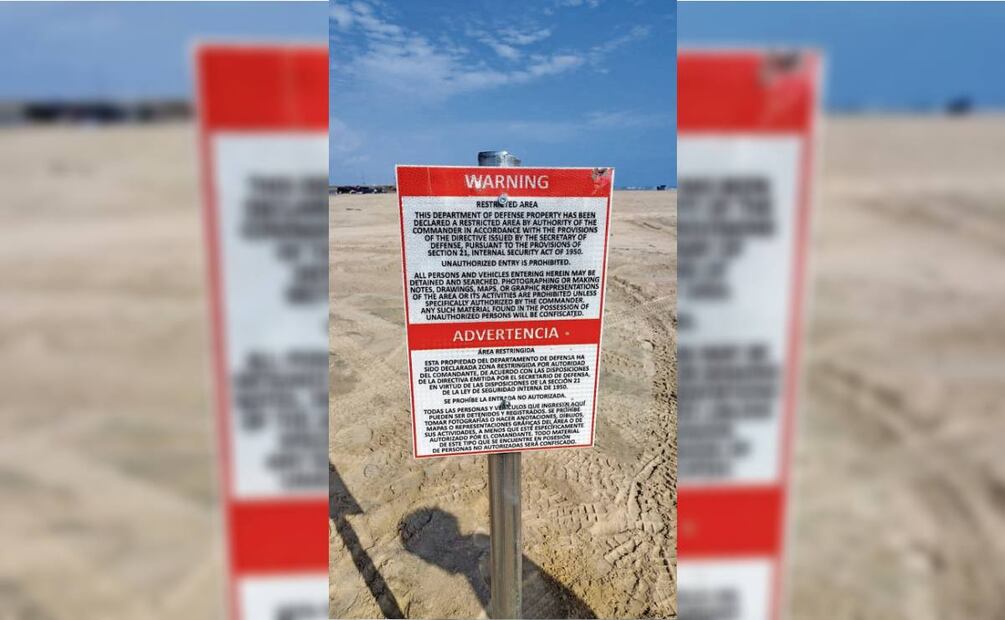
The action took place last Monday around 10:00 a.m. and was observed and documented by members of the Conibio Global collective. Their images show at least four people entering through the mouth of the Rio Grande to reach Bagdad Beach, where they placed metal stakes and signs with messages in English and Spanish that read: “Restricted Area. This Department of Defense property has been declared a restricted area by the authority of the commander, in accordance with the directive issued by the Secretary of Defense, pursuant to the provisions of Section 21 of the Homeland Security Act of 1950.
“Unauthorized entry is prohibited. All persons and vehicles entering may be detained and searched. Taking photographs or making notes, drawings, maps, or graphic representations of the area or its activities is prohibited unless specifically authorized by the commander.” “Any material of this type found in the possession of unauthorized persons will be confiscated,” read the signs, which do not mention any government nor bear any emblems or symbols of any agency or country.
In response to these events, Conibio requested the presence of Mexican authorities at the site.
The Navy reported in a statement that its personnel arrived at the location and removed the structures on Bagdad Beach.
See also: Map: Bagdad Beach in Tamaulipas, where Americans placed “restricted zone” signs; a “space” tourism hotspot… and a SpaceX debris site
It specified that the Mexican section of the International Boundary and Water Commission (IBWC) will begin technical consultations to clarify this incident and will also conduct the review established by current boundary and water treaties of the maps and instruments that delimit the border between the two countries.
President Claudia Sheinbaum, in her press conference, read a joint statement from the Ministries of the Navy and Foreign Affairs regarding the discovery of the signs and noted that in Initial inquiries made by the Mexican Consulate in Brownsville, Texas, did not confirm that the structures had been placed by any U.S. authority.
“Boundary signs were put up on a section of Bagdad Beach. The consulate was consulted first, then the embassy, but they had no report that this was an official matter; the signs were removed. Later, a U.S. government agency stated that a company had indeed been contracted to put them up.
“But as Admiral [Raymundo Pedro Morales, Secretary of the Navy] explained to us, the river’s course changes, it siltes up, and according to the treaty (on the border between Mexico and the United States), the territorial boundary must be clearly defined,” he said.
“That’s what we’re working on so that, through U.S. and Mexican institutions, the exact boundary in that area of Tamaulipas, near the Gulf, can be clearly defined with more information and resources,” he specified.
Source: eluniversal