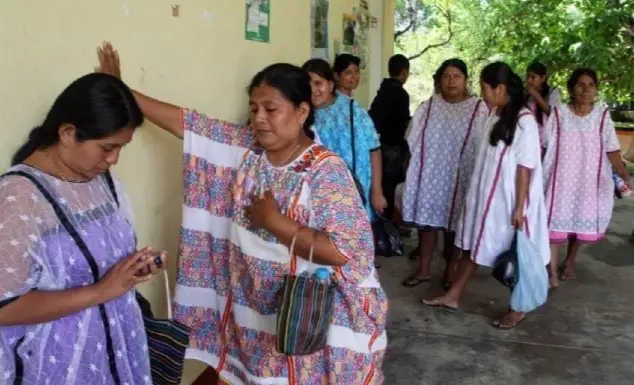

In the proclaimed “Year of the Indigenous Woman,” the governments of Claudia Sheinbaum Pardo and of Guerrero, headed by Evelyn Salgado Pineda, continue to neglect Indigenous women victims of violence and those who assist them, also Indigenous, in the Montañana region of that southern state.
Due to the non-payment of salaries to staff at the Gu’wa Kumá House of Knowledge in Ayutla de los Libres, the Justice Center for Women of the Montaña Region, and the Comprehensive Strategy Component for Justice and Well-being of Women and Girls, the latter two located in Tlapa de Comonfort, work has been suspended, leaving dozens of women victims of violence without support. These women typically receive assistance at these centers, which are administered by the Program for the Prevention, Attention, Sanction, and Eradication of Violence against Women of the state government’s Women’s Secretariat.
Noemí Prisciliano Fernández, coordinator of Gu’wa Kuma, explained in an interview that so far in 2025, the Guerrero Women’s Secretariat has only covered staff salaries for the first four months, which were paid last June, leaving the following seven months uncovered.
“There are many open investigations and some child support cases that have been left unfollowed due to a lack of resources, precisely because they don’t provide resources for monitoring the women who use the services, and support for the victims has been discontinued because we don’t have the resources to help them,” she pointed out.
Prisciliano Fernández is the daughter of Inés Fernández Ortega, a Me’phaa woman who sued the Mexican State before the Inter-American Court of Human Rights (IACHR) for having been a victim of sexual torture by members of the Army in 2002. This resulted in a 2010 ruling that included, as part of the reparations, the creation of a community center to serve Indigenous women who have suffered violence and Indigenous children and adolescents who were displaced from their communities to study in Ayutla.
Noemí explained that although the Mexican State is obligated to maintain the Casa de los Saberes (House of Knowledge) as part of the ruling, “the federal government has refused to assume this responsibility or its commitment to the community center. It leaves everything to the state government, and the state government argues that it lacks the resources to maintain this center.”
From Ayutla, Prisciliano Fernández emphasized that, precisely as part of the court ruling, his mother Inés, who is practically monolingual, deemed it necessary to establish a community center like Gu’wa Kumá, where women victims of violence could be assisted by professional women who spoke their native language. This would prevent them from also suffering institutional violence, as happened to her when she reported soldiers who assaulted her.
Noemí, a lawyer by profession, pointed out that at least 15 investigations into domestic violence and seven lawsuits against those who fail to pay child support, which the Casa de los Saberes (House of Knowledge) is monitoring, are currently suspended due to the inability of the professionals to handle them.
“We ask the victims for their understanding. We would love nothing more than to follow up on their cases, but because we don’t have our own resources to travel, we can’t continue working until the authorities pay the professionals, the ambassadors (representatives of the indigenous communities), and the driver.
“This is very worrying for us because we provide support to people with limited resources, and now they are left unprotected, without legal support or everything that a legal process entails,” she pointed out.
Noemí Prisciliano recalled that last July, representatives from the federal and state governments visited the Casa de los Saberes (House of Knowledge) to gather complaints about the lack of payment to staff and the lack of funds to maintain the space designated for women and the shelter for some 45 teenagers from remote communities in the La Montaña region who want to continue their basic, upper secondary, and higher education.
“On July 29, we had a meeting here (in Ayutla) with the Women’s Secretariat “There were also representatives from the federal Women’s Secretariat and the federal Undersecretariat of Human Rights. We had a working meeting and they promised that they would cover our salaries no later than 15 days after that meeting, but to date nothing has been reflected,” Noemí Prisciliano pointed out.

Source: proceso