
Querétaro reveals itself as a state capable of surprising all types of travelers: those seeking history, those pursuing authentic flavors, those yearning for nature, and those needing a meaningful break. From colonial cities to lush mountain ranges, from wine and cheese routes to forests ideal for disconnecting, there is much to discover and much to visit in Querétaro if you are looking for a profound and diverse getaway. This tour will take you through its main regions to help you plan a trip that is as complete as it is inspiring.
A city that surprises day and night
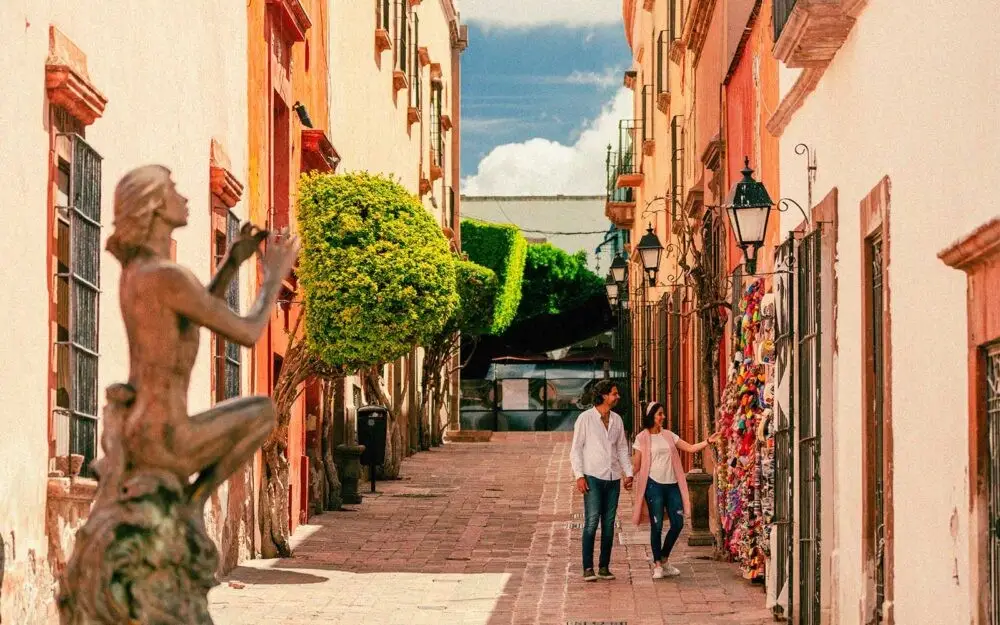
The city of Santiago de Querétaro itself stands out as a complete destination. Walking through its historic center is to rediscover the viceregal heritage that shaped the course of Mexico, among colonial mansions, baroque churches, and plazas where local life flows at a leisurely pace.
During the day, you can visit the Aqueduct, the Casa de la Corregidora, the Teatro de la República, and the churches of Santa Rosa de Viterbo and San Agustín. At night, the pedestrian walkways in the city center light up and the atmosphere transforms, with quiet cafes, bohemian cantinas, and restaurants that fuse local cuisine with international trends. Evenings in the city offer everything from open-air concerts to terrace dining with views of the monuments.
The capital of Querétaro is also famous for its orderliness and cleanliness. It’s a modern city, with shopping malls, recreational parks, and residential areas that coexist with its history. This blend of the traditional and the contemporary is part of what characterizes the state of Querétaro—a balance between the past and the future that can be experienced at every turn.
Intense flavors, breathtaking landscapes, and a culture that unfolds effortlessly in every detail. What was once the Art, Cheese, and Wine Route is now much more than a catchy name; it has become one of the most compelling reasons to explore the state. This region—Bernal, Tequisquiapan, and Cadereyta—winds through hills and semi-desert, its vineyards growing unhurriedly alongside towns steeped in centuries of history. And every event, every meal, feels more like a shared celebration than a tourist itinerary.
Here, wine ceases to be a mere beverage, becoming a legitimate excuse to stop time. In the surrounding area, dozens of wineries offer everything from walks among the vines to intimate tastings, meticulously designed meals, and events that mark each season. During the harvest season, which runs from June to September, everything comes alive: open-air concerts, harvest blessing rituals, grape stomping, and pairings that teach more than any guidebook.
And if wine is the heart of this region, cheese is undoubtedly its soul. The cheesemaking tradition is deeply experienced. Some ranches allow you to witness the entire process, from the animals grazing to the moment the cheese matures in cool cellars. There are workshops, tastings, family-friendly tours, children’s areas, country lanes, and restaurants where the local flavor is unadulterated.
The landscapes also tell their own story: expansive skies, the Peña de Bernal majestically rising on the horizon, verdant vineyards against reddish soil. Some prefer to explore them by bicycle or tram; others simply stroll leisurely among the rows of vines. More than just visits, these are ways to understand the essence of wine from its most fundamental element: the land.

This natural paradise in the north of the state is one of Mexico’s most biodiverse regions. Its landscapes range from cloud forests to canyons, turquoise rivers, and semi-arid zones. Hidden within its heart are several towns: Jalpan de Serra, Landa de Matamoros, Arroyo Seco, San Joaquín, and Pinal de Amoles.
Culturally, the Sierra Gorda is home to the Franciscan missions founded by Father Junípero Serra in the 18th century, a UNESCO World Heritage Site. These churches blend European Baroque with indigenous elements, creating a unique aesthetic that speaks of syncretism and resilience.
The Sierra Gorda represents freedom: hiking trails, hidden waterfalls like El Chuveje and El Salto, campsites, and ecotourism activities managed by local communities. It’s a destination to disconnect and reconnect, where every bend in the road offers a different view. Furthermore, by exploring it, you directly contribute to the region’s sustainable tourism.
Forests and Fields of the South: Rest and Tradition
Southern Querétaro is a whole other world worth discovering. Unlike the mountainous north or the urban center, temperate forest landscapes and farming communities predominate here. Amealco de Bonfil, with its Otomi embroidery and traditional Lele dolls, is one of the most representative destinations.
The cool climate, cabins nestled in the forest, and hiking trails make this region a perfect retreat for relaxation. In addition, there are places like San Ildefonso Tultepec or Santiago Mexquititlan where you can learn about Otomi traditions, their cuisine, and their worldview.
For travelers wondering what characterizes the state of Querétaro, this balance between nature, culture, and community is one of the clearest answers. It’s a small state in size, but immense in possibilities for exploring, discovering, and admiring.
Querétaro, a transformative getaway
Visiting Querétaro isn’t just ticking a destination off your list. It’s opening a window to different ways of living, eating, celebrating, and seeing the landscape. From the colonial city to the northern mountains, from the vineyards to the indigenous communities, Querétaro is a collection of stories worth exploring at a leisurely pace.
It’s a destination that invites you to return, to come back in another season, with different company, or with fresh eyes. Because every time you visit, Querétaro tells you something different. And that’s what makes it unforgettable.

Source: escapadas.mexicodesconocido