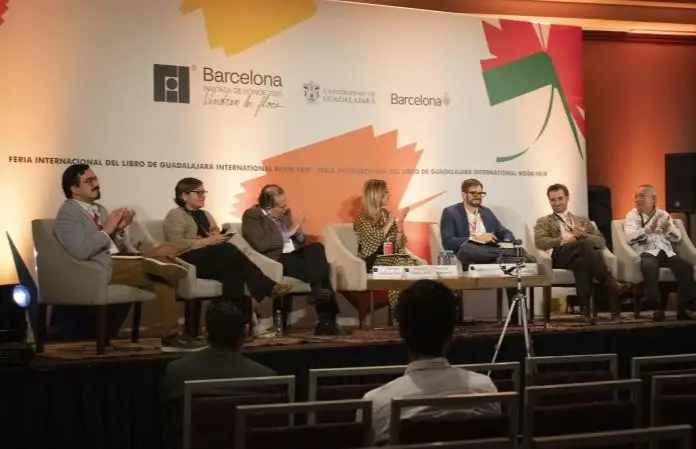

Journalists from various media outlets shared their stories of judicial harassment at the 21st International Meeting of Journalists, asserting that this has been a recurring practice in Mexico to silence journalistic work.
Hernán Gómez Bruera, an investigative journalist, published the book Betrayal in the Palace: The Business of Justice in Mexico, which describes the modus operandi of an extortion, corruption, and influence-peddling network orchestrated from the office of former presidential legal advisor Julio Scherer Ibarra, and involving the federal judiciary and that of Mexico City.
Although he is not the only one who has addressed the issue in the media, “I am probably the one who has bothered him the most. I am just a journalist facing the fury of a powerful man,” said Gómez Bruera, who is facing three separate legal proceedings as a result.
The legal persecution has sought to strip him of his assets, but also to remove his book from bookstores and pressure for Gómez Bruera to be fired from the media outlets where he works.
Marcela Nochebuena, a reporter for Animal Político, recounted that they were sued for moral damages due to a report on obstetric violence, based on the testimonies of 14 victims of a doctor.
Although the lawsuit was filed by the doctor in his personal capacity, it reflects what private citizens have learned from public officials and politicians in trying to evade the consequences.
“It is these contexts of impunity that allow people to sue journalists today, and furthermore, that judges favor them even if they are the aggressors, even if they are fugitives from justice,” she denounced.
José Luis González, former director of the newspaper Tribuna, reported that he is facing civil and criminal lawsuits for work presented by Layda Sansores, governor of Campeche, on the digital platform program Expediente, and at his former workplace.
“I haven’t filed any lawsuits or accusations against her because it would do me no good, since—and I think this is evident throughout the country—whoever attains executive power also seizes control of the legislative and judicial branches. That’s not relative; that’s a fact,” he stated.
Political scientist Rogelio Campos faced a lawsuit from Paula Ramírez Höhne, president of the Jalisco Electoral and Citizen Participation Institute, which he considered a punishment for freedom of expression, although the ruling was in his favor.
“The real punishment for freedom of expression is not the sentence, which I won; it is the process, and this punishment does not fall only on journalists, but also on citizens, and those of us who practice journalism have to fight to expand that protective shield, because there cannot be first-class citizens and second-class citizens,” he said.

Source: cosmoc.udog