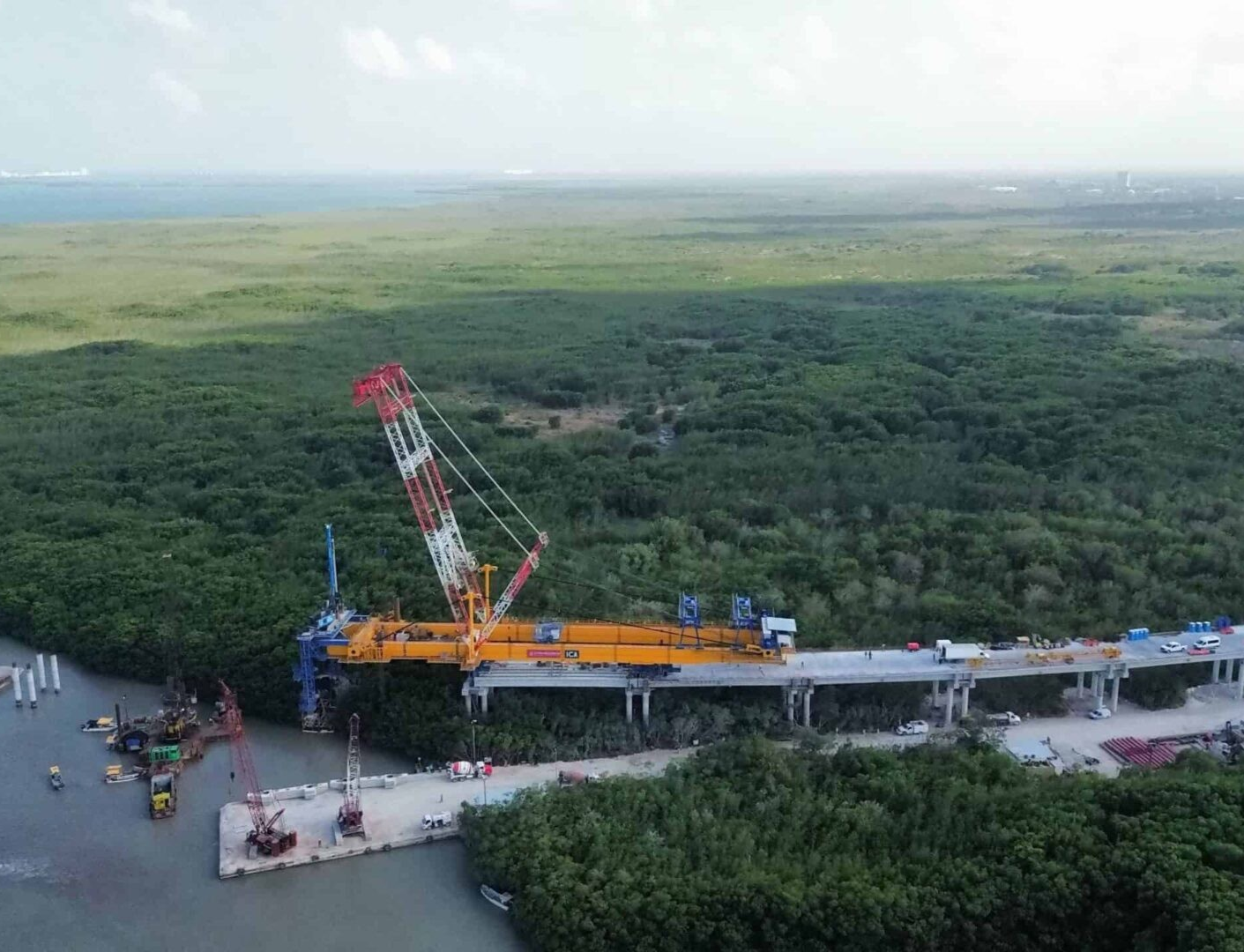

The Nichupté Vehicular Bridge, one of the most important road infrastructure projects in Cancún, is 90% complete and is expected to open to traffic by the end of this month, according to federal authorities.
The bridge is part of Cancún’s 2030 Strategic Sustainable Development Plan, conceived in 2006, but construction did not begin until 2022, after several years of technical, environmental, and financial discussions.
The Nichupté Vehicular Bridge will have a total length of 11.2 kilometers, including crossings and ramps, and will directly connect the city of Cancún with its hotel zone across the Nichupté lagoon system.
The main section will include:
Three traffic lanes in each direction, one of which will be reversible.
A bicycle lane.
A pedestrian walkway. The design positions the bridge not only as a roadway, but as a multimodal corridor that incorporates private vehicles, micromobility, and pedestrian access—something uncommon in traditional infrastructure accessing tourist areas in Mexico.
Structural Design and Environmental Stewardship in the Nichupté Lagoon
The Nichupté Bridge structure is supported by piles driven into the lagoon’s seabed, with the aim of minimizing the impact on the protected mangrove area.
Although the project has been criticized by environmental groups, the official statement is that the design seeks to:
Reduce direct contact with the mangrove ecosystem.
Maintain water flow within the lagoon system.
Limit landfill and direct impacts on soil and vegetation.
For Cancún’s tourism and real estate market, the balance between connectivity and conservation will be key: the lagoon and mangroves are central to the environmental appeal that sustains the value of the hotel zone.
One of the strongest arguments for the Nichupté Vehicular Bridge is the reduction in travel times between the city and the hotel zone. Authorities estimate that crossing the lagoon system can shorten journeys by up to 45 minutes, depending on the point of origin.
The bridge will also serve as:
An alternative evacuation route in case of hurricanes or other emergencies.
A redundant route in case of accidents or closures of existing access roads.
In a city exposed to hydrometeorological phenomena, the existence of an additional corridor for the entry and exit of people, supplies, and services becomes a compelling argument for hotels, tour operators, investors, and insurance companies.
Source: inmobiliarie