
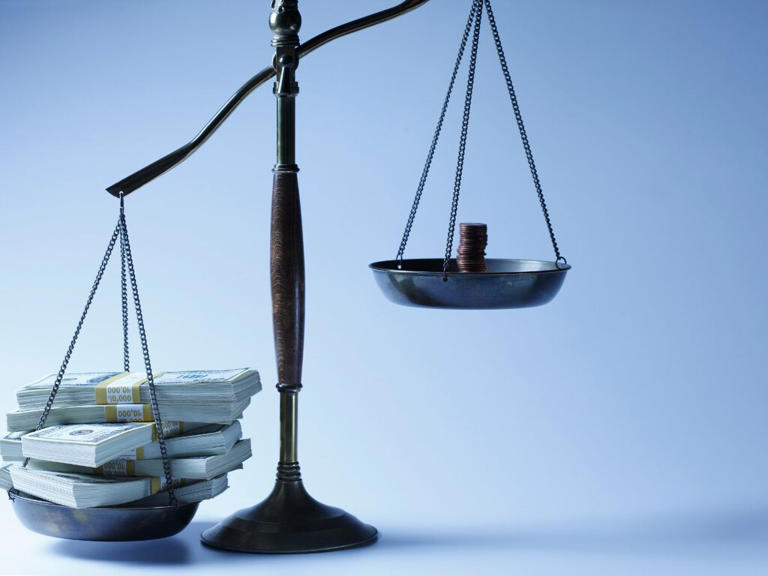
Mexico remains one of the most unequal countries in Latin America: the richest 10% hold 71% of all national wealth, according to the Global Inequality Report 2026. Although progress in the last decade has narrowed some gaps, the report itself notes that the progress has been “modest” and that inequality in the country remains at “extremely high” levels.
The report details that the top 10% of earners capture 59% of total income, while the poorest half of the country receives only 8%. Wealth inequality is even greater: the richest 1% owns 38% of total wealth. According to the study, between 2014 and 2024 the gap between the richest 10% and the poorest 50% narrowed from 111 to 76 times—progress, yes, but limited.
According to the study, wealth concentration is not unique to Mexico. Globally, 75 out of every 100 pesos of wealth are in the hands of the richest 10%, while the poorest possess barely 2%. The report emphasizes that inequality is a political choice, stemming from progressive tax systems, inadequate public policies, and economic structures that favor accumulation at the top.
National data confirms this disparity. According to INEGI (Mexico’s National Institute of Statistics and Geography), the average quarterly household income in 2024 was 81,920 pesos, although distribution is profoundly unequal across deciles.
Furthermore, CONEVAL (Mexico’s National Council for the Evaluation of Social Development Policy) underscores that the multidimensional poverty measurement reveals structural barriers to accessing basic rights: education, health, and decent housing. Although poverty has fluctuated over time, gaps in access to opportunities continue to disproportionately affect the lower half of the population.
According to a report by El País, income inequality in Mexico is barely decreasing; the richest 10% earn 14 times more than the poorest 10%. The 2024 National Survey of Household Income and Expenditure (ENIGH) shows that while the poorest families live on 16,795 pesos per quarter, the wealthiest households earn 236,095 pesos in the same period.
Furthermore, the gap between income deciles has narrowed very slowly, decreasing by about two percentage points every two years since 2016. However, between 2022 and 2024, this progress stalled, with a drop of only 0.91 percentage points. The gender gap also persists; men earn an average of 13,000 pesos more per quarter than women, and the impact of motherhood further widens this difference.
As we previously reported on Xataka Mexico, the top 1% of the Mexican population earns an average of 958,777 pesos per month, according to Oxfam and Indesig. In contrast, the poorest 10% survive on just 2,168 pesos per month: a difference of 442 times.
According to INEGI, between 2018 and 2024, the income of the poorest segment of the population grew by 29%. However, that same growth rate, applied to the wealthiest segment, translates into daily increases of more than 7,000 pesos, compared to only 16 pesos for the poorest households.
The report also warns of housing risks. The poorest 10% spend more than a third of their income just on rent, leaving little room for food or transportation.
Households headed by women face incomes less than half those earned by households headed by men in couples. And as we noted previously, the millionaire population continues to grow: it is estimated that by 2028 there will be more than 411,000 millionaires in the country.
Source: msn