
Approximately 1,168,000 people born in other countries live in Mexico, according to the 2020 Population and Housing Census, which is conducted every 10 years. The majority were born in countries in the Americas, with the United States being the primary country of origin, although there are also residents born in Europe, particularly Spain.
Breakdown by sex shows that among those born in Spain, Cuba, and Argentina, there is a higher proportion of men; while among those born in Colombia and Venezuela, women predominate.
Where do migrants living in Mexico reside?
According to the 2025 Mexico Migration and Remittances Yearbook, the foreign-born population living in Mexico (2020 Census) was concentrated in a few regions, with 37.1% residing in four states:
Baja California (152,000; 12.6%)
Mexico City (105,000; 8.6%)
Chihuahua (101,000; 8.4%)
Jalisco (92,000; 7.6%)
The yearbook’s map also highlights other areas of concentration: Tamaulipas (68,000; 5.6%), State of Mexico (63,000; 5.2%), Chiapas (60,000; 5.0%), Sonora (52,000; 4.3%), Nuevo León (50,000; 4.1%), Michoacán (47,000; 3.8%), Guanajuato (42,000; 3.5%), and Quintana Roo (40,000; 3.3%).
Where do they come from?
Besides the United States, with 797,000 people living in Mexico (representing 65.8% of the total), the following are among the nationalities from which the most migrants originate:
Americas (25.2%)
Guatemala, Venezuela, Colombia, Honduras, Cuba, El Salvador, Argentina, Brazil, Peru, Chile, Haiti, Nicaragua
Europe (5.0%)
Spain, France, Germany, Italy
Asia (2.5%)
China, Japan, South Korea
It is also noted that the U.S.-born population residing in Mexico is predominantly young (under 20 years old) and is mainly located in Baja California, Chihuahua, and Jalisco.
In Mexico, there has been a recent increase in foreigners from developed countries such as Canada and the United States, associated with the so-called “digital nomads.” Between 2020 and 2022, applications for permanent and temporary residency from Canadians increased from 2,442 to 5,961.
Digital nomads are people who use technology to work remotely, allowing them to travel and live in different places without being in a physical office.
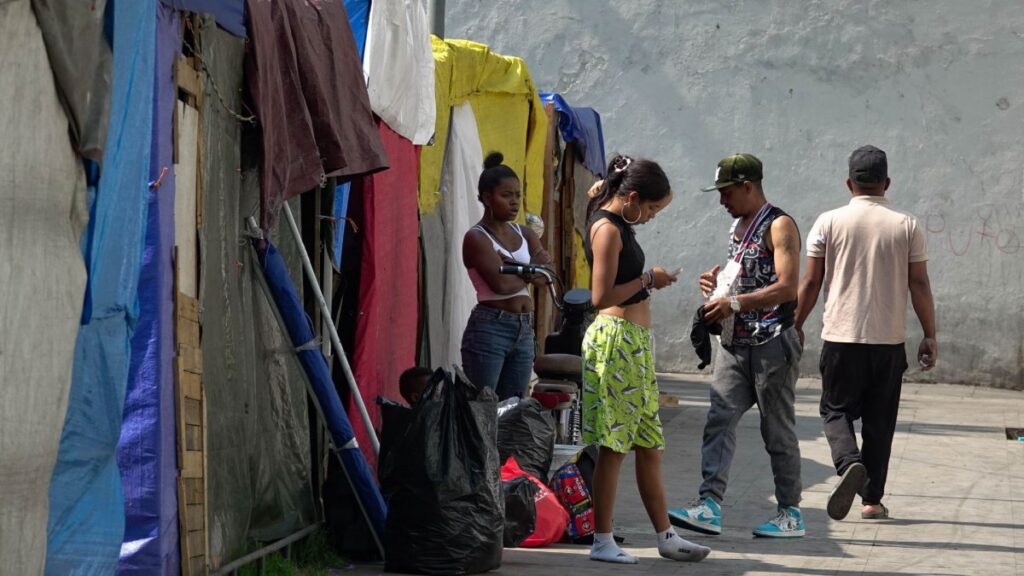
In 2023, the Mexican Commission for Refugee Assistance (COMAR) registered 140,982 asylum applications, an all-time high. In this context, UNHCR (United Nations High Commissioner for Refugees) has warned that the asylum system has become overwhelmed, with a high concentration of applications in the south of the country. Among the most represented nationalities were Haiti, Honduras, and Cuba, in addition to Guatemala, El Salvador, and Venezuela.
Furthermore, in 2024, Mexico remained among the 10 countries with the most asylum applications worldwide, with nearly 80,000 registered by COMAR, according to UNHCR data. The majority of applicants came from Honduras, Cuba, Haiti, El Salvador, and Venezuela.
For its part, UN Migration highlights that between January and May 2025, Mexican immigration authorities issued approximately 70,000 documents certifying legal residency in the country. This represents a 22% decrease compared to the same period the previous year.
What kind of work do migrants do in Mexico?
An information document from the International Labour Organization (ILO) dated August 2024 confirms that Mexico is a destination country for migrants—particularly those from the United States, Guatemala, and Honduras—and highlights that a significant portion of their labor market integration is concentrated in cross-border work dynamics along the southern border, especially in Chiapas, Tabasco, Campeche, and Quintana Roo.
In these states, the document explains that migration regulations for border workers have expanded the available sectors:
First, a scheme focused on agricultural activities in Chiapas (1997-2008).
Later, it was opened to any sector (2008-2011).
Since 2011, with the Border Worker Visitor Card (BWV), individuals with this document can access any employment for the duration of their immigration status.
The official figures cited indicate that in 2023 there were 6,633 migrant workers with BWVs. In 2019, the number was 9,997, followed by declines and a partial recovery by 2023.
The Mexican government reported in 2024 that since 2022 it had issued more than 17,500 temporary visas to people seeking international protection “to address the labor shortage,” and that it launched a pilot program with the Haitian Embassy, the IOM, and Tent Partnership to offer employment opportunities and work permits to Haitian migrants.
Source: unotv