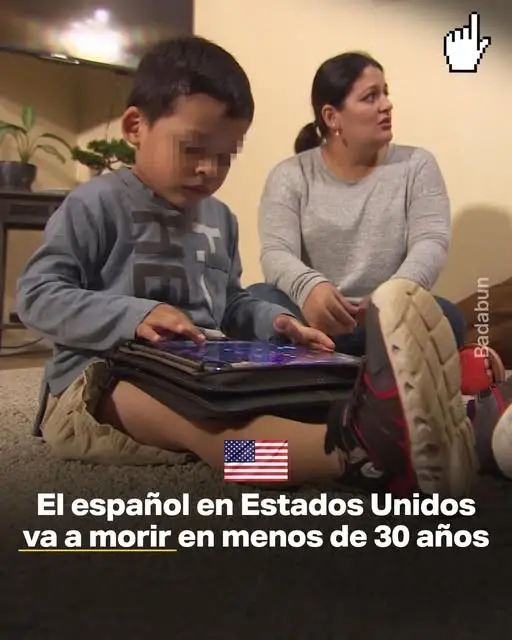

For years we lived with the idea that Spanish in the United States was guaranteed: more immigrants, more children, more Spanish. But today the landscape is changing rapidly, and almost no one wants to say it out loud.
Latino migration is no longer growing as it once did. In fact, it’s at one of its lowest points in decades. The United States is entering a different stage: more pro-natalist, more closed, betting on its own population having more children, and depending less and less on mass immigration. And when it does accept immigrants, they are often highly specialized profiles: engineers, scientists, professionals with decades of experience, mostly from Europe or Asia. Not necessarily young Latino families who bring the language with them.
But the most delicate issue doesn’t stem from policies, but from homes.
Many Latino parents in the United States—out of fear, social pressure, or a desire to “do the right thing”—prioritize that their children speak perfect English. And without realizing it, they leave Spanish out of the equation, out of the equation, out of daily life. There are children who feel Mexican, Salvadoran, or Latino… but they can’t hold a conversation in Spanish with their grandparents.
The language isn’t lost in one generation. It weakens.
In the next, it disappears.
A child who doesn’t speak Spanish at home will hardly pass it on to their children. And when those children grow up, there will no longer be Spanish in the homes of descendants of Mexicans, Central Americans, or South Americans. There will be identity, perhaps nostalgia, but not a living language.
That’s why some experts and cultural observers are beginning to talk about a horizon of 30 to 50 years where Spanish in the United States will cease to be an everyday language and become something symbolic, residual, almost decorative.
Not because Spanish is weak.
But because it’s not being cared for where it matters most: at home.
This is not a condemnation or an attack. It’s an invitation to reflect. The language isn’t defended with flags or speeches, but with daily conversations, bedtime stories, and dinner tables where people speak without fear. If Spanish is lost, it won’t be because of the United States.
It will be because of what we’ve unknowingly stopped teaching.

Source: badabun