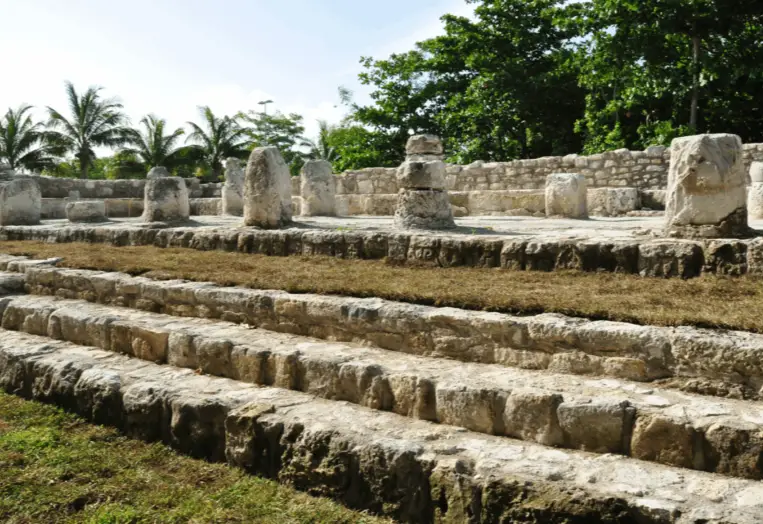

The San Miguelito archaeological zone preserves the remains of a Late Postclassic Maya port dating from 1200 to 1350 CE. Its architecture, burials, and trade networks reveal a history that is not visible from the beach. Furthermore, it is believed that during this period San Miguelito had ties to Tulum, Xcaret, and Xelhá because the architecture of all four sites is similar, belonging to the East Coast style.
San Miguelito was part of the ancient chiefdom of Ecab, a political and economic entity that controlled various coastal points in the Caribbean. Its location between the sea, the Nichupté Lagoon, and land routes made it a strategic point for fishing, salt production, the exchange of cotton, honey, copal, and tools, as well as for navigation to other Maya settlements.
The Museum as a Gateway
To reach San Miguelito, one must first pass through the Maya Museum of Cancún, which houses one of the most important archaeological collections in southeastern Mexico. The integration of the museum and the site is no accident. The artifacts found in the hotel zone, including sculptures, ceramics, and funerary offerings, have provided insights into daily life along this stretch of coastline, and the museum’s design complements the archaeological tour. The transition from the minimalist white building to the jungle trail creates a bridge between academic research and the original landscape of the Mayan city.
Why is it inside a museum?
When the National Institute of Anthropology and History decided to create the museum, it chose to integrate the archaeological zone within the complex to ensure its preservation and to connect visitors with the original landscape of the pre-Hispanic city. The museum opened in 2012 with a contemporary architectural design that avoids competing with the ruins and, at the same time, protects the site with walkways, gardens, and elevated, hurricane-resistant galleries.
This model transforms the visit into a complementary experience: the museum offers the historical context and the artifacts excavated in Quintana Roo, while the tour of San Miguelito allows visitors to see firsthand the place where that life unfolded. It is one of the few archaeological sites in Mexico where a museum and a pre-Hispanic city coexist seamlessly.
What to see at the museum and the San Miguelito archaeological site

The Maya Museum of Cancún has three galleries: two permanent and one exhibition hall, which houses collections from various sites on the peninsula: polychrome ceramics, sculptures, ritual objects, stone tools, and funerary offerings that showcase the cultural complexity of the Maya.
The archaeological tour winds through tropical vegetation. The site is divided into four architectural groups connected by a shaded path. The North Complex preserves the foundations of ancient dwellings and more than twenty burial sites. The Chaak Palace is notable for its original columns and the relief of the rain god on the staircase. The Dragon Complex contains remnants of a marine mural that suggests symbolic links with the coastal environment. The final section, the South Complex, houses the San Miguelito pyramid, whose orientation toward El Rey demonstrates the relationship between the two settlements.
Information for your visit to the San Miguelito Archaeological Zone

The museum and archaeological site are open Tuesday through Sunday from 9:00 a.m. to 6:00 p.m. Last entry to San Miguelito is at 4:30 p.m. General admission is $100 MXN and includes both areas. Students, teachers, children under 13, seniors, and visitors with disabilities receive free admission. Mexican citizens and residents with valid ID are admitted free on Sundays.
A complete visit takes between two and three hours. It is advisable to bring water, insect repellent, and comfortable shoes, as the walk is along natural trails. Arriving early allows you to enjoy the site in softer light and with fewer visitors.

How to get to the San Miguelito archaeological site
San Miguelito is located at kilometer 16.5 of Boulevard Kukulcán, in the Cancún Hotel Zone. From downtown, you can reach it by taking bus routes R1, R2, and R27, which travel along the entire Hotel Zone and stop near the site.

Source: mexicodesconocido