Despite having warned that he would only return to public life in the event of an attempted coup or political harassment against Mayor Claudia Sheinbaum, former President Andrés Manuel López Obrador reappeared to condemn the actions of US President Donald Trump and describe the capture of Nicolás Maduro in Venezuela as a kidnapping.
Because of this, the former president was heavily criticized on social media by members of the opposition, mainly from the National Action Party (PAN) and the Institutional Revolutionary Party (PRI), who reproached López Obrador for his support of the Nicolás Maduro regime and asserted that he is not retired, but rather living in fear and seclusion.
Thus, López Obrador emerged from his self-imposed retirement to take a stand following the US military intervention in Venezuela and the capture of President Nicolás Maduro. He addressed a direct message to US President Donald Trump, whom he accused of acting as a “global tyranny,” while maintaining that neither Simón Bolívar nor Abraham Lincoln would have accepted such an action.
Through his Twitter account, López Obrador described the military deployment ordered by Washington as an “arrogant attack” against the sovereignty of the Venezuelan people, and characterized Maduro’s arrest as a “kidnapping.”
“I am retired from politics, but my libertarian convictions prevent me from remaining silent. Neither Bolívar nor Lincoln would accept the United States government acting as a global tyranny,” the former president wrote in one of the harshest messages he has directed at the U.S. administration since leaving office.
In his statement, López Obrador called on Donald Trump “not to become complacent” and to act with “practical judgment,” warning that “today’s fleeting victory could be tomorrow’s resounding defeat.”
“Politics is not about imposition,” he emphasized, and unlike other instances where he closed his messages with a conciliatory tone, he concluded with an unusual phrase: “For now, I’m not sending him a hug.”
The former president reiterated his support for President Claudia Sheinbaum and echoed one of the emblematic phrases of Mexican foreign policy’s non-intervention: “Among individuals, as among nations, respect for the rights of others is peace, as Benito Juárez taught us in the 19th century.”
López Obrador’s reappearance contrasts sharply with what he himself stated in November 2015, when he presented his book, Grandeza (Greatness), and explained that his return to public life would only occur in the face of serious threats to the country or the President, such as “an attempted coup d’état or political harassment.”
He also affirmed that he would break his retirement in Palenque, Chiapas, if he detects actions that undermine the democratic system or the citizens’ right to freely choose.
Reactions from the opposition were swift. The PAN spokesperson, Jorge Triana, criticized the Obrador administration for now showing concern for international law, when—he asserted—during the previous six-year term, autonomous bodies were eliminated, the judiciary was taken over, the country was militarized, journalists were censored, and social protest was repressed.
Senator Lilly Téllez also lashed out at the former president, accusing him of returning to the public eye out of “fear,” and labeling him an “accomplice and partner of the narco-terrorist Nicolás Maduro.” On social media, she claimed that both “handed over sovereignty to cartels” and launched harsh personal attacks against former President López Obrador.
For his part, the national leader of the PRI, Alejandro Moreno Cárdenas, maintained that López Obrador “is not retired from politics, but rather in hiding and on the run,” and asserted that this is why he was denounced before international bodies.
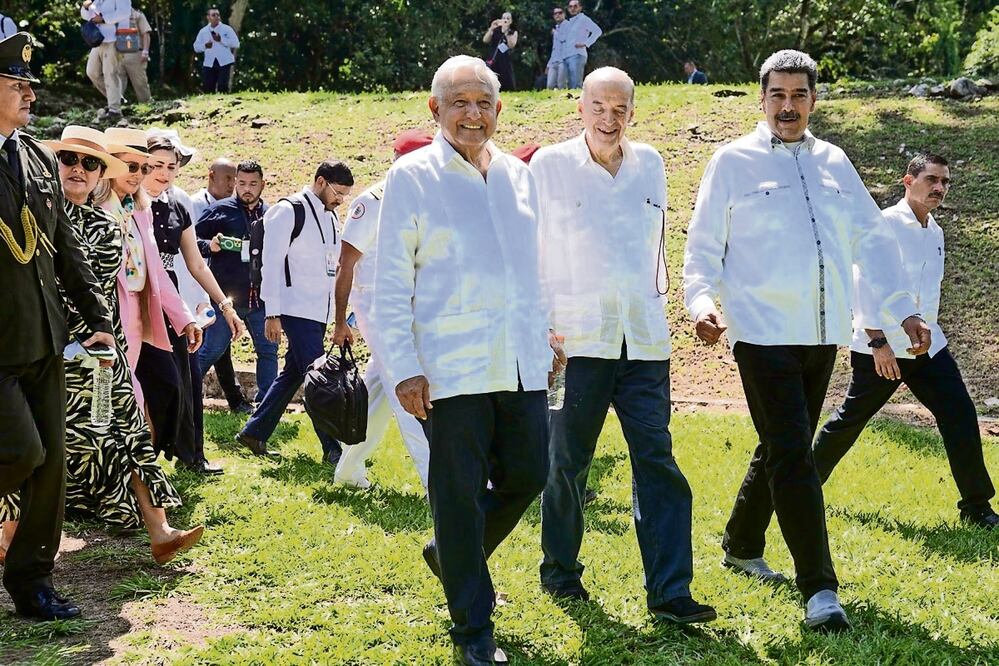
The relationship between López Obrador and the Venezuelan government strengthened during his six-year term. Nicolás Maduro visited Mexico on three occasions: on December 1, 2018, to attend the presidential inauguration; on September 17, 2021, during the VI CELAC Summit in Mexico City; and on October 22, 2023, in Chiapas, within the framework of the Meeting for a Fraternal Neighborhood with Well-being on migration.
Source: eluniversal