
Rubén Cortés explains how AMLO did business with Nicolás Maduro in violation of US sanctions, which is why he came to his defense on the day of the politician’s capture. Maduro now faces narcoterrorism charges in a New York federal court.
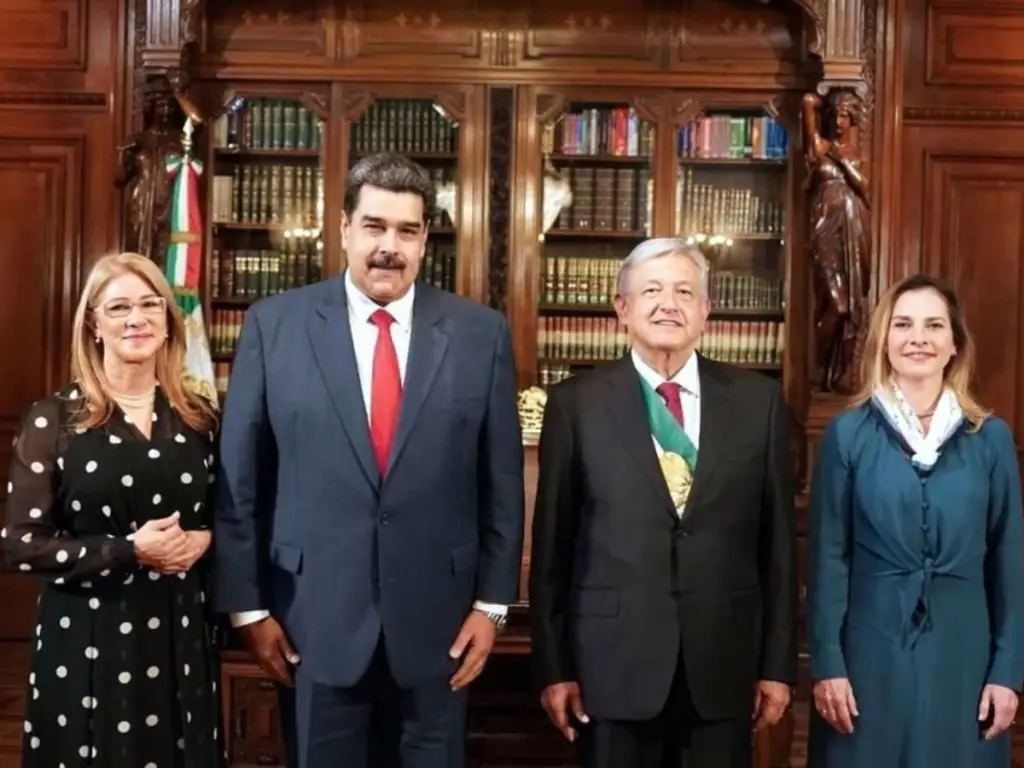
In his article titled “López Obrador and his friend Nicolás Maduro,” for his column Canela Fina, the political analyst recalls that AMLO’s presidential campaign “began the year Chavismo won, and they supported him until he won the 2018 elections. That’s why López Obrador reappeared to condemn the kidnapping of Nicolás Maduro.”
He also highlights that López Obrador even “defended Maduro before Sheinbaum,” despite having said that he would only come out of his “retirement” to defend Sheinbaum if she were harassed.
However, on the day of Maduro’s capture, he “reappeared to condemn the ‘arrogant attack on the sovereignty of the Venezuelan people and their president.’”
However, Rubén Cortés writes that “he said nothing about Trump’s verbal harassment of the president.”
“Now retired from politics, he condemns the ‘attack on the sovereignty of the Venezuelan people,’ but as president, he remained silent as a mummy when, in July 2024, Maduro stole the elections without presenting the voting records.”
In his column, Rubén Cortés points out that “Mexico” appears 19 times in the court file, and although Andrés Manuel López Obrador’s name does not appear in the public indictment against Maduro in New York, it will “come up in court: Maduro violated U.S. sanctions against him through the López Obrador administration.”
The columnist maintains that if Maduro was ever linked to Mexico, it was during López Obrador’s presidency, which is why he categorically asserts that “López Obrador did not reappear on Saturday for no reason” in defense of Maduro.
But how did AMLO do business with Maduro? Rubén Cortés points out that López Obrador classified the information about the embezzlement at Segalmex as secret because it was “through Segalmex that Maduro violated U.S. sanctions for seizing control of the electoral body, usurping the government, and committing crimes against humanity.”
In 2019 and 2020, Maduro bought $64 million worth of food from Segalmex to sell at inflated prices to Venezuelans through his social programs designed to buy votes, Cortés claims, adding that “he also smuggled tanker trucks, oil, and more.”
Thus, according to Cortés, “Segalmex and Maduro created a network that moved millions of dollars through ports, airports, and banks around the world with virtually no trace, evading the sanctions imposed by the United States on the Chavista dictatorship.”

Who was Segalmex’s contact in Caracas? The analyst indicates that it was Joaquín Leal Jiménez, a young man with no business background, “for whom the company Libre a Bordo was hastily created. This company negotiated directly with Venezuelans, who then smuggled Segalmex products to Iran.”
An investigation by the Spanish newspaper El País highlighted that the opaque network that traded Venezuelan oil operated with the help of the Mexican government. The article presents documents as evidence that Mexican authorities were key in the negotiations and instructed a state-owned company to facilitate the deals, which were disguised as humanitarian aid.
Now, Rubén Cortés points out that this is why Joaquín Leal was sanctioned by the U.S. Treasury Department, accused of leading a scheme to evade sanctions imposed by the U.S. government. Leal established the bases of his network in Mexico and Dubai.
That’s why he ironically says that everything López Obrador wrote about “neither Bolívar nor Lincoln would accept the United States government acting as a global tyranny” is ennobling, since it’s interpreted as a mockery after the alleged illicit business dealings he supposedly carried out with Maduro, because “the truth is different.”
What did the U.S. Treasury Department say about Joaquín Leal?
It’s important to remember that on June 18, 2020, a statement from the U.S. Treasury Department indicated that “since at least 2019, the illegitimate Maduro regime and PDVSA have cooperated with U.S.-designated Alex Nain Saab Moran (Saab) and Leal to evade U.S. sanctions and facilitate the sale of Venezuelan crude. One of Saab and Leal’s recent schemes to sell Venezuelan crude was presented as an oil-for-food program that never resulted in any food deliveries to Venezuela.”

Source: yucatan