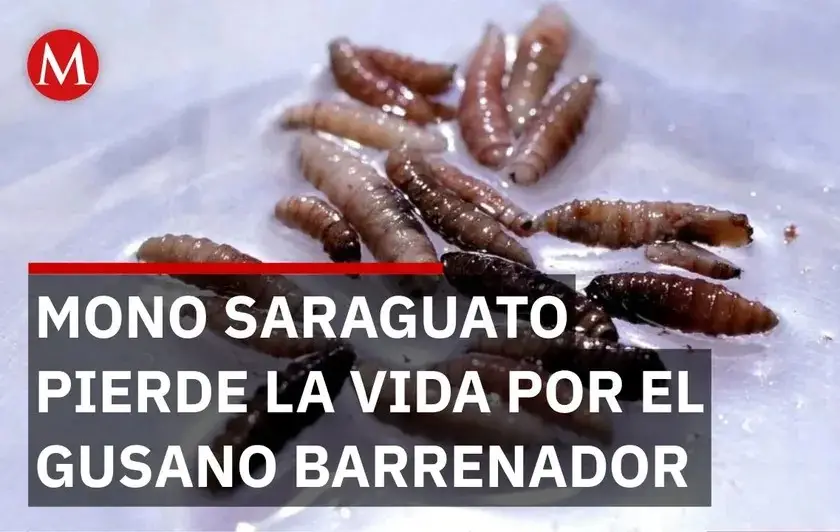

The Ministry of Environment and Natural Resources (Semarnat) confirmed that a mantled howler monkey (Alouatta palliata) died after being infested with the Cattle Screwworm (CSM) in Palenque, Chiapas.
As reported by MILENIO, the screwworm infestation has spread beyond the confinement of farm animals and is also affecting domestic animals, reaching wildlife such as the endangered howler monkey.
Oaxaca has registered 1,119 cases of screwworm infestation, remaining the second state with the most cases nationwide.
“The monkey, approximately 5 years old, died from its injuries. So far, no other members of the troop have been identified with myiasis; this is the only reported case in this species.” The Ministry of Environment and Natural Resources (Semarnat) reported that the case of the mantled howler monkey was reported on December 2, 2025, in Palenque, Chiapas; it is one of four cases of giant gall wasting (GBH) in wild animals reported by authorities.
“During observation of the animal in the wild, lesions with myiasis were detected on its left forelimb, so the National Service for Agrifood Health, Safety and Quality (Senasica) was notified for the identification of the larvae, which confirmed that it was a case of GBH.”
It is worth noting that the mantled howler monkey is a species highly vulnerable to local extinction; between May and June 2024, at least 287 mantled howler monkeys (Alouatta palliata mexicana) fell from trees, killed by extreme heat waves in the Chontalpa region of Tabasco. This event resulted in the loss of 21 percent of the mantled howler monkey population.
The howler monkey that inhabits this region is classified as “Endangered” on the International Union for Conservation of Nature (IUCN) Red List of Threatened Species due to severe habitat fragmentation caused by deforestation for agriculture and urban development. Following last year’s mortality event, the species was also included on the list of “The 25 Most Endangered Primates in the World.”
The analysis warns that the restricted distribution of the Mexican howler monkey in the remaining forests of southeastern Mexico and Guatemala further exacerbates its vulnerability, as it alters population dynamics and social structure, and increases susceptibility to disease and hunting.
The Ministry of Environment and Natural Resources (Semarnat) highlighted that, through the General Directorate of Wildlife (DGVS), it has strengthened preventive and outreach efforts in its state offices, including the distribution of informational flyers, brochures, and talks on the identification and treatment of myiasis.
The goal of this is to detect and promptly refer cases to Senasica (National Service for Agrifood Health, Safety and Quality). Training on this issue has also been provided to the National Guard, Civil Protection, and the Federal Attorney for Environmental Protection (Profepa).
As of January 7, the Ministry of Agriculture and Rural Development reports 13,335 accumulated cases of the Cattle Screwworm, of which 492 are active: 254 cases are in cattle and 163 in dogs. The myiasis caused by the infestation is currently affecting 25 pigs, 24 horses, 11 sheep, 9 goats, 3 cats, and two birds in 13 states across the country.
The majority of cases have been reported in Chiapas, Oaxaca, Veracruz, and Yucatán. States in the central region, such as the State of Mexico and Puebla, have also reported cases. In addition to San Luis Potosí in the north-central part of the country, and Tamaulipas in the far northeast of Mexico.
According to the most recent report from the health department, Chiapas has the highest number of accumulated cases with 5,408, and 96 active cases. Meanwhile, Veracruz has the highest number of active cases with 125, and a total of 1,963 accumulated cases.

Source: milenio