
Mexico’s economic and political reality reveals that, despite rhetoric and aspirations for independence, the country remains deeply tied to the U.S. economy.
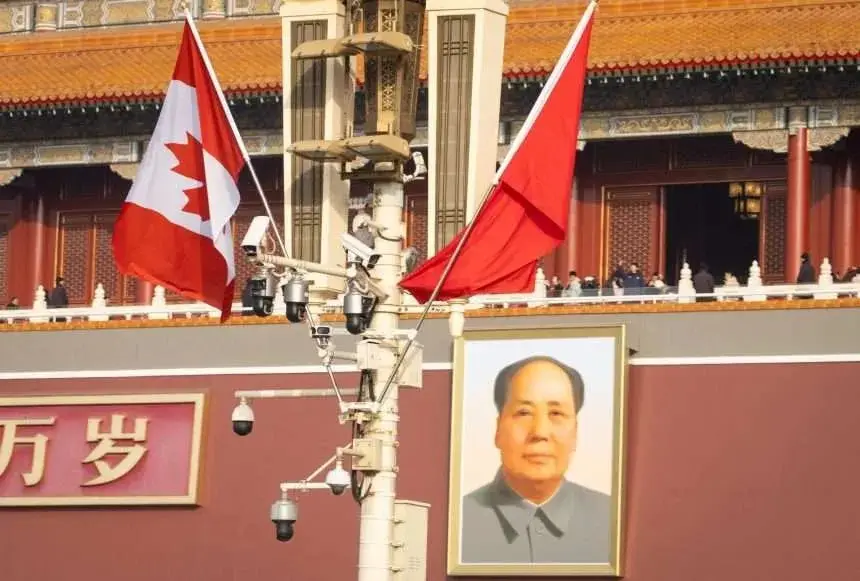
The global trend, as evidenced by Canada’s recent alliances with China, shows a shift toward diversification and the search for new trading partners.
However, in Mexico’s case, this strategy is not only unfeasible but also dangerous.
Trade with the United States represents more than 80% of Mexican exports, and the dependence on this market is so pronounced that any change in U.S. policy has a direct effect on the country’s economic stability.
Data indicates that Mexican imports from China have almost doubled in the last decade, reaching $62 billion by 2025, with intermediate goods that enhance the competitiveness of Mexican industry.
But this same vulnerability is reflected in exports, which reached a record $5.2 billion to China in 2022, primarily minerals, electronic circuits, and auto parts.
However, this diversification does not alter the reality: the Mexican economy is structurally designed to depend on the United States.
Canada’s proposal to reduce its dependence on the U.S. through agreements with China and other countries serves as an example that Mexico cannot afford to ignore, but it also reveals the complexity of doing so without losing stability and sovereignty.
The narrative of Mexican nationalism, a pantheon of myths, has fueled a perception of self-sufficiency for decades, which in reality has only served to reinforce dependence.
The idea that Mexico can become a middle power, like Canada, requires not only a sound economic strategy but also a profound cultural shift, one that blends Anglo-Saxon and Mexican influences to build a more autonomous identity.
However, in practice, the country remains a U.S. backyard, with an economy and politics that reflect this subordination.
While Canada seeks alliances with China to reduce its dependence, Mexico remains trapped in a system where economic sovereignty is increasingly becoming an illusion.
The stark reality is that, however painful it may be to accept, Mexico cannot detach itself from the United States without jeopardizing its stability, its jobs, and its very future.
This dependence is not only economic, but also cultural and political, and this reality, however much it is disguised, is one of the main barriers preventing Mexico from truly taking off without that shadow that, ultimately, shapes its destiny.

Source: elindependiente