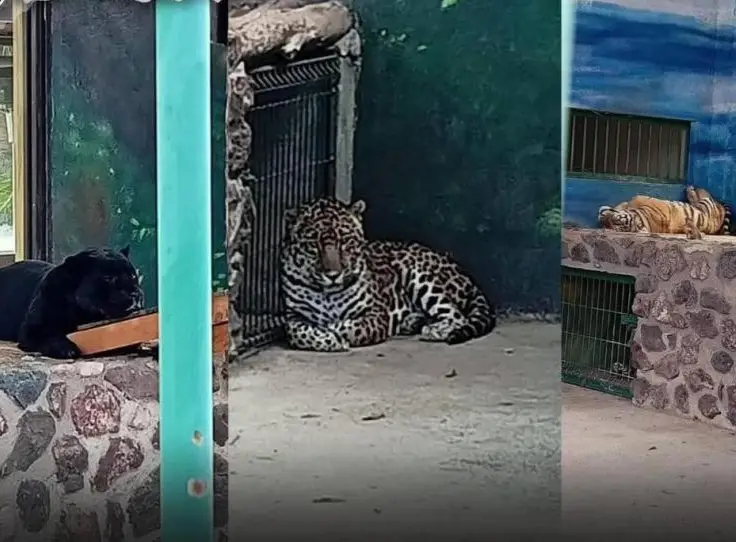

The Querétaro State Attorney General’s Office led a search warrant operation in the state capital, where they seized an arsenal and various specimens of exotic fauna in the Santa Rosa Jáuregui district.
The court-ordered search was carried out at a property linked to investigations into drug trafficking and other illicit activities in the northern part of the city of Querétaro. Agents from the Criminal Investigation Police (PID) entered the premises after obtaining a warrant from a judge, locating items that suggest the operation of criminal groups.
During the search, law enforcement officials found long and short firearms, as well as magazines and live ammunition of various calibers. In addition to the weapons, agents seized license plates, official documents with seals, and a banknote counting machine.
The property was placed under the custody of the Attorney General’s Office, while the physical evidence was added to the corresponding case file to determine if the weapons are related to other recent violent incidents in the state.
The operation was notable for the discovery of captive wild animals. Among the animals seized were:
Two tigers.
One black jaguar.
One spotted jaguar.
Ornamental birds (macaws and peacocks).
Smaller animals (a raccoon, horses, and dogs).
Specialists from the Animal Control Unit and federal environmental protection authorities went to the site to assess the animals’ health. The felines were transferred under security protocols to authorized wildlife sanctuaries for specialized care.
According to the Federal Penal Code, the trafficking, capture, possession, or transport of protected terrestrial wildlife species, whether endangered or protected by international treaties, constitutes a crime against biodiversity.
Article 420 stipulates that anyone who illegally possesses specimens of wildlife species considered endemic, threatened, or endangered will be sentenced to one to nine years in prison and fined the equivalent of three hundred to three thousand days’ wages.
In the case of large felines such as tigers and jaguars, the General Wildlife Law requires proof of legal origin through registration with the Ministry of Environment and Natural Resources (Semarnat).
Failure to provide these documents and keeping the animals in conditions that do not guarantee their well-being may result in additional administrative penalties and permanent confiscation.

Source: excelsior