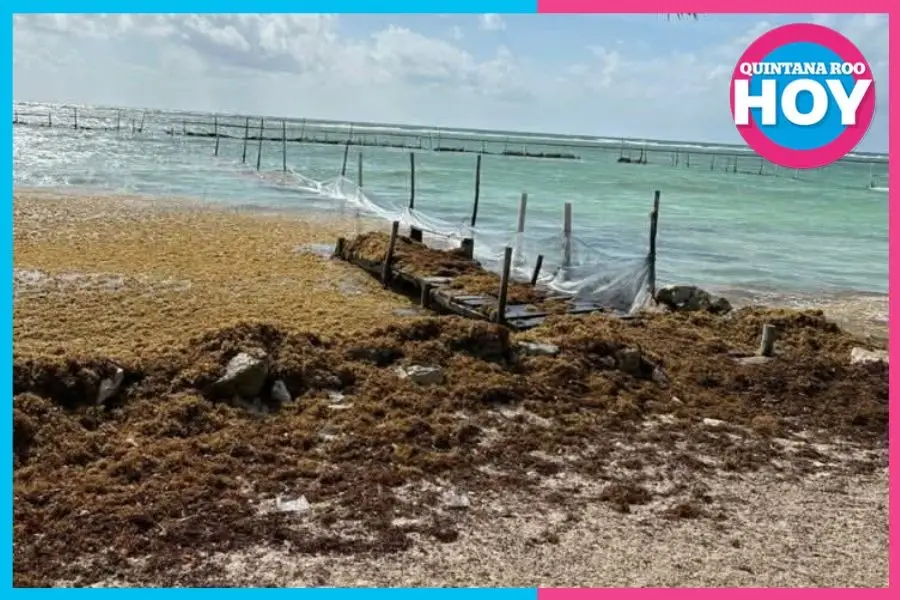

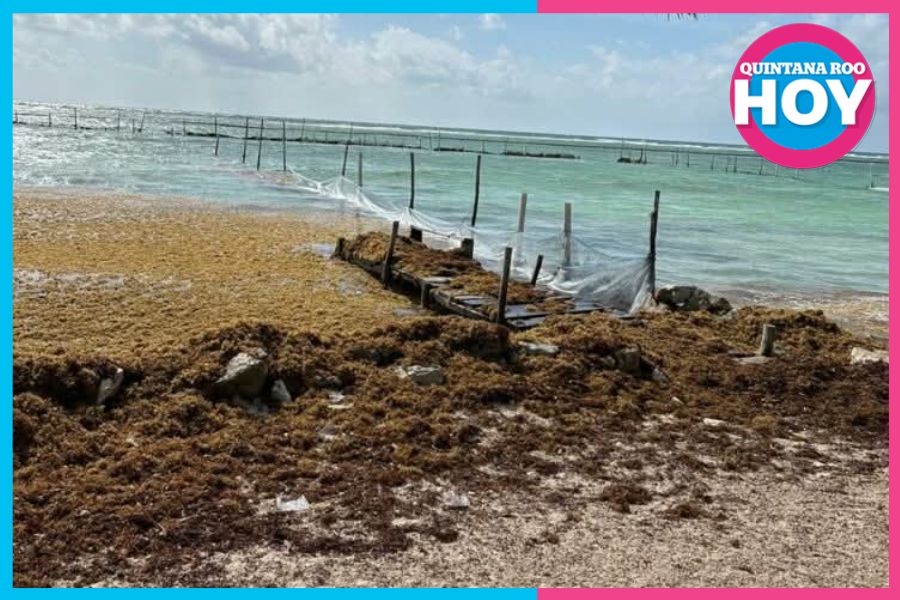
The massive arrival of sargassum seaweed on the coasts of Quintana Roo could be related to climate change, due to the alteration of ocean currents and wind patterns in the Atlantic.
This was stated by Óscar Rébora, Secretary of Ecology and Environment, who explained that these changes have allowed the macroalgae to reach the region in large quantities.
The official noted that previously, sargassum remained contained in specific areas of the Atlantic and did not reach the coasts of the Mexican Caribbean in significant amounts.
Massive arrival of sargassum and alteration of ocean currents
According to recent studies, climate change has fragmented the ocean currents that kept sargassum in the open sea.
This situation has favored the formation of the so-called sargassum belt, which is currently moving toward the coasts driven by winds and tides.
“Because of this situation, we believe we may see more frequent sargassum influxes, which are a consequence of climate change,” Rébora stated.
The secretary added that there are currently more than 60 million tons of biomass floating in the Atlantic Ocean.
He explained that the amount of sargassum that reaches land depends on factors such as wind, waves, and sea temperature.
Therefore, authorities are maintaining constant monitoring of the sargassum belt detected in the Atlantic.
For environmental context, general information on climate change can be consulted.
Containment Strategy and Impacts in Quintana Roo
Since the beginning of the atypical influx of the macroalgae, 1,500 tons of sargassum have been collected in Quintana Roo.
The efforts have been carried out in at least seven coastal municipalities of the state.
The greatest impact has been recorded in Playa del Carmen, Tulum, and Cancún.
Although the amount of sargassum in the Atlantic is considerable, the response strategy remains unchanged.
However, the action plan will be adjusted to expedite the deployment of barriers and containment points.
“The strategy remains the same: to contain the problem at sea and increase operational capacity,” the official stated.
These actions are being carried out in coordination with the municipalities and the Mexican Navy.
In addition, projects initiated in 2022 and 2023 are currently being consolidated.
The Mexican Navy is participating in maritime containment efforts.
Authorities reiterated that proactive preparation is key given the increasingly frequent shipwrecks.
Source: quintanaroohoy