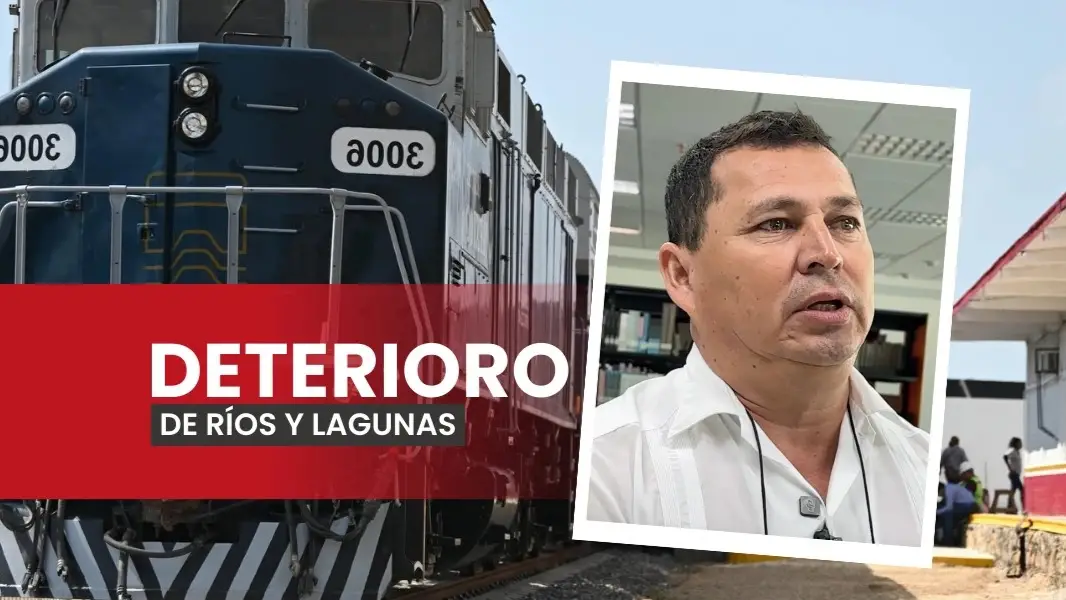

Construction, rehabilitation, and reactivation projects for trains in Chiapas have caused serious damage to biodiversity, according to experts in coastal research and geofacial analysis in the state.
“A lot of construction work has been done, like now with all the train work. Many bridges were modified, and there was a lot of heavy machinery involved. This damaged riverbanks and channels, and in these cases, groynes are necessary to complement the work,” he noted.
For researcher José Reyes Díaz Gallegos, modifications made to rivers, such as straightening them, contribute to accelerating erosion of riverbanks and channels, often causing irreversible damage.

“Yes, any type of intervention on a river, if not done with a prior study of the potential impact, can have many negative effects. Absolutely,” he stated.
The Interoceanic Railway’s Line K and the Maya Train are two projects developed in Chiapas that aim to improve connectivity in southeastern Mexico and enhance sectors such as production, tourism, and trade.
The Maya Train project promotes the exploration of Mayan culture, archaeological sites, and natural reserves in the states of Chiapas (Palenque), Yucatán, Campeche, Quintana Roo, and Tabasco.
Meanwhile, the Interoceanic Railway (Line K) is part of the Interoceanic Corridor that connects the Gulf of Mexico through the Isthmus of Tehuantepec. In the case of Chiapas, it links the Soconusco and Isthmus-Coast regions with the state of Oaxaca, thus fostering commercial development.
Researcher José Reyes Díaz Gallegos emphasized the importance of raising awareness about the effects of these types of projects, citing as examples the dredging and desilting work being carried out in the state’s lagoon systems, such as in Arriaga and Tonalá, where damage has been observed in the La Joya Buenavista lagoon, Puerto Arista, and Cabeza de Toro. He also mentioned the Chocohuital lagoon in Pijijiapan, and the Suchitepe and Lagartero rivers in Tapachula.
He noted that the deterioration of these lagoon systems has been observed there, with decreased water levels, soil erosion, and the disappearance of aquatic species, all of which impact local fishing activities.

Source: alertachiapas