
Chiapa de Corzo is an ideal place to relax in nature, enjoying delicious Mexican products and charming streets. It boasts must-see attractions like canyons where you can enjoy outdoor activities, refresh yourself with a refreshing pozol or tascalate, or take home a unique wooden or embroidered handicraft. So, take a look at everything it has to offer and make your visit worthwhile.
If there’s one thing that’s certain, it’s that Chiapas is one of the southeastern states with the greatest biodiversity and natural wealth, and among its various Pueblos Mágicos (Magical Towns), Chiapa de Corzo stands out for its diverse attractions.
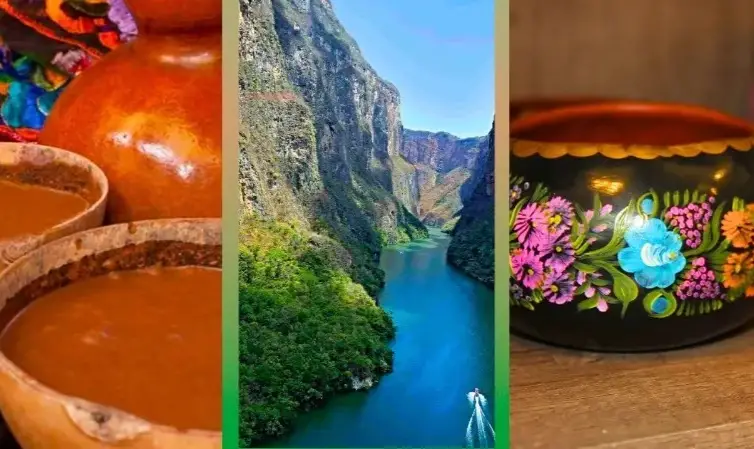
One of these is its stunning landscapes, featuring two canyons: the Sumidero Canyon, considered an amazing geological fault formed 36 million years ago! You can explore it by boat and fall in love with its flora and fauna, as it flows through the Grijalva River; and the Jaguar Canyon, where you can hike and rappel. It also boasts El Chorreadero Waterfall, where fig and fig trees surround a cascading waterfall and swimming pools—a truly memorable experience.
Likewise, it has an impressive artisan corridor with workshops where you can watch locals create their art of lacquerware, clothing, and wood carving, transforming them into jewelry boxes, furniture, chairs, tables, and more, all painted with flowers, dark tones, and pastels. This is also done at the Casa Escuela de Tradiciones (House School of Traditions), where they even teach embroidery techniques, hold lectures, and offer workshops.
And, of course, being Chiapas, you’ll find refreshing tascalate and pozol on every corner—traditional sweet corn-based drinks that you can enjoy however you like. You can also try other typical delicacies such as chipilín soup, baked pork, and pepita with tasajo (dried beef), all made with recipes passed down through generations.
“It’s a beautiful Magical Town considered one of the oldest settlements on the American continent, founded in March 1528. It was initially inhabited by Dominican friars and the indigenous people of the region, and was therefore called “Chiapa de los Indios” (Chiapa of the Indians). Its current name was given in honor of Don Ángel Albino Corzo, a prominent liberal politician from Chiapa de Corzo,” explained the Mexican government.
What else can you enjoy in Chiapas?
It’s not just the handicrafts, nature, or traditional drinks and dishes; Here, like in any small town, you can explore on foot, sample local delicacies, visit restaurants and shops selling beautiful products, and see the Church of San Sebastián, which played a role in the Mexican War of Independence, or the Church of Santo Domingo, built in the mid-1500s.
It also has a large park called La Pila, built in the 18th century, which has a similar feel to the Moorish Kiosk in Mexico City, but is older. If you enjoy museums, you’ll love the marimba museum, where you’ll learn how they’re made, their history, and how beautiful they sound—perfect for a dance.
And every January, they hold their iconic Fiesta Grande de Chiapa de Corzo, where you can witness traditional dances with colorful costumes and handcrafted masks.
How far is Chiapa de Corzo from Mexico City?
Being part of southeastern Mexico, the journey from Mexico City is quite long. By car, it can take more than 10 hours, and by bus, it can take 12 to 14 hours, whether you go through the Taxqueña bus terminal in southern Mexico City or the TAPO bus station, which drops you off in Tuxtla Gutiérrez. From there, you’d have to take another bus to Chiapa de Corzo, which can add even more time.
The ideal and fastest way is to fly, which takes about an hour and a half (yes, also to Tuxtla Gutiérrez), and then fly to this magical town. The cost is over 500 pesos per person, but it’s definitely a worthwhile trip, perfect for a long weekend or a free week.
Head to the magical town of Chiapa de Corzo and be sure to visit and try everything it has to offer: handicrafts, traditional drinks, dishes, and nature. It’s a must-see in Chiapas, along with its surroundings.
Source: guacamole.radioformula