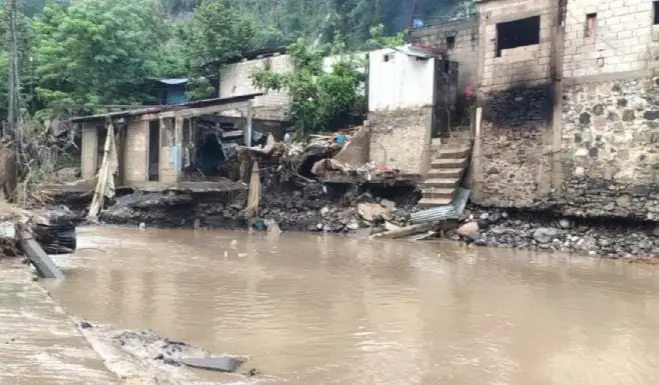

Three months after Tropical Storm 90-E devastated 28 municipalities in Hidalgo, and with a census of 2,650 homes destroyed, damaged, or located in high-risk areas, the state government expects to begin the first relocation of families to a one-hectare plot of land in San Bartolo Tutotepec. There, in conjunction with the federal government, they plan to build the first 55 to 100 houses.
The overflowing rivers, floods, and the collapse of natural and infrastructure resources also left 384 communities isolated and 22 people dead.
The victims, in turn, are requesting government support to recover, as the losses also affected agriculture, employment, and property. They are also requesting an accurate census that truly includes those most affected and is not limited to municipal capitals, but reaches the communities where the greatest devastation occurred.
Governor Julio Menchaca Salazar acknowledged that some residents report not having been included in the census of those affected by the disaster and, therefore, are not eligible for reconstruction aid. However, he mentioned that this census was conducted by the federal Ministry of Welfare, which is responsible for collecting data for social assistance to those impacted by the hydrometeorological event.
“The aid has already been physically delivered, all the studies have been completed (…) and between 55 and 100 homes will be relocated; progress is being made on the plan, and meetings will be held with local assemblies to establish certain rules. One of these rules is to ensure awareness of not rebuilding in areas where damage occurred,” the governor stated in an interview following the inauguration of the State Robotics and STEM Skills Tournament, Girl Powered Mexico 2025-2026.
He mentioned that, with personnel from the Ministry of Agrarian, Territorial and Urban Development (Sedatu), the State Civil Protection Undersecretariat, the local Housing Commission, and the State Public Infrastructure Secretariat, they have also identified high-risk areas where, “although damage was caused, with some mitigation work, it could be rebuilt; for example, with a retaining wall.”
“For several reasons: one is the cost of the land, but another is that it can be resolved right there, simply by reinforcing it with some measures,” he added.
According to the governor, the state census, endorsed by Sedatu, lists 2,650 homes, although he mentioned that “some municipalities are still being reviewed, because there is a kind of reconfirmation process underway in all areas.” He also acknowledged that, while some families continue to live with relatives, others are trying to rebuild their lives in the damaged areas out of necessity.
“Most are living elsewhere, with relatives, because there is a risk, and people know they are at risk. We also know that some are using the damaged areas out of necessity, but at a high risk,” Menchaca explained, while mentioning that the cold fronts that have impacted the state in recent days are causing rain and strong winds, and that among the 2,650 homes registered as damaged, “some are very badly affected” where the danger is even greater.
The governor said that “in many cases” the affected people will have a house “better than the one they had before” and pledged to expedite the work of locating land and starting construction.
The property located in San Bartolo Tutotepec, a municipality in the Otomí-Tepehua Sierra and one of the hardest hit, is state property and, according to the state’s chief executive, was approved by Sedatu for urban development. He did not mention the criteria by which priority will be given to which families receive housing first, other alternative locations, and the estimated times for this and subsequent construction projects, although he stated that the goal is to be able to carry out the changes of address for all those affected this year.

Source: proceso