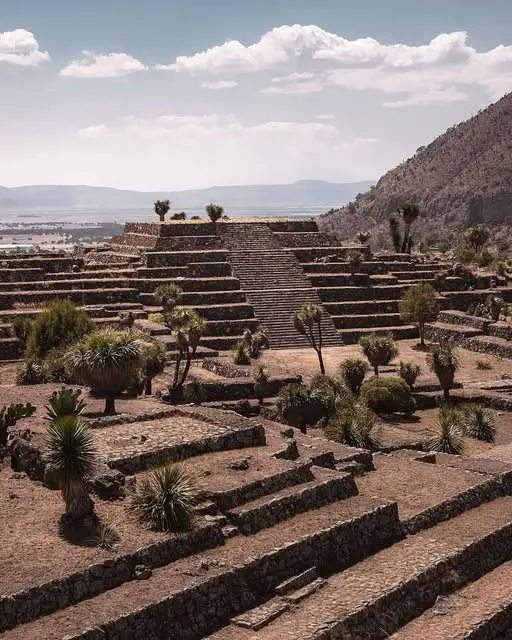

It’s called Cantona, and it’s probably the strangest and most fascinating archaeological site in all of Mexico. Unlike other ancient cities, not a single drop of cement was used here; it’s a monumental city built “dry,” where each basalt stone is held in place by sheer precision and gravity.
What makes it an enigma is its labyrinthine design. The city boasts more than 500 paved causeways and thousands of walls that formed enclosed passageways. If you didn’t live there, it was practically impossible to move around without getting trapped in a dead end—a unique military defense strategy in Mesoamerica.
Its inhabitants are known simply as Cantonians. They were a multiethnic group, so powerful that they became the commercial rivals of the great Teotihuacan, as they controlled the largest obsidian network in the region.
It’s impressive to know that at its peak, 90,000 people lived here, and it had 27 ballcourts, the most found at any archaeological site. It was a capital city almost entirely dedicated to this ritual. 🏟️
However, around 1050 AD, this stone fortress was completely abandoned. It is believed that a drastic climate change desertified the area, forcing thousands of people to leave their temples and walls behind, disappearing into history without a trace of where they went.
Today, walking through its black stone streets is like stepping into a dimension where time has stood still. It is a place that emanates a raw and mysterious energy, perfect for those seeking to understand what life was like in a true pre-Hispanic fortress. 🧐
📍 Cantona Archaeological Zone, Puebla.

Source: sabiasque