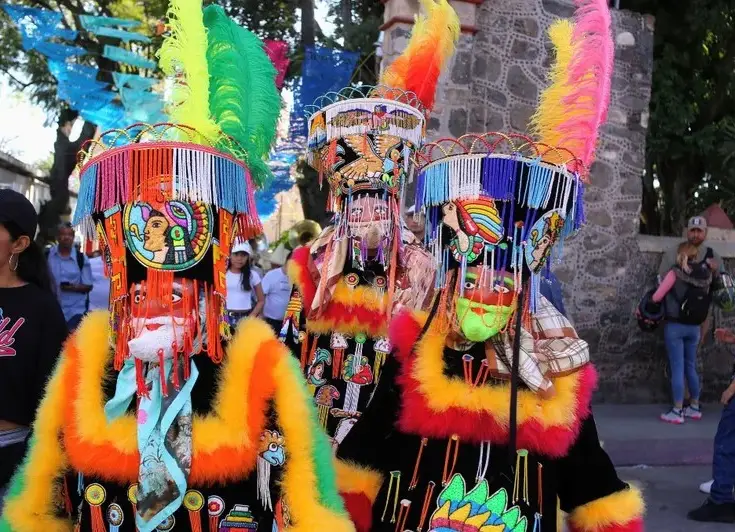

The Tepoztlán Carnival, one of the most emblematic celebrations in the state of Morelos, is preparing for another edition, promising to fill the streets of this magical town with music, dance, and joy, as it does every February or March, depending on the Catholic calendar.
Year after year, the festival attracts hundreds of local, national, and international tourists who come to enjoy everything from the parade of dance troupes to the rituals that evoke ancestral traditions. We’ll tell you all the details about this celebration.
This year, the Tepoztlán Carnival will take place from February 14th to 17th. During these days, the dance troupes will gather to dance to the rhythm of the “chinelo jump,” the heart and soul of this celebration.
The chinelo tradition in Morelos originated as a way of mocking the Spanish landowners during the festivities. It is said that when the landowners celebrated, the workers wanted to join in too, but they weren’t allowed to. So they devised a way to avoid being recognized by the foremen.
To do this, they used masks and old clothes to conceal their identities, playing flutes and drums to imitate the landowners’ music. Over time, this evolved into the brass bands that now accompany carnivals and festivities.
While in Tlayacapan—the birthplace of this tradition—the costumes are simpler, with two-tone tunics and short hats, in Yautepec they are known for being colorful, adorned with beads and hats decorated with ostrich feathers.
Meanwhile, in Tepoztlán, the costumes are primarily black with white embellishments and embroidered or painted figures. Beads, feathers, and sequins are prominent.
The Tepoztlán Carnival begins four days before Ash Wednesday, meaning it must always be held on a Saturday and end on Tuesday. This year, Lent begins on February 18th, the date that officially marks the start of the period of spiritual preparation for Easter.
Four troupes participate—Anáhuac (represented by a toad), Unión y Paz (a lizard), Santa Cruz (a ring-tailed cat), and América Central (an ant). Each is made up of musicians and residents of the neighborhood who dress up in costumes.
At the beginning of the carnival days, each troupe gathers at its respective church, where, with fireworks, they announce the arrival of the four days of festivities.
Saturday is dedicated to children, who are the only ones allowed to enter the main square to witness the traditional jump. Meanwhile, the festivities officially begin on Sunday with the unveiling of hand-painted banners depicting local themes or satirical takes on the current municipal administration.
The groups of revelers parade to the main square, alternating their order of entry and waving their banners adorned with confetti and blowing trumpets. They typically remain in the square from 5:00 p.m. to 9:00 p.m.
A fair is also set up, offering local cuisine, sweets, games, and crafts for visitors to browse and enjoy.

Source: milenio