
-American was driving a Malibu when he disappeared
-Gas bills nearly 50 percent more expensive
Advertisement
-Anti-Corruption System is eyeing the Attorney General’s Office suspiciously
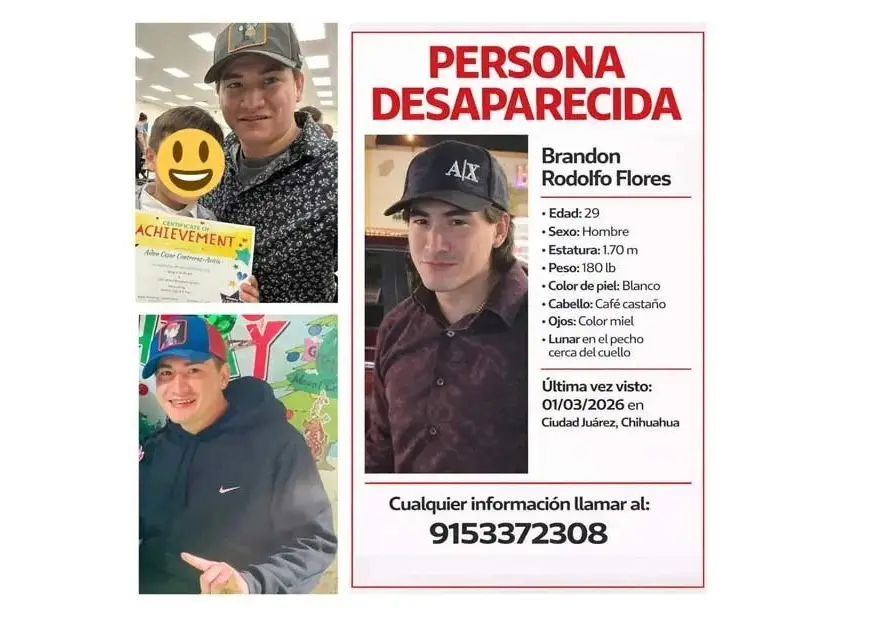
Amid the ever-high statistics of disappearances on the border is the case of Brandon Rodolfo Flores, an American born in El Paso, Texas, but with a home in the Altavista neighborhood of Juárez, from where he lost all contact with his family in early January.
Since then, there have been no calls, messages, phone use, or any verifiable trace of his whereabouts, according to a report filed last week with the Northern Zone Prosecutor’s Office, where a preliminary investigation suggests that his disappearance was not voluntary.
Advertisement
The official response from U.S. authorities, they say, was that there is no evidence of a crime or risk, but on this side of the river, they know the reality is different.
In the United States, his family was told they could not file a formal report because Brandon is an adult and has the right to disappear. The investigation was opened here, but it is awaiting further information from the authorities in the neighboring country, because Brandon is a U.S. citizen and a report must first be filed in his country.
The case is now in this binational limbo, but according to the report from which we obtained essential information, Brandon’s disappearance presents clear red flags: strange social media posts, phones turned off, previous conflicts with third parties, and an abrupt breakdown in all communication.
According to family members, Brandon did not do this kind of thing, and on his last visit to Juárez, they knew he was driving a Chevrolet Malibu with Texas license plates (the image of the vehicle is from the digital version of La Columna).
His last communication was on January 3rd, when he responded to text messages. Subsequently, on January 13th, activity appeared on a Facebook profile whose authenticity the family has been unable to confirm, as it contains strange photos and messages.
Sensitive information was shared on that profile, including bank account details, alleged income, and the change of beneficiary on a life insurance policy to his ex-wife, with whom he no longer lived. After these posts, no further activity on social media or direct communication was recorded.
The matter appears to go beyond possible personal conflicts of the 29-year-old man, judging by the initial information that has come to light, leading some to suspect something more serious than the disappearance itself.
These past few days, gas bills for January 2026 consumption have begun to arrive. We want to confess to our readers that we were wrong to warn them that they would include an approximate 20 percent increase.
Yes, we were substantially wrong: the increases are not 20 percent, but rather an average of 48 percent. The price per cubic meter has jumped from 3.16 pesos to 4.67 pesos, significantly higher than our initial estimate.
The 48 percent increase in the cost of natural gas is already reflected in the bills arriving at Juarez homes, further straining family budgets in a context where other basic services and products have also become more expensive. It’s the January and February financial strain.
This is not a minor or marginal adjustment: it’s a direct hit to the wallet, especially during the cold season, when consumption increases and alternatives are limited.
This type of increase once again highlights the vulnerability of border cities to external energy price shocks and the lack of local mitigation policies.
While natural gas is key for domestic consumption and productive activity, end users are exposed to abrupt variations without clear information or buffering mechanisms.
For now, all that’s left is to grin and bear the increase and open the curtains to let in the sunshine and, as much as possible, avoid using space heaters or radiators. The cost is exorbitant.
The State Auditor, Héctor Acosta Félix, participated over the weekend in the first ordinary session of the Coordinating Committee of the State Anti-Corruption System (CC-SEA), which meets regularly to address the common agenda involving all its member institutions.
Also in attendance were Roberto Fierro, Secretary of Public Administration; Sergio Facio, President Commissioner of the Transparency Institute; Francisco Acosta, Presiding Magistrate of the Judicial Disciplinary Tribunal; Abelardo Valenzuela, Anti-Corruption Prosecutor; Alejandro Tavares, Presiding Magistrate of the Administrative Justice Tribunal; and Jesús Abdalá Yépez, President of the Citizen Participation Committee.

Source: diario