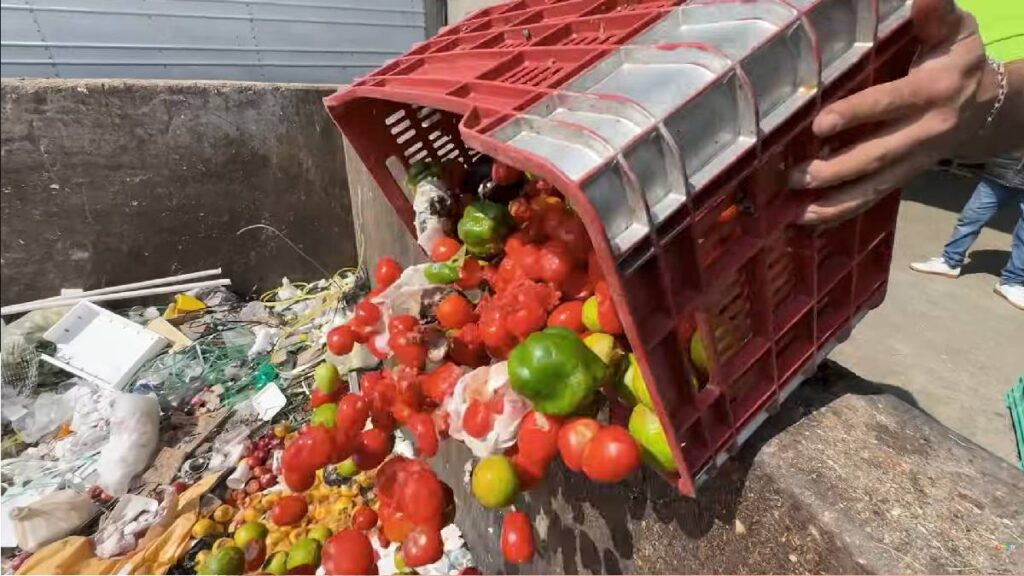
Mexico is among the countries with the highest rates of food waste, according to data from the World Bank and estimates from the Food and Agriculture Organization of the United Nations (FAO). In Mexico, a significant portion of basic food products goes unconsumed, generating economic and environmental impacts.
According to the World Bank’s 2013 report, “Food Losses and Waste in Mexico,” 28.7% of tortillas, 43.1% of white bread, 35.4% of beef, 37.2% of rice, 38.7% of fish, 48.7% of shrimp, 43.1% of milk, and 40.2% of pork are wasted each year.
These figures place Mexico among the nations with the highest levels of food waste, despite having the second largest food bank in the world, explained Luis Fernando González Martínez, an academic at the University Coordination for Sustainability (COUS) of the National Autonomous University of Mexico (UNAM).
The researcher pointed out that there is a difference between food loss and food waste. Loss occurs from harvest until the products reach store shelves. Waste happens in warehouses, stores, and homes, when food is already available for consumption.
From an economic perspective, waste represents wasted resources. Globally, around 30% of food is lost or wasted each year, according to international estimates cited by the academic.
Data from the FAO indicates that 14% of food is lost between harvest and distribution, with a value of nearly 400 billion dollars. Another 17% is wasted during distribution and among final consumers.
González Martínez warned that if all the world’s food waste were concentrated in one place, it would cover an area the size of a country and become the third largest emitter of greenhouse gases.
During decomposition, food generates methane, a gas with a greater polluting potential than carbon dioxide (CO2). These emissions contribute to global warming and are linked to phenomena such as droughts, heavy rainfall, and extreme temperatures.
The World Bank estimates that food waste generates approximately 36 million tons of CO2 each year, an amount comparable to the emissions of nearly 16 million cars. In terms of volume, the equivalent of four truckloads of food would be wasted every minute.
The UNAM academic pointed out that one of the first steps is to better plan food consumption, such as calculating portions according to the number of people. This practice helps reduce waste in households.
He also mentioned the circular economy as an alternative for reusing products, in addition to properly storing food to extend its shelf life. Buying seasonal fruits and vegetables, using leftovers for new meals, and separating organic waste for compost are all part of these practices.
Finally, she indicated that purchasing local products can reduce costs, support small producers, and decrease losses associated with transportation and intermediaries.
Source: unotv