

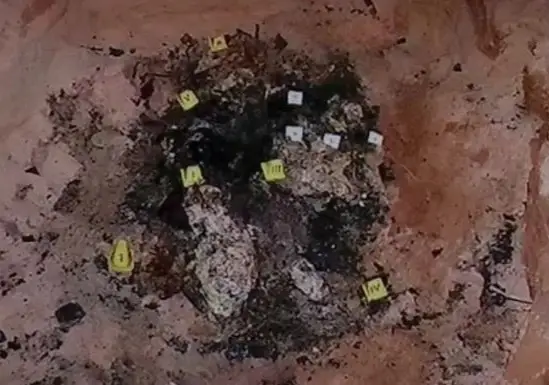

One month after the initial discoveries, the number of clandestine graves and 28 remains found at different locations in the Miguel Alemán neighborhood nature reserve in Mexicali, Baja California, has reached 14.
This count was released by groups representing families of missing persons, such as Madres Unidas and Fuertes Oficial, following work carried out at the site by the civil association Pro Natura Noroeste, where an Interdisciplinary Forensic Group is currently present.
On Friday, February 6, the discovery of grave number 14 and the remains of at least three victims was announced, according to local media reports.
According to general information, they found what appeared to be three torsos, bone fragments, handcuffs, and even the remains of an office chair, as well as aluminum foil, cans, and a large quantity of burnt wood.
Of the six people identified after reviewing genetic data, the Baja California State Attorney General’s Office (FGE) has now announced that the number has risen to 17, following the review of DNA samples.
Of this group, nine have been identified and four released to their families, according to the information released. Authorities have clarified that the burning of the bodies complicates obtaining positive test results.
The alert regarding the presence of remains began on January 8 of this year, prompting a mobilization of searchers to the site; later, personnel from the Attorney General’s Office joined the search efforts.
Aleida Limón Sánchez, mother of Josué Romo, who disappeared on February 3, 2022, believes her son could be among the remains found. She urged authorities to identify the findings as soon as possible, also pointing out that they are limiting the access of members of search groups.
“It’s extremely urgent: the searches must continue. They’re limiting it to two people per group. That’s why I haven’t been able to physically go to the Miguel Alemán site. There are more people who want to join the searches, and they’re not being allowed to. They’re restricting access,” she told the news outlet Cree en la Noticia.
Limón Sánchez pointed out that the searchers lack resources for gasoline, transportation, and food, even though they are doing the work that the Attorney General’s Office (FGE) should be doing.
“Knowing that there are millions of dollars allocated to the search that we don’t know where they are, once again they’re making us doubt their work. We feel that they’re still protecting us, that they don’t want to recover bodies. They don’t want us to find our missing loved ones,” the mother of a searcher expressed.

Source: proceso


