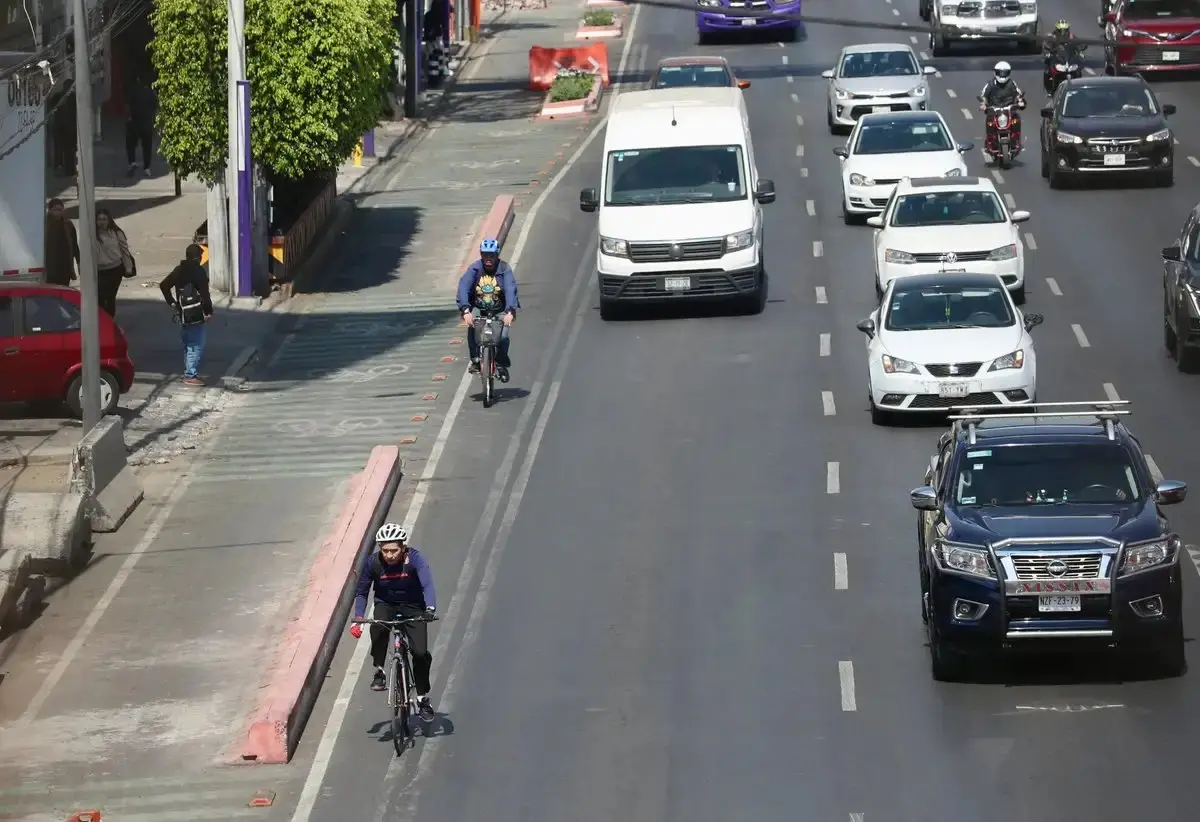

The Traffic Regulations do not include penalties or fines for cyclists who violate the rules, so authorities lack a record of infractions, even though they routinely invade lanes and ride on sidewalks in various parts of the city.
In response, Isaac Deneb Castañeda, executive director of the National Alliance for Road Safety, stated that the guidelines “have many areas for improvement” in this regard because, he said, although cycling is prohibited in center lanes or on expressways, doing so does not result in specific penalties.
During surveys conducted on Calzada de Tlalpan, Eje Central Lázaro Cárdenas, and Viaducto, it was observed that cyclists engage in these practices with the excuse of “saving time,” even without traffic congestion; furthermore, they leave their bikes parked in pedestrian areas, which pedestrians must navigate around. Those who ride on sidewalks also sometimes do so at high speeds.
They Ride Without Protection
In the streets of the Historic Center, it was observed that some bicycles are being used to transport more than one person, with a passenger standing on the back without any protective gear such as helmets or knee pads, which are not stipulated as mandatory in the regulations.
Castañeda stated that the verbal warnings given to those who violate the rule “have a minimal effect on this population,” and therefore proposed practical measures to address the problem. The first involves physical infrastructure, through the installation of clear signage at access points where cycling is prohibited. The second focuses on training the officers of the Undersecretariat of Transit and establishing a protocol to guide their interventions.
He even indicated that devices and actions similar to breathalyzer checkpoints could be implemented to remove cyclists from prohibited areas, not with a punitive approach, but with an educational and restrictive focus.
Likewise, strengthening institutional communication between agencies is crucial, as both the Secretariats of Mobility and Citizen Security must take a more active role and clearly communicate the prohibitions, since without leadership to communicate these rules, “people don’t find out.”
He mentioned that improving inter-institutional coordination is also essential, as is establishing a registry to measure lane encroachment by tracking the percentage of people improperly occupying them. He stated that agencies like the SSC (Secretariat of Citizen Security) have the technological tools for this, with radar and nearly 200,000 cameras distributed throughout the city, which could be used to conduct a census.
He emphasized that an important aspect is that the regulations do not include as an aggravating circumstance the fact that a cyclist causes an accident while riding in a prohibited lane, and therefore he considered it necessary to incorporate a legal provision that specifically addresses this.

Source: jornada