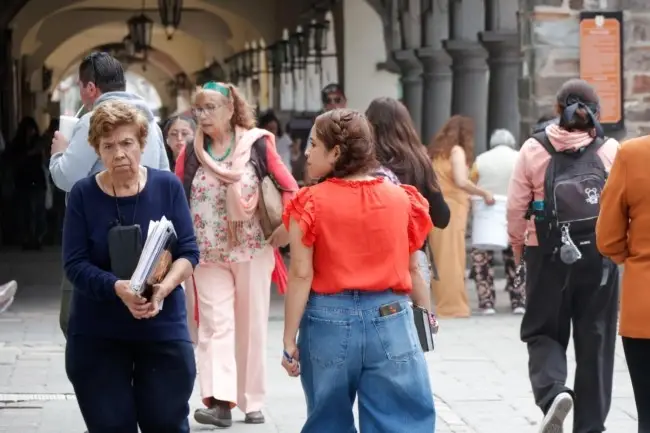

In Puebla, living in the city as a woman is an experience marked by violence that is not exceptional, but structural. This is not a rhetorical statement: it is based on data. According to the National Survey on the Dynamics of Household Relationships (ENDIREH, INEGI, 2021), 70.8% of women aged 15 and over in the state of Puebla have suffered some type of violence in their lifetime, a figure that is directly related, in daily life, to the use of public space and urban mobility.
For its part, the National Survey of Urban Public Security (ENSU, INEGI, 2025) indicates that almost three out of ten women in the state capital have experienced harassment or sexual violence in public or digital spaces, while, at the national level, 96% of women who use public transportation have suffered some type of harassment or violence. These data reveal that fear is not an isolated perception, but a central factor in how women inhabit and move through the city.
Violence against women is not a problem of individual behavior, but a persistent failure of public policies, urban design, and planning that has not been inclusive. Unsafe public transportation—with long routes designed according to the logic of the male “home-to-work” commute—poorly maintained sidewalks, inadequate lighting, and physical barriers that pose risks, especially for women, are compounded by social permissiveness toward street harassment. Thus, walking ceases to be a choice and becomes a forced act.
Another less visible variable of the gendered urban experience is that of the women who sustain entire neighborhoods, districts, and peripheries. According to the National Time Use Survey (ENUT, INEGI, 2024), women in Puebla dedicate an average of almost 42 hours per week to unpaid work—domestic activities, caregiving, and community support—while men dedicate just over 18 hours to the same tasks. This represents a gap of almost 24 hours per week without pay or formal recognition, which increases the economic vulnerability of women in Puebla.
According to the 2022 Satellite Account of Unpaid Household Work in Mexico (INEGI), domestic and care work in Puebla is equivalent to 30.6% of the state’s Gross Domestic Product (GDP), a proportion higher than the national average (24.3%). The value generated by unpaid work in Mexico exceeds that of sectors such as manufacturing, commerce, or educational services. This demonstrates that caregiving activities are a fundamental economic pillar for life in our cities.
Informal work in Puebla does not affect men and women equally. The National Survey of Occupation and Employment (ENOE, INEGI, 2025) indicates that, in the third quarter of last year, 70.2% of the employed population in the state (2.2 million people) worked in informal and precarious conditions, meaning without a contract or social security. The ENOE also indicates that women account for the largest increase in informal employment: between 2024 and 2025, almost one million women joined this sector.
High levels of informality limit access to labor rights, housing, and healthcare, and reflect the need to balance paid work with caregiving responsibilities, which pushes many women into precarious jobs.
This March 8th, many of us will take to the streets to exercise our right to protest in public spaces for these and many other reasons. Those of us who work at the Citizen Urban and Environmental Observatory for the State of Puebla will be there.

Source: leviatan