
As part of the first panel of the “Cultural Heritage Seminar: Anthropology, History, and Legislation,” organized by researchers from the National Institute of Anthropology and History (INAH), the simulation of archaeological parks in Campeche and Quintana Roo following discoveries made during the construction of the Maya Train was highlighted. The main structures of these parks were dismantled from their original sites, reconstructed in other locations (in the best-case scenario), and completely altered in others. This situation was described as an act of “archaeological destruction.”
In a presentation lasting almost three hours, including questions and answers, the following individuals spoke: archaeologist Fernando Cortés de Brasdefer, who has faced a complaint before the Internal Control Body (OIC) since the previous presidential term, filed by INAH authorities for having denounced the Maya Train’s impact on cultural heritage; and Noemí Castillo, archaeologist, professor emerita, and member of the Directorate of Archaeological Studies (DEA), with 73 years of experience at INAH. and Bolfy Cottom, anthropologist, jurist, and researcher from the Directorate of Historical Studies (DEH) of the INAH, as coordinator of the panel.
Cottom introduced the panel, recalling the topic for discussion: “The Archaeological Parks of Quintana Roo and Campeche.” He stated that the discussion would not only address the problems the institute faces in its decision-making, but also questions regarding its powers and the federal government’s constitutional mandate concerning the conservation of monuments of national interest.
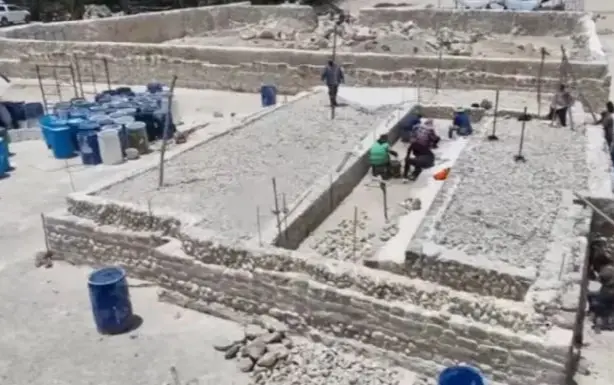
Brasdefer reviewed the situation that has led him to confront the OIC (Institute of Cultural Heritage) and then denounced the dismantling and separation from their original context of monuments that have led to the construction of the Balaam Tun Memorial Park in Chetumal, Quintana Roo, and the K’awill Memorial Park in Xpuhil, Campeche, plus a third building near the Maya Train in Escárcega, Campeche, which would constitute a serious alteration of the heritage.
Displaying photographs of these sites, he said:
“We’re talking about two parks and a heritage building in Escárcega. In this building, they construct something that looks like a skate park, something made up, with a site—a building that imitates a pre-Hispanic one, filled with modern construction materials. They filled it with modern lime, not pre-Hispanic lime, and built a city.
“Worse than that, inside one structure they found a substructure which they removed. State information mentions an archaeological site ‘1500 years old,’ which I don’t know what they mean by that… Then I understand that a commission arrives to review the progress, and when they make a comparison, surprise! They lost the sequence of the original stones. So where are the ones they claim to have taken?”
He recounted that his knowledge of what happened in those parks came from contacting a source who worked directly there, who confirmed that only 16 of the 47 structures in those rebuilt spaces were the originals; “the rest were added by them (those in charge of construction),” he said.
He also recalled the creation of the recently established Unit of Living Cultures, Intangible Heritage, and Interculturality (UCUVI), as a recognition of Diego Prieto, former head of the INAH (National Institute of Anthropology and History), in gratitude for his support of the Maya Train construction:
“As a token of appreciation, they give him an institution that is difficult to understand, not only for citizens but even for anthropologists themselves. It’s difficult to grasp—the Unit of Living Cultures, Intangible Heritage, and Interculturality. I ask: does the public even know what this is about?”
“But the worst is yet to come. The military also had to be decorated, and they decorated themselves at the Chetumal airport, where a monument was erected, along with a bronze plaque bearing the names of a hundred military engineers…”

Source: proceso