

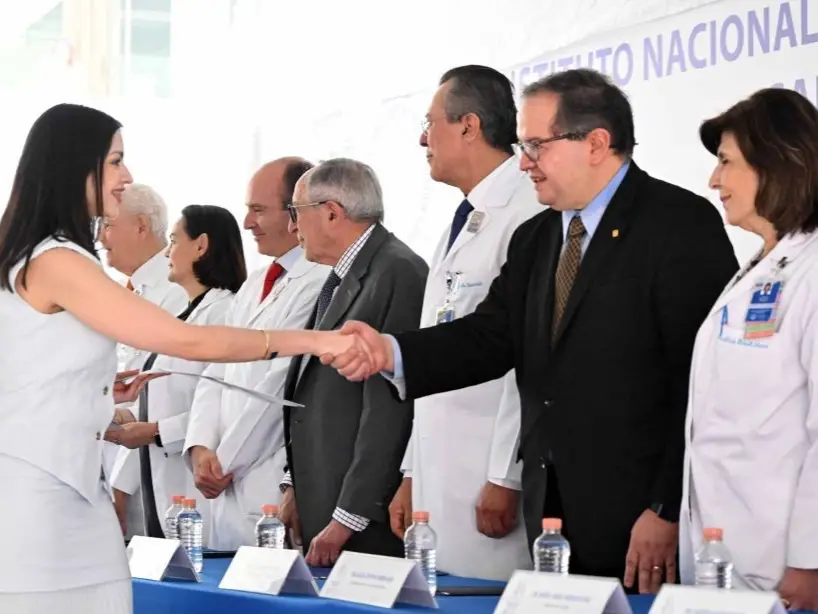

The Rector of the National Autonomous University of Mexico (UNAM), Leonardo Lomelí Vanegas, emphasized that Mexico needs more highly qualified doctors with integrity, the capacity to innovate, conduct research, and train future generations, without losing sight of the human dimension of their discipline.
Participating in the 2026 graduation ceremony of the National Institute of Medical Sciences and Nutrition “Salvador Zubirán” (INCMNSZ), he highlighted the alliance between UNAM and this Institute to train professionals with cutting-edge skills and provide effective, scientific, and humane care.
The event was also attended by the Secretary of Health of the Federal Government, David Kershenobich Stalnikowitz; And the Director General of the INCMNSZ, José Sifuentes Osornio, added: the two institutions that support the 252 graduating physicians “embody a long history of defending public health and higher education as unquestionable rights. From now on, that history will also be written through your daily work in hospitals, clinics, schools, and outreach forums.”
He assured the graduates that challenges persist in the country to guarantee more comprehensive and equitable healthcare, and that professionals like yourselves, with cutting-edge clinical training, acquire strategic value in directly influencing the timely detection and appropriate treatment of many diseases.
He added that among the structural challenges our country faces in health matters is that life expectancy at birth is 75.5 years, 5.6 years lower than the average for OECD nations. Preventable mortality stands at 243 deaths per 100,000 inhabitants, while treatable mortality is at 175 per 100,000, figures considerably higher compared to other member countries.
Meanwhile, David Kershenobich asserted that the INCMNSZ has established itself as a benchmark of clinical excellence, scientific rigor, and social commitment to Mexico.
Addressing the graduating class, he stated that highly specialized medicine must respond with quality and equity to current challenges such as chronic diseases, mental health challenges, gaps in access to certain health services, and an accelerated transformation driven by technological innovation, precision medicine, and artificial intelligence, among other tools.
This scenario, the Secretary emphasized, also raises questions about how to ensure that innovation does not exacerbate inequalities, how to guarantee that decision-making remains person-centered, and how to preserve ethics and confidentiality in increasingly complex environments. “Continuing medical education is the foundation for maintaining a balance between scientific innovation and social commitment.”
José Sifuentes, in turn, congratulated the specialist physicians, reminding them that their profession is one of service, and that neither technology nor state-of-the-art facilities will replace their sound medical judgment and attentiveness to their patients.
At the ceremony, awards and recognitions were presented to tutors and residents. Among those present were the head of the Coordinating Commission of National Institutes of Health and High Specialty Hospitals, Carlos Arturo Hinojosa Becerril; the president of the National Academy of Medicine of Mexico, Raúl Carrillo Esper; the director of the UNAM Faculty of Medicine, Ana Carolina Sepúlveda Vildósola; and other authorities.

Source: gaceta.unam


