Mexican President Claudia Sheinbaum Pardo stated that the Highway Infrastructure Program is ambitious and historic, as it includes a public and mixed investment of 397.046 billion pesos (MXN) for the improvement of nearly 5,000 kilometers (km) of highways and roads, as well as 29 km across 21 bridges. This will create jobs, reduce travel times, improve quality of life, decrease poverty and inequality, and connect the country.
“It is a very ambitious, historic highway program for the country that involves public and mixed investment, and is being managed by the Ministry of Infrastructure, Communications and Transportation and Banobras, specifically a Banobras division called Fonadin, the National Infrastructure Fund, which is coordinated by Jorge Mendoza,” she explained at the morning press conference, “Las mañaneras del pueblo” (The People’s Morning Briefings).
The President emphasized that the program impacts economic development, noting, for example, that the new Bavispe-Nuevo Casas Grandes highway connects Sonora with Chihuahua, and the Tamazunchale-Huejutla highway will improve connectivity in the Huasteca region. She also highlighted that in 2026, this highway program includes projects as part of the Michoacán Plan for Peace and Justice, addressing the requests of the state’s population.
The Secretary of Infrastructure, Communications, and Transportation, Jesús Antonio Esteva Medina, reported that the Highway Infrastructure Program consists of the following priority routes: With an investment of 113.361 billion pesos for approximately 2,500 km of highways, the San Ignacio Tayoltita, Bavispe-Nuevo Casas Grandes, and Tierra y Libertad Circuit highways have already been completed.
Meanwhile, the Cuautla-Tlapa and Tamazunchale-Huejutla highways are currently under construction. Macuspana-Escárcega; Salina Cruz-Zihuatanejo; Toluca-Zihuatanejo; and Guaymas-Esperanza-Yécora-Chihuahua. Work will begin this year, 2026, on the Ciudad Valles-Tampico highway.
Bridges: With an investment of 13.558 billion pesos for the improvement of 29 km across 21 bridges, two of which have already been completed in Morelos and Sinaloa, 13 are under construction, and eight are part of the 2026 program in Colima, Morelos, Nayarit, Veracruz, and Querétaro.
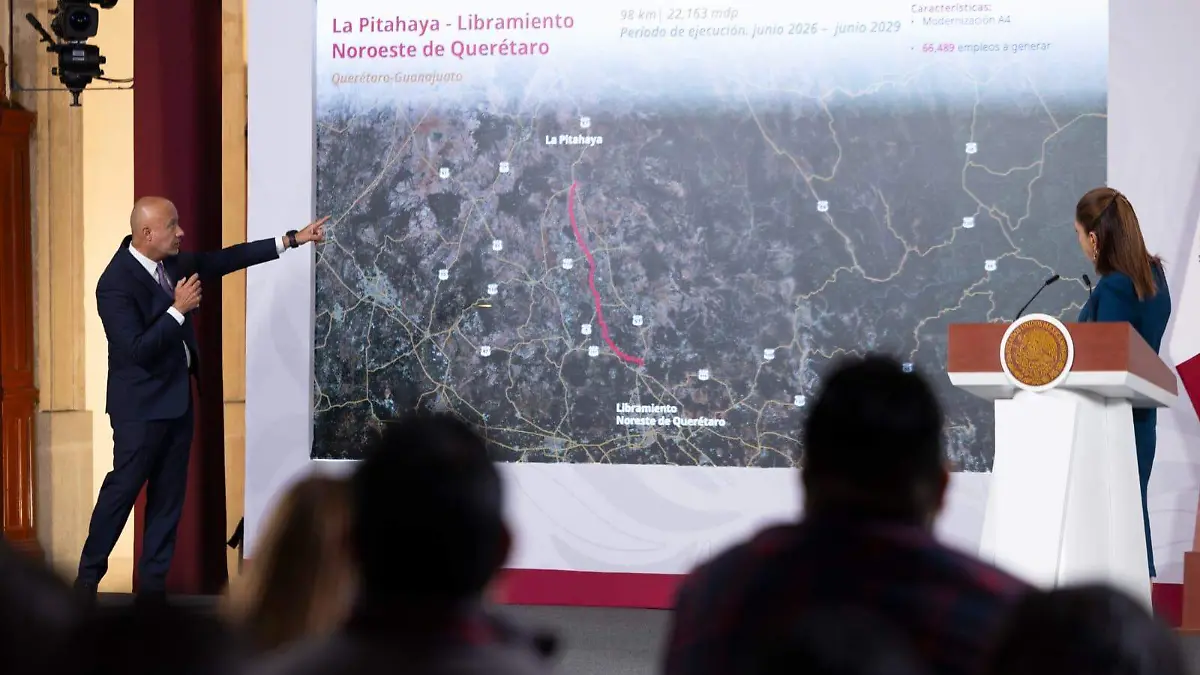
Highways: With an investment of 120.127 billion pesos for the improvement of nearly 980 km of highways, including the completed Pátzcuaro-Uruapan highway; the Zitácuaro-Maravatío highway; the Uruapan-Nueva Italia highway; the Nueva Italia-Lázaro Cárdenas highway; and the Lagos de Moreno branch. Armería – Manzanillo; Atizapán – Atlacomulco; Cardel – Laguna Verde – La Mancha and La Pitahaya – Libramiento Oriente. And in 2026, work will begin on the Uruapan access road; Uruapan – Zamora; La Pitahaya – Libramiento Noroeste de Querétaro; Sonoyta – Puerto Peñasco; R57D Arco Norte – San Juan del Río and Cuauhtémoc – Osiris.
He explained that the MegaBachetón project continues, which includes the repaving of 18,000 km of federal highways.
The Director General of Banobras, Jorge Mendoza Sánchez, detailed that there are 18 Construction, Maintenance, Rehabilitation, and Operation (CMRO) projects and seven mixed-investment projects, plus five more projects currently under review. These represent a combined estimated investment of over 150 billion pesos, which will generate 177,000 direct and 142,000 indirect jobs in Baja California, Coahuila, the State of Mexico, Hidalgo, Nayarit, Nuevo León, Puebla, Querétaro, San Luis Potosí, Tamaulipas, and Veracruz.
He explained that CMRO projects are self-financing, with short- or medium-term contracts. They are not concessions; the private sector participates in the investment and assumes certain risks. Furthermore, payments are contingent upon meeting performance standards, and an independent supervisor ensures compliance. The 11 CMRO projects currently underway in the country include: Reynosa Bypass Connection; Phases 1 and 2 of the Tulancingo–Nuevo Necaxa highway; Las Varas–Platanitos; side streets along the Mexico City–Querétaro highway; Tepalcapa–Tepotzotlán; San Juan del Río–Querétaro; the Querétaro Northeast Bypass; Tihuatlán–Tuxpan; the New Gulf of Mexico Corridor; and Puebla–Acatzingo.
He explained that the seven mixed-investment projects are also self-financing. The private sector participates in the investment, and the benefits and risks are shared. Furthermore, the projects include corporate governance and operating mechanisms, and the private sector recovers its investment once the project is operational. These seven projects are: Puerto Verde (Piedras Negras III); the Tijuana–Ensenada Bypass; Phase 1 of the Baja California highways; Saltillo–Monclova; the Matehuala–Puerto México Bypass; the Saltillo–Ramos Arizpe Urban Connection; and the Nuevo Laredo International Bridge.
Source: oem