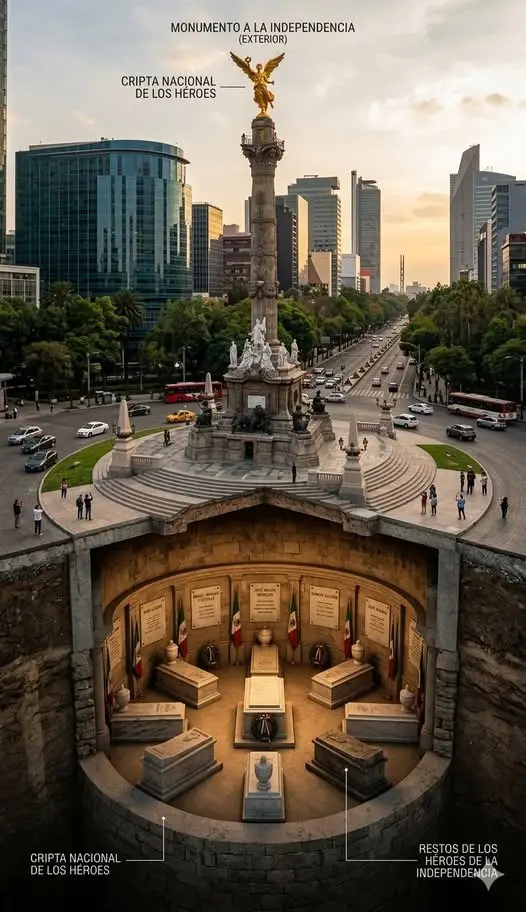

In the first part, we saw something many people don’t imagine when they pass by the Angel of Independence.
The monument isn’t just a golden statue atop a column.
Beneath the structure lies a historical crypt.
A space built within the monument’s base where several figures from the movement that gave birth to Mexico as a nation rest.
Now let’s take a closer look at what’s really under this monument and who is there.
🌎 A Monument That Also Functions as a Mausoleum
When the Angel was inaugurated in 1910, during the centennial of Independence, it wasn’t conceived solely as a visual symbol.
It was also designed as a national mausoleum.
A burial chamber was built within its base where the remains of several key figures of the independence movement were transferred.
This space remains closed to the public most of the time and is only opened for official ceremonies or special investigations.
⚱️ The Heroes Who Rest Beneath the Angel
In the first part, we mentioned some of the most well-known figures. Among them:
Miguel Hidalgo
José María Morelos
Ignacio Allende
Vicente Guerrero
But the crypt also houses the remains of other important figures in the same historical movement.
Among them are:
Juan Aldama
Mariano Matamoros
Nicolás Bravo
Guadalupe Victoria
Leona Vicario
Andrés Quintana Roo
Each of them participated in different ways in the process that led Mexico to become an independent nation.
🧱 A Monument That Holds Part of National History
This makes the Angel of Independence more than just an urban symbol.
It not only commemorates Mexico’s Independence.
It also physically safeguards part of that history beneath its foundations.
That’s why this monument serves several purposes at once:
It is a national symbol.
A meeting point for the city.
And also a place where some of the key figures of the independence movement rest.
🌎 A Symbol Millions See… But Few Truly Know
Every day, thousands of people pass by the Angel of Independence.
They photograph it, visit it, or celebrate important moments around the roundabout.
But very few know that beneath this column lies a historical chamber where some of the country’s most important figures rest.
And that raises an interesting question:
If a historical crypt exists beneath this monument…
how many other monuments in Mexico also hold important stories beneath their foundations?
(Note: Theoretical illustrative image)
📌 Note: The image used is an illustrative representation created to explain the historical topic. Some visual elements may vary from the actual structure of the monument.
lifestyle
Author
What You Didn’t Know
Hello friends 👋 🙂↕️🫶
By subscribing, you gain access to exclusive posts about symbols, calendars, gods, and roots that still live on today.
It’s not your average history. https://www.facebook.com/100067159148327/subscribenow…
Content is currently unavailable
Content is currently unavailable
15 h
Reply
Jorge Luis Barbosa Mollinedo
The “Angel of Independence” in Mexico City is actually a 6.7-meter-tall gilded bronze sculpture representing Nike (or Niké), the Greek goddess of victory. Inaugurated in 1910 by Porfirio Díaz, it symbolizes freedom with a broken chain and glory with a laurel wreath, and is not a biblical angel.
Details of the sculpture: It was designed by the Franco-Italian artist Enrique Alciati, weighs approximately 7 tons, and is covered in gold leaf.
Meaning: Nike represents triumph. She holds a laurel wreath in her right hand (victory) and a broken chain in her left (freedom from Spanish oppression).
History and Earthquakes: During the 1957 earthquake, the statue fell and its head broke; it was restored, and the original is on display at the Historical Archive of Mexico City.
Location: Crowning a 45-meter-high column on Paseo de la Reforma, it also serves as a mausoleum for heroes of the Mexican War of Independence.
Source: loquenosabias