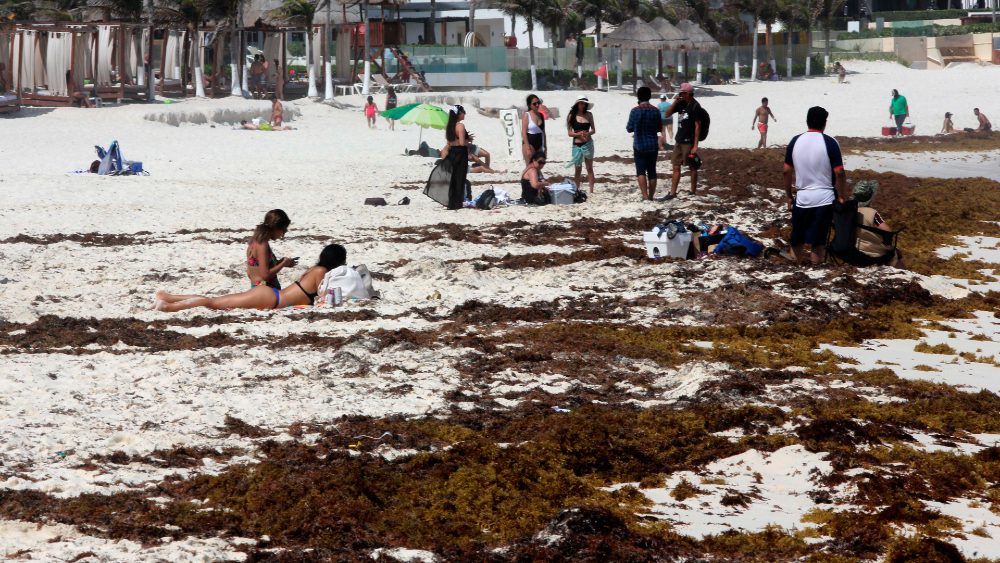
Sargassum season usually begins in March; however, in 2026, the macroalgae began arriving in January, which is a cause for concern.
Sargassum was detected in Isla Mujeres during the second week of January, and by the second week of March, there are already signs of its presence in other parts of Quintana Roo.
“This year is going to be terrible,” declared Rosa Rodríguez, a researcher at the Institute of Limnology and Marine Sciences of the National Autonomous University of Mexico (UNAM) in Puerto Morelos.
All indications are that more sargassum will reach Mexican coasts in 2026 than in 2025, when the amount of the macroalgae was double that recorded in 2022.
Proof of this is that in January there were 9.5 million tons of sargassum in the Atlantic and 13.6 million tons in February, figures that broke the historical record of 7.8 and 4.3 million tons respectively in the first two months of last year.
However, Rosa Rodríguez pointed out that only about 10 percent of the total tonnage in the Atlantic reaches Quintana Roo.
The increase in the volume of sargassum is attributed to climate change, the warming of the seas, and ocean acidification.
Prior to the official start of the season, measures such as the placement of barriers have already been taken in Isla Mujeres and Puerto Morelos.
In Meanwhile, in Playa del Carmen, the “Sargassum Challenge 2026” will be implemented, which includes a double barrier of up to 5 kilometers to contain the sargassum as it reaches the coast, as well as the deployment of cleanup personnel at 15 locations.
For his part, Rear Admiral Topiltzin Flores Jaramillo, in charge of the Navy’s strategy, reported that the ship Natans, with the capacity to collect more than 200 tons of sargassum daily, will be available.
Other vessels and an amphibious vehicle will also be deployed to transport the macroalgae to land.
Source: lopezdoriga