
State authorities indicated that 15 municipalities in Yucatán are at higher epidemiological risk for dengue and chikungunya, vector-borne diseases transmitted by the Aedes aegypti mosquito.
According to the information, these municipalities together account for 1,833,741 people out of Yucatán’s more than 2.5 million inhabitants.
Mérida tops the list due to its population density; however, in the north-central part of the state, Kanasín, Umán, Progreso, Hunucmá (part of the capital’s metropolitan area), and Motul are also included.
The list continues with the eastern municipalities of Valladolid, Chemax, Tinum, and Tizimín, and in the southern region, the communities of Ticul, Tekax, Peto, Oxkutzcab, and Tzucacab.
This information was released during the opening of the First National Campaign Against Dengue and Chikungunya 2026, held in Tizimín.
According to data presented at the event, official records indicate that dengue maintains an endemic behavior in the region, meaning it is a constant, common, or characteristic disease of the area.
This means that an infectious agent circulates continuously in a population, with predictable seasonal peaks, without disappearing.
However, the current behavior of this disease transmitted by the Aedes aegypti mosquito has shown a downward trend in recent years.
After 10,493 cases were recorded in 2023, the number dropped to 368 in 2024. By the end of 2025, 192 cases had been confirmed, representing a 45 percent decrease compared to the previous year.
So far in 2026, the epidemiological report records nine confirmed cases and no deaths, maintaining the zero-death statistic registered since the previous year.
Reports from the Federal Ministry of Health indicate that these nine cases are distributed across three municipalities, at least as of epidemiological week 10: Mérida, Progreso, and Tixméuac.
Mérida has registered five cases of non-severe dengue, while Tixméuac has one case with warning signs. Progreso, meanwhile, has one case of non-severe dengue and two with warning signs.
Currently, only dengue serotype 3 (DENV-3) is circulating in Yucatán. According to the Pan American Health Organization (PAHO), this is a more aggressive and potentially lethal viral variant that can cause hemorrhaging, serious complications, and death if not treated promptly.
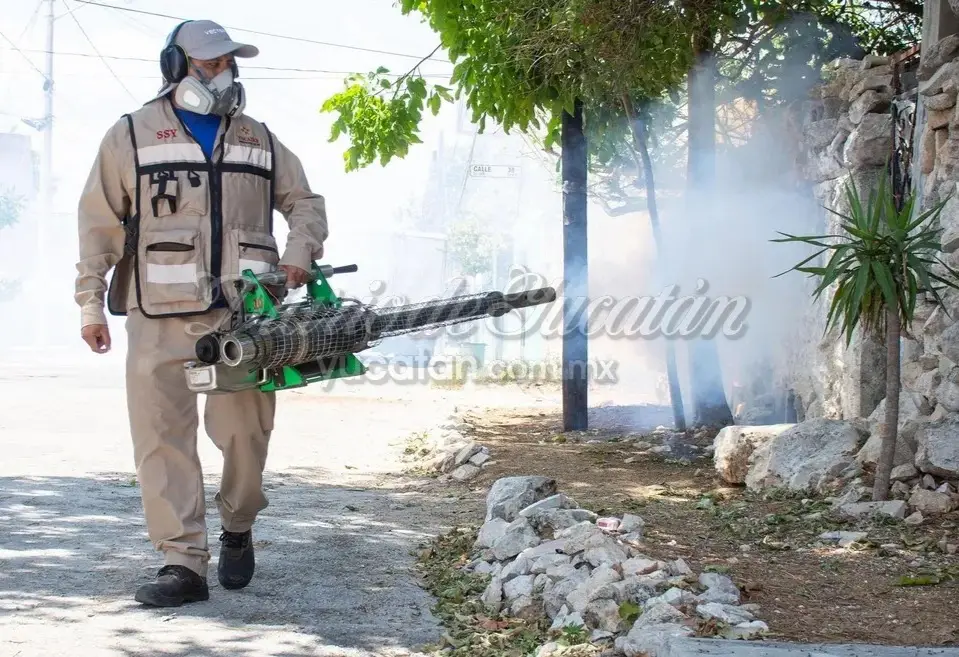
For epidemiological surveillance and vector-borne disease control, 534 health workers from the three health jurisdictions have been deployed.
These workers are supported by 41 vehicles equipped for space fogging in strategic areas.
The National Campaign Against Dengue and Chikungunya, coordinated by the State Health and Education Secretariats, includes fogging and breeding site elimination operations in all 106 municipalities of Yucatán, with a specific focus on schools and areas of greatest vulnerability.
The education sector’s participation centers on identifying and eliminating water containers in schools at all levels.
Health authorities reiterated that controlling these arboviruses depends largely on intervention in the domestic environment, as a significant portion of the breeding sites for the transmitting mosquito are located in homes.
In this regard, the population is urged to keep yards and containers clean to contribute to vector control in the state.

Source: yucatan