Specialists consulted by EL UNIVERSAL explain that malathion is a highly toxic, broad-spectrum insecticide that kills all insects it comes into contact with, contaminates soil, river water, seawater, and drinking water, and remains on trees and fruit to which it has been sprayed. It is highly toxic to people who handle or apply it, and furthermore, when ingested directly or through contaminated water or food, it becomes a precursor to cancer, among other diseases. Its breakdown into other substances is even more dangerous.
This chemical has been banned in European countries for four years; however, it is permitted in Mexico and the United States. In Mexico, it has not been included on either of the two lists of pesticides banned during the administrations of former President Andrés Manuel López Obrador and current President Claudia Sheinbaum Pardo.
Its impact is not limited to the moment of application. In the soil, for example, it can persist for more than 20 years, and in mango trees, the insecticide is transferred to the fruit. Only with agroecological practices is it possible to eliminate it from the soil within a period of three or four years.
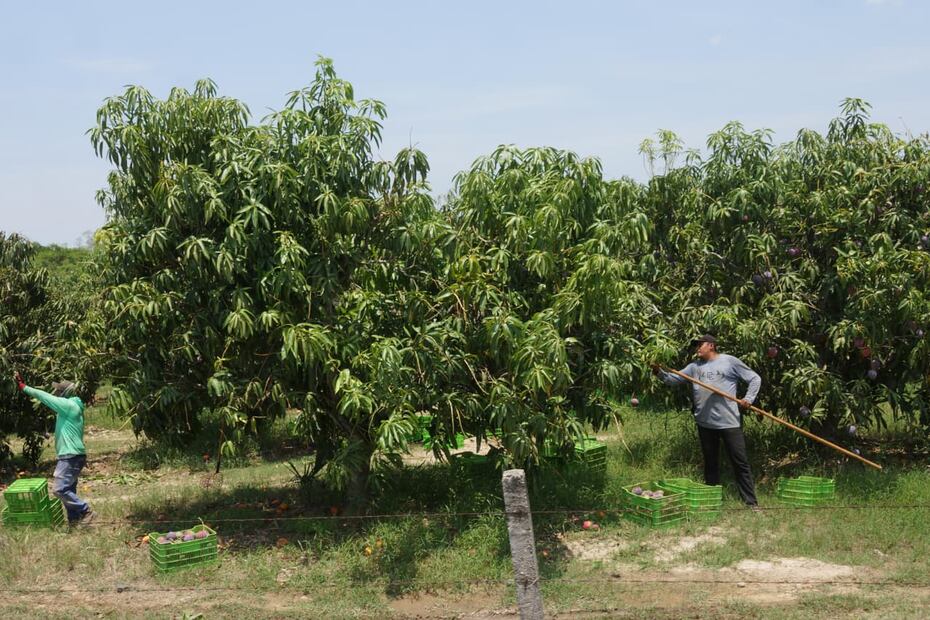
Homero Blas Bustamante, a consultant for international organizations such as the United States Department of Agriculture (USDA) and the German Cooperation Agency (GIZ), among others, warns that the Oaxaca government’s program, which involves spraying 2,500 liters of malathion, will cause, first, the contamination of the mango trees and fruit themselves; and second, the contamination of all living and non-living material with which it comes into contact, such as plants, animals, water, and soil.
This chemical, he explains, not only remains in the environment but also undergoes a degradation process and is transformed into other substances called metabolites, which are much more dangerous than the insecticide itself.
“The manufacturers themselves and the technicians who apply it recommend extreme protective measures when applying this product to crops. Now, if extreme protective measures are required for its application, imagine the residues that could be present on the fruit or other products, because once released into the environment, the substances are carried by the wind, water, the transport of goods, and so on; they spread to other places. That’s why it’s classified as highly hazardous.”
Adela Solar Hernández, president of the Oversight Council of the National Beekeepers Union, suffers from an allergy and maintains that it was caused by the use of malathion for the past 50 years in the eastern part of the Isthmus of Tehuantepec region. She believes that the increase in the number of people with cancer in municipalities in this area of Oaxaca is linked to the spread of this pesticide.
“I remember that since I was a child, they stored malathion in the Commissioner’s offices, and they burned the boxes and pallets impregnated with the insecticide. My house is next to those offices, and in my case, it caused an allergy. That’s why I fight against that chemical, regardless of my fight for the lives of the bees.
“Many people are dying of cancer lately in the region.” “Malathion usually goes to the liver and pancreas,” he says.
The International Agency for Research on Cancer (IARC) of the World Health Organization (WHO) classifies malathion in Group 2A, probably carcinogenic; that is, associated with risks of cancer, DNA damage, and hormonal dysfunction.
Specialist Homero Blas, former president in Latin America of the International Federation of Organic Agriculture Movements (IFOAM), adds that in southern countries, this insecticide causes everything from allergies and kidney problems to cancer. He even points out that residues of this substance have been found in the urine of children and adults.
“It’s a cancer precursor. When the body detects a foreign molecule in a human cell, like malathion or its metabolites, it goes into overdrive, and that leads to cell death.” “That cell death is what we call cancer,” he explains.
In the eastern part of the Isthmus of Tehuantepec region, in towns like Chahuites, San Pedro Tapanatepec, Santo Domingo Zanatepec, San Francisco Ixhuatán, and San Francisco del Mar, there are between 150 and 170 beekeepers who produce around 80 tons of honey per season, which lasts four months, from November to February.
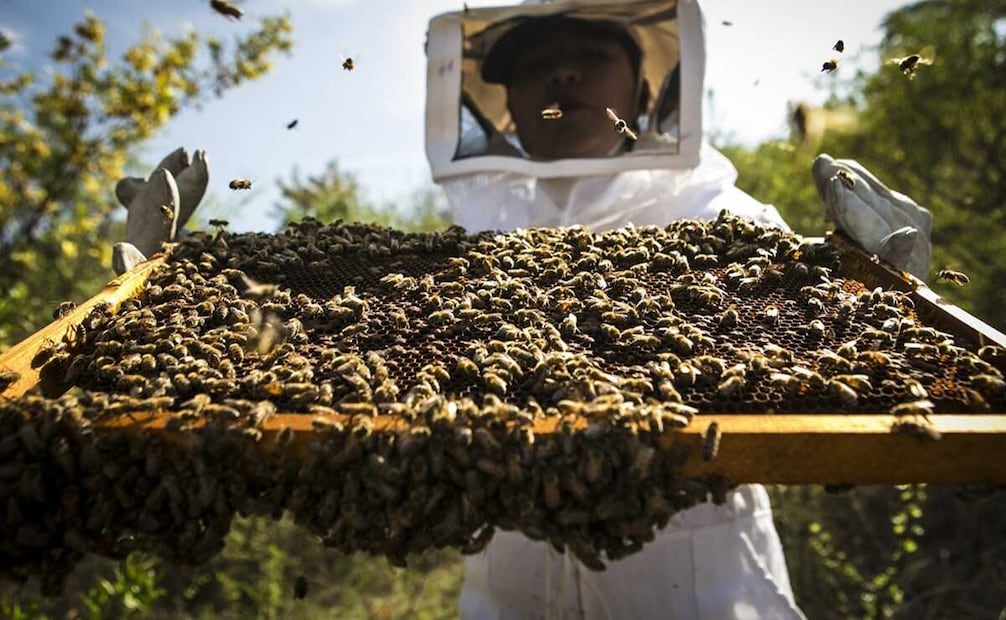
He says that most of the honey used to be exported to Europe, but exports have decreased because tests on the product have detected residues or the presence of malathion. That, he points out, is why beekeepers have opted for the local market.
Blas Bustamante mentions that bees are also economically important, in addition to their significance for the environment. Their mortality in Mexico and worldwide is mainly associated with the use of pesticides applied to crops.
“That’s why beekeepers are worried when malathion is released, and in this case, it’s not just a liter or two that the Oaxaca government is going to release, but 2,500 liters. And the honey itself has a high risk of containing traces of malathion; the hives collapse, the honey is contaminated, and this honey is for human consumption. That’s why Mexican honey has faced critical periods in the international market because pesticide residues have been found in export containers, mainly to Europe.”
According to the Oaxaca State Secretariat of Agriculture and Rural Development (Sefader), the use of malathion in the fruit fly control campaign is approved by the Federal Commission for Protection against Sanitary Risks (Cofepris) and is applied “under technical criteria, current federal regulations, and strict safety protocols; with the objective of protecting fruit production and the phytosanitary status of the state.”
It also maintains that the use of this chemical is supported by the Mexican Official Standard NOM-023-FITO-1995, which establishes the guidelines for the fruit fly control campaign.
“According to the United States Environmental Protection Agency (EPA), it has concluded that, when used according to the technical specifications, it does not represent significant risks to the general population,” the Oaxaca government agency emphasizes.
However, Homero Blas responds that the fact that Cofepris and the USDA allow the use of malathion does not guarantee that it will not cause significant harm.
“That’s why I find it strange that the Oaxaca government is resorting to this measure, because there are environmentally friendly techniques that can be used. But well, I think they are desperate to control this pest, and I think the cure is worse than the disease.”
The expert states that Governor Salomón Jara Cruz should evaluate this policy and seek environmentally friendly alternatives to control not only the fruit fly in mangoes, but also other pests. “In Mexico, we have almost half a million farmers who don’t use agrochemicals,” he asserts.
Source: oaxaca.eluniversal