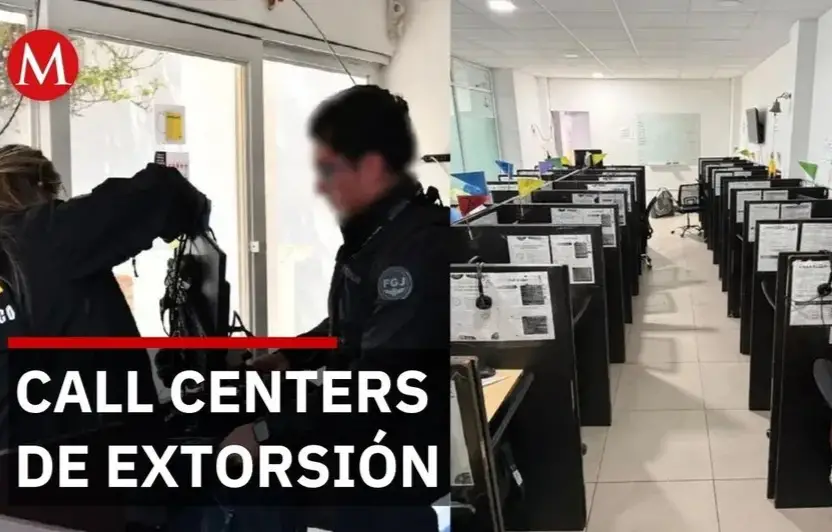

Operation Disconnection resulted in the arrest of 102 people in the State of Mexico, 77 of whom are foreign nationals, following a 46-day operation targeting extortion networks operating through call centers and informal lending schemes.
The operation focused on organizations that used phone calls, text messages, and digital platforms to contact victims, obtain personal information, and demand payments through various methods.
As part of the operation, 192 properties were seized. Of these, 67 were identified as call centers. Authorities also raided five loan companies, 14 drug sales points, and 106 businesses used as fronts.
The investigation established that these locations served as operational hubs for coordinating calls, storing databases, and carrying out mass contact schemes.
Between July 8, 2025, and March 30, 2026, 1,084 extortion complaints were filed in the state. 62 percent were committed remotely.
In which municipalities is the operation taking place?
Atizapán
Coacalco
Cuautitlán Izcalli
Ecatepec
Ixtapaluca
Metepec
Naucalpan
Nezahualcóyotl
Nicolás Romero
Otzolotepec
Tecámac
Tlalnepantla
Toluca
Valle de Chalco
According to the investigation, the call centers were involved in activities related to extortion, fraudulent product offers, and impersonation of financial institutions.
Those involved used cloned websites and phone calls to impersonate bank employees. Through these methods, they alerted victims about supposed account activity, thereby obtaining confidential data or facilitating transfers.
Practices related to supposed prizes and package deliveries were also detected, using similar contact and deception schemes.
In these loan companies, loans were granted with unclear terms, either in cash or through the transfer of goods. The schemes involved frequent payments with high interest rates.
When people failed to make payments, acts of intimidation were documented to demand the money, both by phone and in person.
The investigations also indicate that these networks used other businesses and drug sales points to diversify their income and sustain their operations.
During the operation, servers, computer equipment, cell phones, SIM cards, banking devices, firearms, narcotics, and various documents were seized.
Among the materials found were lists with personal information, copies of official identification documents, receipts and financial data, as well as manuals and scripts used to make calls and send messages.
Of the 102 people arrested, 50 have already been formally charged and remanded in custody. They include citizens of various nationalities.
The rest remain at the disposal of the corresponding authorities, while in the case of the foreign nationals, immigration authorities were notified to determine their status.
The investigations also link these activities to other crimes such as express kidnapping, human trafficking, money laundering, and identity theft, which allowed for expanding the lines of investigation surrounding these networks.
Of the 32 devices removed by Public Services workers, nine were returned to their owners and 23 were impounded for lacking permits.
As part of the Holy Week operation in Ecatepec, State of Mexico, members of the Mexican Navy and the municipal police, along with personnel from the state prosecutor’s office, removed 32 video surveillance devices that had been illegally installed in public areas.
In 2025, 205 cameras were removed, and so far this year, 47 have been removed. These operations will be carried out permanently to prevent them from being used to monitor the movements of the authorities.
A total of 79 tons of contraband goods, including cosmetics, nail polish, and Arabic perfumes, were seized by Mexico City authorities in the Historic Center.
During an operation on República de Costa Rica Street in the Cuauhtémoc borough, officers from the Secretariat of Citizen Security assisted authorities from the Secretariat of Administration and Finance in an inspection.
At the location, a van containing 40 boxes of Arabic perfumes was seized. The driver could not provide documentation proving the perfumes’ legal origin.
On the same street, a warehouse was located where 79 tons of foreign merchandise were being stored, the legal origin of which could also not be verified.
Sorce: milenio