What was once the ultimate symbol of the excesses of the former police chief of the Federal District, Arturo “El Negro” Durazo Moreno, is now a must-see for tourists seeking more than just sun and sand in Zihuatanejo during this Easter holiday season.
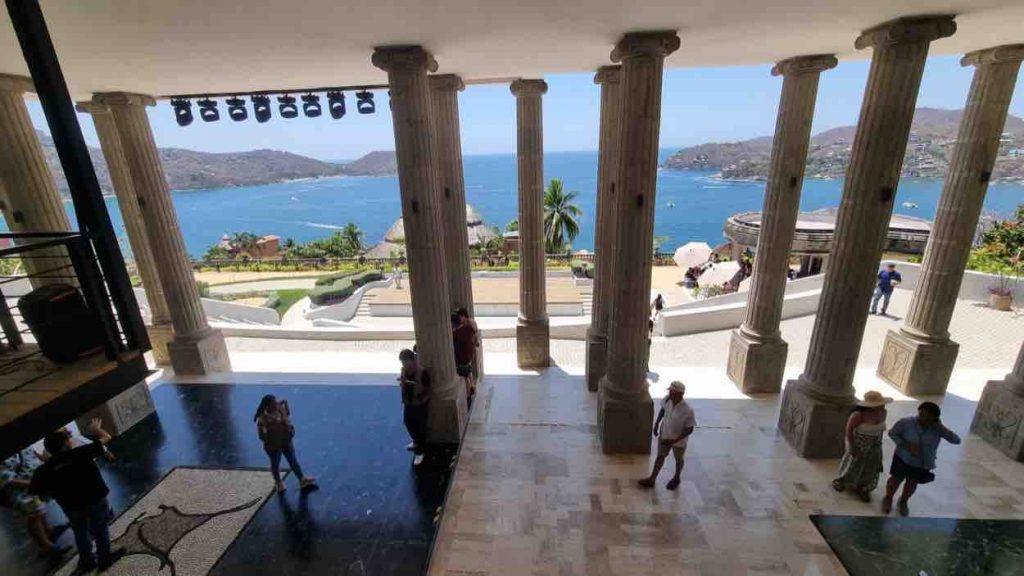
The Parthenon, the residence with its Greek-style columns that commands a privileged view of the bay from atop the hill in the La Ropa tourist neighborhood, receives dozens of visitors daily during this holiday season, drawn primarily by the morbid fascination with the building’s dark history.
The entrance fee to this now cultural site is 100 pesos for general admission, while for locals with a valid INE (National Electoral Institute) ID it is 50 pesos; students and minors pay 20 pesos, but senior citizens enter free with their INAPAM (National Institute for Older Adults) card, as do people with disabilities and children under five.
For many, climbing to the top fulfills a long-held curiosity. Francisco Díaz and María Elena, originally from Zitácuaro, Michoacán, visited the site for the first time this Wednesday.
Francisco didn’t mince words about why he, his mother, his wife, and their two children had come here: “We come from Michoacán. We heard about El Partenón from a brother who had been here before. I heard it was being built, and they said it belonged to El Negro Durazo. We were intrigued by the morbid curiosity of coming to see and learn about the place,” built by the former Mexico City police chief during the presidency of José López Portillo (1975-1982).
As they walked through the terraces and admired the finishes, these tourists were astonished by the sheer cost of its construction. “Incredible, it really cost a fortune,” Francisco remarked while observing the structure.
For them, the place is a testament to what power could build without limits. “He did what he could in his time, he certainly lived the high life, but he didn’t even take it with him when he died,” the visitor from Michoacán concluded.
The comments of the visitors overheard in the corridors of El Partenón spoke of the extravagance, luxury, and opulence that characterized the place during its heyday in the late 1970s and early 1980s. Currently, the building no longer appears abandoned. After a lengthy legal battle, the state government managed to acquire the property, which to this day is still known among locals as the Monument to Corruption. It was loaned to the municipal government, which has converted it into a cultural center where paintings by local artists are on permanent display.
In the five rooms that were formerly bedrooms and are located on the second floor, you can see everything from portraits of Frida Kahlo to paintings depicting daily life in Guerrero, all presented from the perspective of their creators.
In addition to the art on the walls, there are exhibitions that capture the attention of tourists, such as the one organized by the City Council for this season: the Insects and Reptiles of the World exhibition. Display cases with collections of insects and butterflies are installed in one of the hallways and in a room that was once the kitchen on the lower level of the building.
As tourists stroll among the replicas of granite and marble statues and the mythological murals that adorn the walls, the guides take the opportunity to explain that there is a wealth of talent in Zihuatanejo: “There is a lot of variety; we have many very talented artists here.” They also recount, in great detail, the entire history of El Partenón, from its construction to the present day. Thus, amidst photos on the steps and the panoramic view of the sea, El Partenón tries to shake off the shadow of its former owner to become a cultural center that, although born from corruption, today serves to help people learn a little more about the local art of Zihuatanejo.
Source: suracapulco