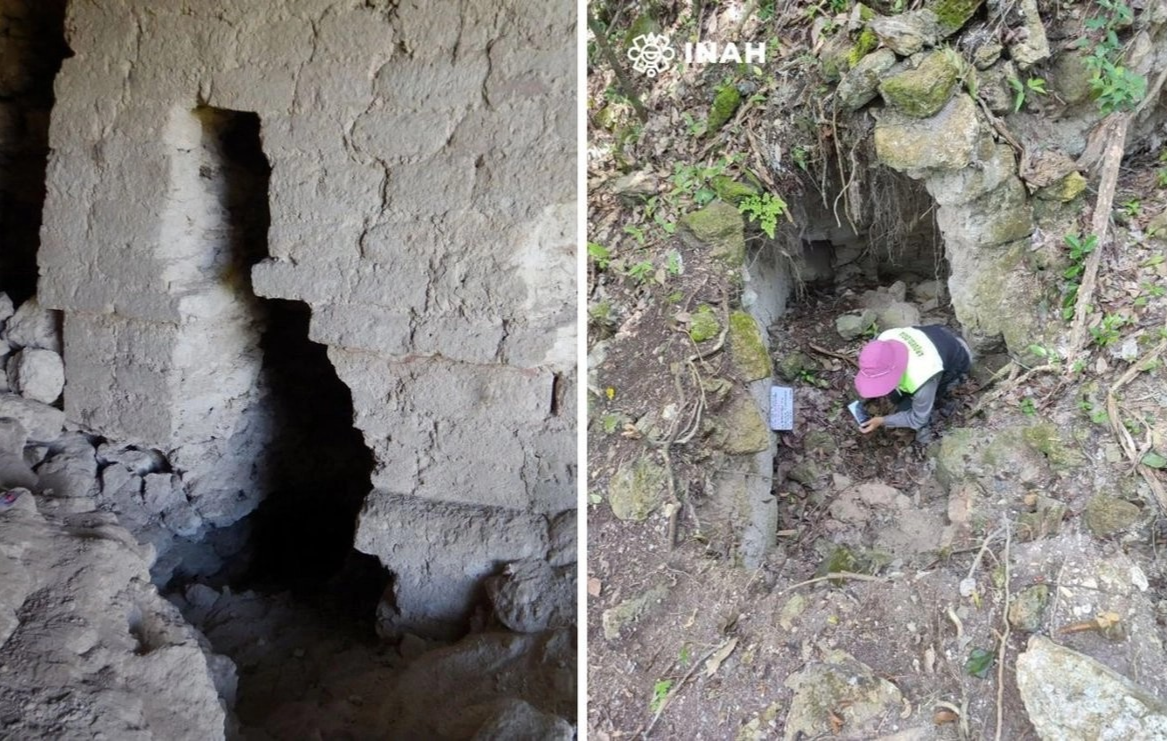

The National Institute of Anthropology and History (INAH) reported the discovery of an area identified as El Jefeciño, an ancient pre-Hispanic settlement of 80 buildings, located in the municipality of Othón P. Blanco, Quintana Roo.
The area was brought to the attention of authorities by local residents during the Tren Maya Archaeological Salvage Project, coordinated by archaeologist Manuel Pérez Rivas, on section 7 of the railway line.
Preliminary data indicate that El Jefeciño covers 100 hectares; however, it could encompass more, so a thorough exploration is necessary to accurately determine its area, the dimensions of the buildings, and the settlement pattern, among other attributes, explained Sonny Ojeda, head of the Dzibanché Kinichná Archaeological Zone.
He added that, according to the evidence, the remains could correspond to the Early/Late Classic period (250-900 CE), during which the Petén-style Maya architecture developed, characterized by large vaulted buildings with rounded, recessed corners and apron moldings.
Diana Blancas, head of the Kohunlich Archaeological Zone, who worked alongside Ojeda between 2023 and 2024 to determine the city’s state of preservation and its possible extent, noted: “We were able to observe what would correspond to the core area, composed of five buildings, between 11 and 14 meters high and 16 to 40 meters long. These monuments are arranged in a C-shaped plaza.”
In building number 53035, located in the northeast of the site, remains of stucco with decorative mural paintings and fragments of human remains were observed, possibly part of a burial context, he noted. The specialists emphasized that no archaeological salvage operation was carried out, making it impossible to conduct an in-depth analysis of the material found or to recover it, as the evidence must remain in situ.
Ojeda explained that the mural painting is decorative, not narrative, with white and orange pigments, as well as red stripes; however, intensive exploration is required to verify this. Additionally, a substructure with an apron molding is visible in monument number 53037, located in the northwest of the complex.
Three construction phases were identified on the surface: the first and deepest phase (approximately 8 meters) contains the apron molding; The second area corresponds to the remains of mural paintings, and the third shows collapses where the foundations of staircases appear. “Based on the size of the buildings, we infer that they must have at least four or five construction phases,” the archaeologist added.
Another discovery consists of three Mayan vaults inside some of the buildings, built on projecting walls, which are in a good state of preservation. It is hoped that a mapping project can be carried out in the future to define and study the settlement pattern.
The Federal Secretary of Culture, Claudia Curiel de Icaza, along with the researchers, agreed that the study of the city will contribute to understanding the network of archaeological sites in the region, as well as expanding what is known about the ancient Maya of southern Veracruz and the social relationships that existed among them.

Source: jornada