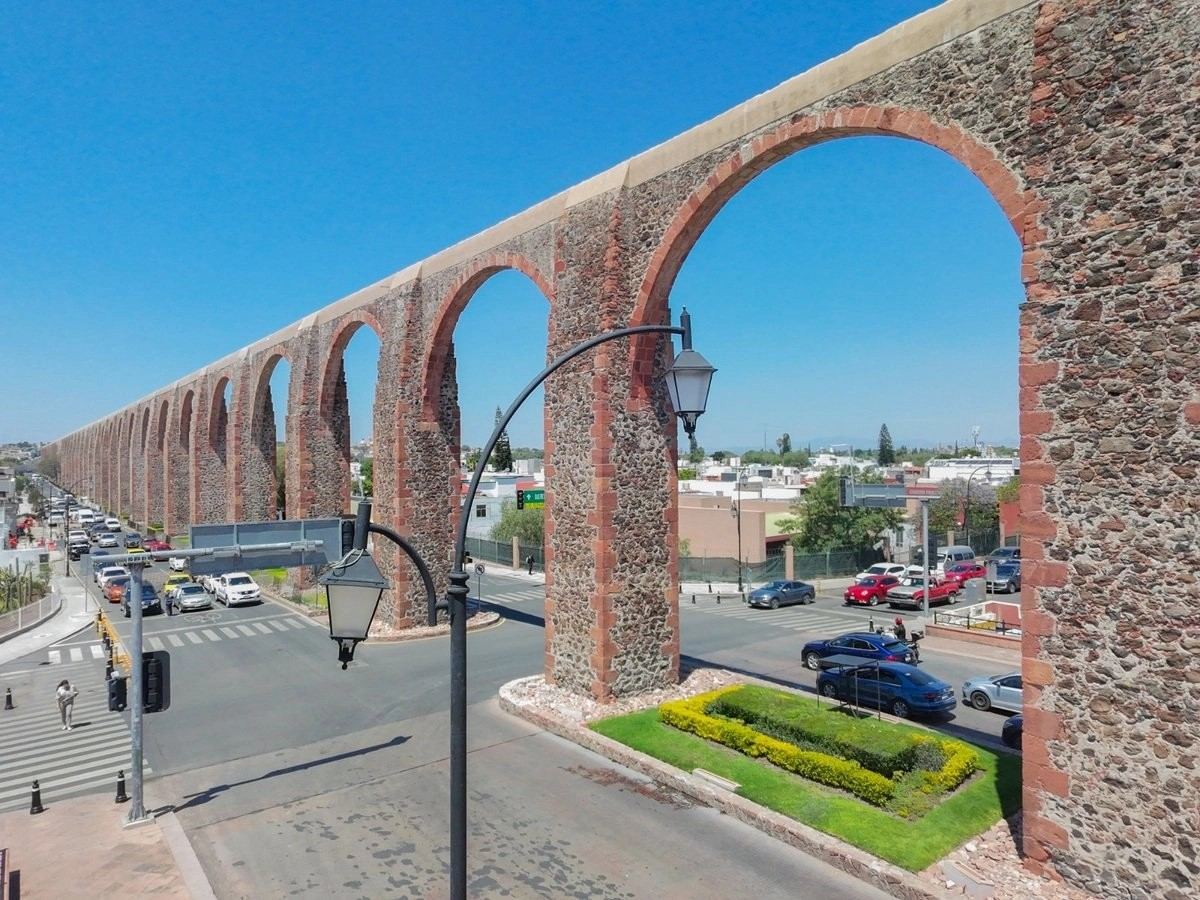

The municipality of Querétaro celebrates this Saturday the 300th anniversary of the start of construction on the aqueduct that supplied the city with water until the mid-20th century, amidst strong criticism of the state government for promoting and authorizing the installation of transnational companies known as data centers, characterized by their high water consumption, in a city where scarcity has forced water rationing, provoking discontent among the population.
Alongside the official celebration, which will cost 1.5 million pesos, according to Mayor Felipe Fernando Macías, water rights activists will take to the streets to protest against the plundering of water resources; they will also be demonstrating for the right to this resource and for legislation that guarantees them 100 liters per person per day, in accordance with international law.
Abelardo Rodríguez Macías, from the Chichimeca Otomí Tlaxco Andamaxei Assembly in La Cañada, explains that in the neighboring municipality of El Marqués, “we have observed the proliferation of data centers. This is irresponsible. They register as service industries because environmental impact regulations are more lenient, instead of what they are: industries that generate a lot of heat, use a lot of water, and pollute. In El Marqués, in La Cañada, there are already shortages, but the situation is most critical in the municipality of Colón.”
Rodríguez cites the case of PRI federal deputy Mario Calzada and shares that “with the wells he has granted concessions to, he maintains an artificial lagoon and polo fields for horses. He was exposed (a few weeks ago during Mayor Claudia Sheinbaum’s morning press conference) because the water theft is now undeniable, while here in La Cañada there is a shortage; one day we have water, and other days we don’t.” “We pay a very high price for it.”
In El Marqués, he adds, intermediary companies carried out a privatization of water. “One company handles the billing, another provides maintenance, another oversees operations—it’s all just business. It’s definitely for the Querétaro elite. That’s why they’re reluctant, because it’s a lucrative business. They get the water for free, they get the land for free, and sometimes they sell it multiple times.”
Regarding data centers, Eric Silva Hernández, a member of the Morena party and president of the 2030 Agenda Commission in the local Congress, told La Jornada: “We have a huge contradiction because Querétaro is considered a protected zone. The two largest underground aquifers that supply water to Querétaro are supposedly overexploited. So, theoretically, the watersheds on which Querétaro sits are considered a high-risk, protected zone by the National Water Commission (Conagua).”
“It is the CEA (State Water Commission) that currently sets the rates and also decides who receives water during the rationing schedule.”
“While the population is told there is no water, that intermittent cuts are coming, on the other hand, they continue to invite companies like Microsoft, Amazon, Google, and all these large multinationals that need water for their data centers. We believe this is completely illogical on the part of the state government.”
Silva Hernández explains that the state does not have a water law, only a law governing the provision of services. Therefore, he has presented a bill that addresses issues of service, the protection of aquifers, recharge zones, with an ecological perspective and regulation by the State Water Commission (CEA); “placing water at the center as a human right and not as a commodity.”
“By guaranteeing this right, we also no longer give the State Commission the power to cut off water service. They can limit it, perhaps, but never leave you without water.”
Ana Cecilia Figueroa, a historian and researcher at the Autonomous University of Querétaro (UAQ), explains that the problem has its origins: the textile factories called obrajes, established during the colonial period, supplied much of New Spain, including mining areas, with clothing and became a fundamental economic resource. But that was the great problem of colonial Querétaro, because so many trapiches, which are like smaller family looms, as well as obrajes, polluted the Querétaro River. People began to get sick, and it became a public health issue. Therefore, the viceroy commissioned the Marquis of Villa del Villar del Águila to build a hydraulic infrastructure to solve this problem.”
The municipal chronicler, Lauro Jiménez, agrees that this was “the problem that forced the city council from 1712 onwards to plan the execution of the work.”

Source: jornada